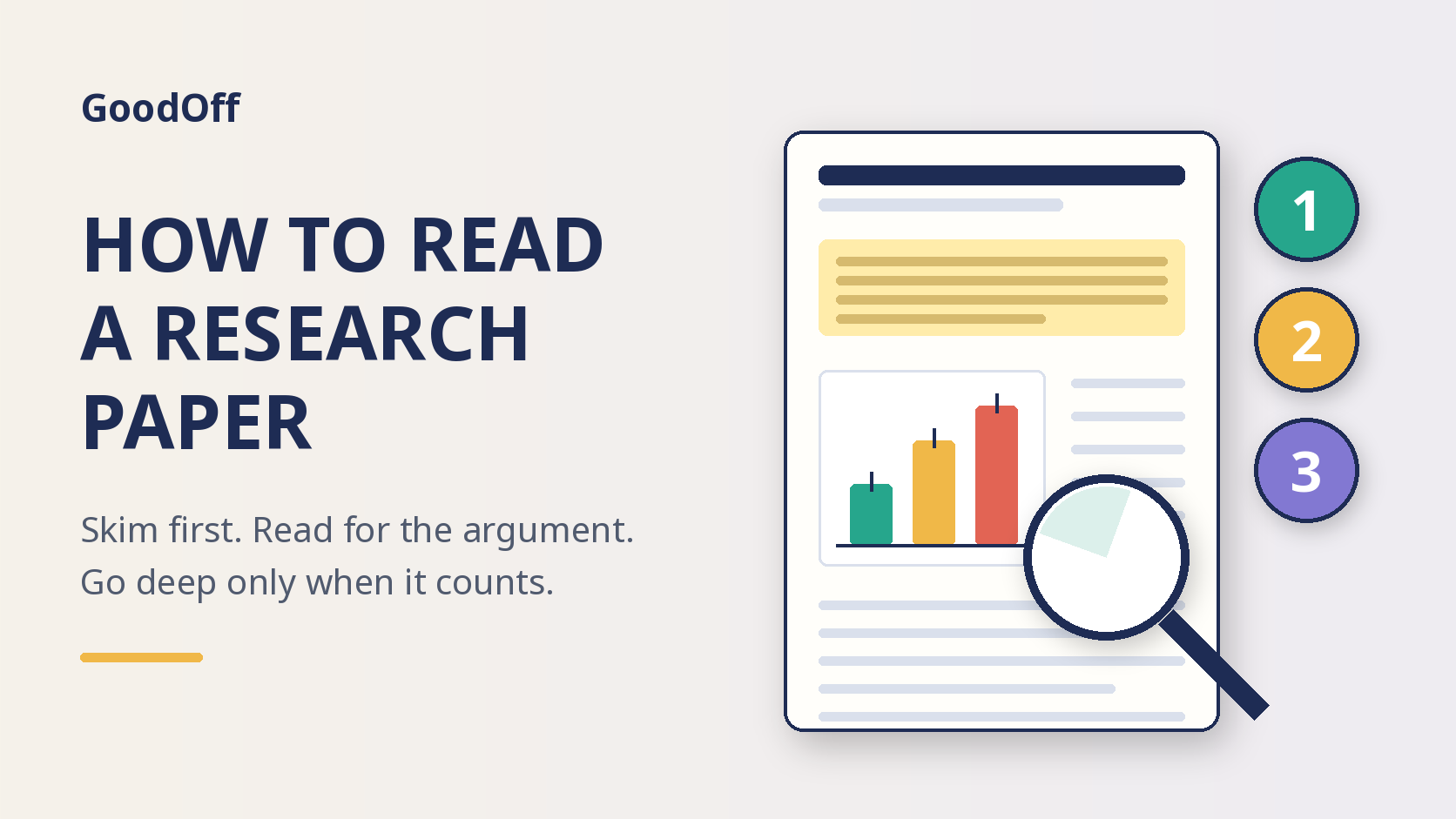
Short answer: to read a research paper, don't start at the top and plow to the end. Read it in up to three passes. Spend 5 to 10 minutes on the title, abstract, headings, figures and conclusion to decide whether the paper matters. If it does, spend up to an hour reading the main text for the argument, studying the figures closely and skipping the dense detail. Only for papers you truly need, do a third pass where you test the authors' assumptions. Then write a short summary in your own words so the paper doesn't vanish by next week.
Most students were never taught this. They open a 14-page PDF at the first line and feel lost by page three. That doesn't mean you're bad at it. Papers are built to be skimmed and questioned, not read like a novel. This guide gives you a repeatable method, a note template and a worked example.
The Quick Version
- Decide why you're reading. A class discussion needs less depth than a literature review.
- Pass 1 (5 to 10 minutes): triage. Title, abstract, headings, figures, conclusion.
- Pass 2 (up to an hour): understand the argument. Study figures, skip proofs and fine detail.
- Pass 3 (only if needed): rebuild the study in your head and challenge every assumption.
- Write a five-line note from memory after each paper you keep.
Why Research Papers Feel So Hard
Part of the difficulty is the writing. Papers are compressed, full of field-specific terms and written for experts. The other part is that reading papers is a skill that develops with practice, and it develops slowly.
A 2017 survey in PLOS ONE by Hubbard and Dunbar asked 260 undergraduates and researchers in biological sciences at one UK university how they read the literature. The abstract and introduction were easy for about 90% of people at every stage. The methods section was another story: only 29% of second-year and 24% of third-year undergraduates called it easy to read, compared with 81% of PhD students and 83% of academics. The authors also found that less experienced readers undervalued the results section and critical interpretation of the data.
The Three-Pass Method at a Glance
The three-pass approach comes from computer scientist S. Keshav, who described it in a 2007 article, "How to Read a Paper," in ACM SIGCOMM Computer Communication Review. It was written for researchers, but it works for students in any empirical field if you adapt it. The idea is that each pass has one goal and builds on the last.
| Pass | Time | What you read | What you should know afterward |
|---|---|---|---|
| 1. Triage | 5 to 10 minutes | Title, abstract, introduction, headings, conclusion, a glance at references | What kind of paper it is, what it claims, and whether to keep going |
| 2. Understand | Up to about an hour | The main text with figures and tables studied closely; proofs and heavy detail skipped | The main argument and its evidence, well enough to explain it to someone else |
| 3. Interrogate | Several hours for a beginner | Everything, including methods and assumptions | Whether the work holds up and what it leaves out |
Keshav estimates a first-timer may need four or five hours for a full third pass, and an experienced reader about an hour, so don't do it for every paper.
Step 0: Decide Why You're Reading It
Before you open the PDF, write one line: "I'm reading this to ___." Your purpose sets how far you go.
- Class discussion: aim for pass 2 and write three sentences (question, finding, one doubt).
- Is this source useful? Pass 1 is enough. Keep or drop it with a one-line reason.
- Literature review: pass 1 for most papers, pass 2 for the key ones, and one row per paper in a comparison table.
- Critique for an assignment: go to pass 3 and list strengths, limits and open questions.
This one habit saves hours. Most of what you read will only need pass 1.
Pass 1: A Five-Minute Triage
Pass 1 is a quick scan, not real reading. Keshav's steps are simple:
- Read the title, abstract and introduction.
- Read the section and subsection headings, and ignore the text under them.
- Read the conclusions.
- Glance at the references and note any you recognize.
I'd add one move for students: look at every figure and table for 20 seconds each. You're not analyzing them yet. You're checking whether the paper shows data you can follow.
Answer the five Cs
Keshav suggests that after pass 1 you should be able to answer five questions:
- Category: Is it an experiment, a survey, a review, a case study, a theory paper?
- Context: What other work is it related to?
- Correctness: Do the assumptions look reasonable?
- Contributions: What's new here?
- Clarity: Is it well written?
If you can't answer these, you don't need to panic. You may need background, a different paper or a break. If the paper isn't relevant, stop here. That's the method working, not failing.
Pass 2: Read for the Argument
Pass 2 is where you actually read, but with permission to skip. Keshav says to ignore details such as proofs, jot key points or margin notes as you go, and mark relevant unread references for later.
Every empirical paper follows the same chain, and your job is to find each link:
- Question: What gap or problem are the authors addressing?
- Method: What did they do, with whom or what, and how much?
- Evidence: What did they find? Which figure or table shows it?
- Claim: What do they say it means?
A reading order that works for beginners
Keshav's paper doesn't prescribe a section order for pass 2. If you're new and the methods section scares you, a common student-friendly order is: abstract, introduction, figures and tables, results, discussion, and then methods. This is practical advice rather than part of Keshav's paper, and plenty of instructors teach some version of it. It lets you understand what was found before you wrestle with how. Then, when you reach the methods, you know why each detail matters.
How to read a figure
Figures often carry the real findings, so slow down on them. Run through this checklist:
- Axes: What's on each one, and what are the units? Does the scale start at zero or is it zoomed in?
- Comparison: What is being compared with what? Is there a control or baseline?
- Error bars or spread: Keshav asks whether results are shown with error bars so that conclusions can be judged as statistically significant.
- Sample size: How many people, animals, samples or trials sit behind each point?
When you still don't get it
Keshav is honest that sometimes you won't understand a paper after pass 2. The topic may be new or the writing may be poor. You can set it aside, return after reading background material, or push on to pass 3. For students, the middle option usually works best: find a review article, a textbook section or a lecture on the topic, then try again.
Pass 3: Interrogate the Paper
Pass 3 is for papers that are central to your project, essay or thesis. Keshav's idea is to "virtually re-implement" the paper: make the same assumptions as the authors, imagine how you'd do the work, and compare that with what they actually did. The gaps show you the paper's strengths, its hidden assumptions and its weak spots.
Here are questions to ask, adapted for students:
- Could I repeat this study from the description alone? What's missing?
- What else could explain the result besides the authors' explanation?
- Do the conclusions match the data in the figures, or do they go further?
Write down your answers. They become the limitations paragraph in your essay.
A One-Page Note Template (With a Worked Example)
Reading without notes means you'll reread the same paper in three weeks. Use a short template and fill it in from memory after pass 2. Writing it from memory is the point, because it forces recall instead of passive rereading. If that sounds like our blurting method guide, it's the same idea applied to papers.
Here it is filled in using the Hubbard and Dunbar paper from earlier. It's a real paper, so you can check my notes against it.
| Field | Example note |
|---|---|
| Citation | Hubbard & Dunbar (2017), PLOS ONE, "Perceptions of scientific research literature and strategies for reading papers depend on academic career stage" |
| Question | How do people at different career stages read and judge scientific papers? |
| Method | Survey of 260 undergraduates and researchers in biological sciences at one research-intensive UK university, mostly Likert-scale questions plus advice in the readers' own words |
| Key evidence | Confidence rises with career stage. Methods rated "easy" by 29% of 2nd years, 24% of 3rd years, 81% of PhD students |
| Claim | Reading skill develops slowly, so students need structured help, especially with methods and results |
| My doubts | Self-reported, not tested; one university; biology only |
| Terms to look up | Likert scale, Kruskal-Wallis test |
| Use for | Background for an essay on teaching scientific reading |
The "My doubts" row is my own reading of the design, not a claim the authors make.
Handling Jargon and Unfamiliar Terms
Jargon is the fastest way to lose momentum, so don't stop for every term. Circle it and keep going if the paragraph still makes sense. Look it up when it shows up three times, because repeated terms carry the argument. Keep a running glossary in your own words, and turn the key terms into flashcards. For ideas you need to truly remember, elaborative interrogation helps: ask "why would this be true?" and answer in your own words.
How to Remember What You Read
Reading a paper well is only half the job. The other half is keeping it. Re-reading gives a feeling of familiarity without much memory. Practicing recall works better. In a well-known 2006 study by Roediger and Karpicke, students who studied a passage once and then practiced recalling it three times remembered about 61% a week later, compared with about 40% for students who read it four times.
So close the PDF and do this within a day:
- Write the question, method, finding and claim without looking.
- Open the paper and check what you missed.
- Fix your note and add one doubt or question of your own.
If you're also pulling facts out of long PDFs for an exam, see how to study from a PDF without just rereading it.
Common Mistakes
- Reading start to finish. It's the slowest way to find out a paper isn't useful.
- Trusting the abstract alone. It's the authors' own summary and can overstate results.
- Skipping the figures. They're often where the real findings live.
- Doing pass 3 on every paper. You'll run out of time long before you run out of papers.
Where GoodOff Fits
GoodOff can support the work around the paper, but it can't do the thinking for you. When you upload a PDF to your GoodOff library, you can ask the Sage AI tutor questions about the parts you don't follow. Sage answers from the document you uploaded and shows the source excerpt it used, so you can check the answer against the paper. Sage is part of the Pro plan.
The free plan includes AI decks, quizzes, study guides and FAQs made from your sources, with daily, weekly and monthly limits. That's useful after pass 2: turn your key terms and findings into flashcards, then quiz yourself on them. You can also read more about how to make a study guide if you're combining several papers into one review.
One caution: an AI explanation can be wrong or oversimplified, and it's no substitute for reading the figures yourself. Use it as a way to ask questions, then go back to the paper to verify.
Frequently Asked Questions
In what order should I read a research paper?
Start with the title, abstract, introduction, headings and conclusion for a quick look. If the paper is useful, read the main text with the figures. Many beginners find it easier to read the results and discussion before the methods, then return to the methods to check how the study was done.
How long does it take to read a research paper?
It depends on your goal. A first pass takes about 5 to 10 minutes. A careful second pass can take up to an hour. A full third pass, according to Keshav, may take a beginner four or five hours and an experienced reader about one.
What should I do when I don't understand the methods section?
Read the results and discussion first so you know what the study found. Then reread the methods looking for four things: who or what was studied, what was measured, how the groups were compared and how the data were analyzed. Look up unfamiliar tests in a textbook or a trusted guide.
Is it okay to use AI to help me read a paper?
It can help you ask questions about confusing parts, if your instructor allows it. But AI summaries can leave out details or get things wrong, so always check against the paper, especially the figures and methods. Never cite a paper you haven't read yourself.
Try the Three Passes on One Paper Today
Pick one paper from your reading list and set a 10-minute timer. Do only pass 1, then write one sentence on what the paper claims and one on whether you'll keep reading. If you keep it, fill in the note template after pass 2. If you'd like to turn your findings into questions for later, you can make a quiz from your own notes with GoodOff and test your recall before the next class.