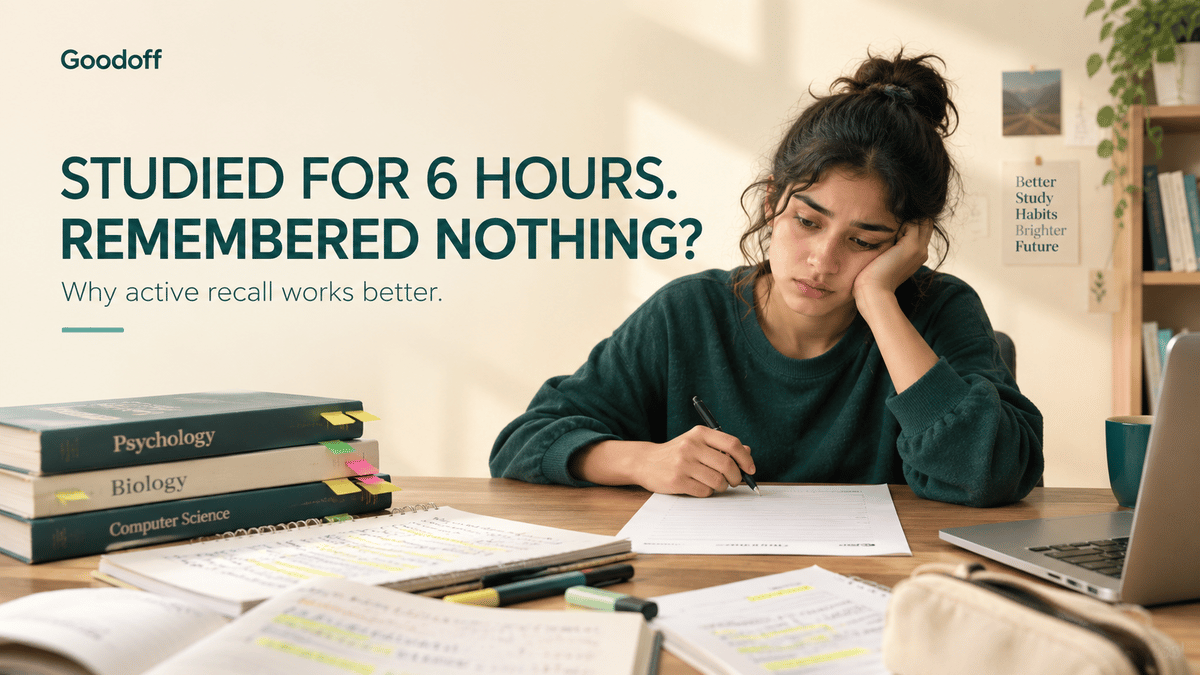
You've read the chapter twice. It feels familiar. Then someone asks you to explain it and... nothing. The blurting method is a 10-minute fix for that gap between "I've seen this" and "I know this," and all it takes is a blank page.
What Is the Blurting Method?
Blurting is a revision technique where you study a small topic, hide your notes, and write down everything you can remember as fast as you can. Then you check your page against the source and fill in what you missed in a different colour. Those coloured gaps become your to-do list for the next session.
It's popular on study TikTok and YouTube, but it's really just a simple form of active recall: pulling information out of memory instead of pushing more in.
Why Blurting Works (The Science)
Re-reading builds recognition. Exams test retrieval. In a well-known 2006 study, Roediger and Karpicke found that students who practised recalling material remembered far more a week later than students who re-read it, even though the re-readers felt more confident. Dunlosky and colleagues' 2013 review ranked practice testing among the most effective study techniques and re-reading and highlighting among the least.
Blurting adds the ingredient that makes retrieval even stronger: feedback. A 2021 meta-analysis of learning techniques found practice testing with feedback consistently beat practice testing alone. Checking your blurt against your notes is that feedback.
How to Use the Blurting Method: Step by Step
Pick one small topic. One textbook page, one lecture section, or one process (e.g. the Krebs cycle). Whole chapters are too big.
Review it for 3 to 5 minutes. Read actively: key terms, definitions, steps, and how they connect.
Hide everything. Close the book, flip your notes over, and put your phone away.
Blurt for 5 minutes. On a blank page or whiteboard, write everything you remember. Don't worry about order, spelling, or neatness.
Check and mark gaps in a new colour. Open your notes. Add anything you missed or got wrong in red or green.
Blurt again, later. Repeat the same topic in a day or two, then after a week. Aim to shrink the coloured ink each time.
Blurting vs. Re-reading vs. Flashcards
Re-reading: feels smooth, builds recognition, gives no signal about what you'd forget.
Flashcards: great for discrete facts, definitions, and formulas; tests one cue at a time.
Blurting: tests how well you can reconstruct a whole topic and the links between ideas.
The best routines combine them: blurt to find your gaps, then turn each gap into a flashcard. If you need a refresher, read our guide to notes vs. flashcards for long-term retention.
Blurting Method Examples by Subject
Biology and Medicine
Blurt processes and pathways: draw the cell cycle from memory, label every stage, then check. Great for anatomy and physiology, where order matters.
History and Social Sciences
Blurt a timeline: causes, key events, dates, and consequences. Your gaps usually show up as missing links between events.
Maths and Physics
Blurt the method, not just the formula: write out how to solve a problem type step by step, then attempt a fresh practice question.
Languages
Blurt a vocabulary set or grammar rule with example sentences, then mark mistakes in colour.
5 Common Blurting Mistakes
Blurting topics you've never learned. Blurting reinforces; it doesn't teach. Do a first pass of learning first.
Choosing chunks that are too big. If the page stays blank, shrink the topic.
Peeking. The struggle to remember is the part that builds memory.
Skipping the check. Without feedback you can lock in errors.
Blurting once. One session finds gaps; spaced repeats close them. Learn why timing matters in our guide to FSRS spaced repetition.
A 25-Minute Blurting Session Plan
Minutes 0-5: Review one small topic.
Minutes 5-10: Blurt from memory.
Minutes 10-15: Check, mark gaps in colour.
Minutes 15-22: Turn gaps into flashcards or practice questions.
Minutes 22-25: Quick re-blurt of just the gaps.
That fits neatly into one Pomodoro focus block.
How GoodOff Makes Blurting Easier
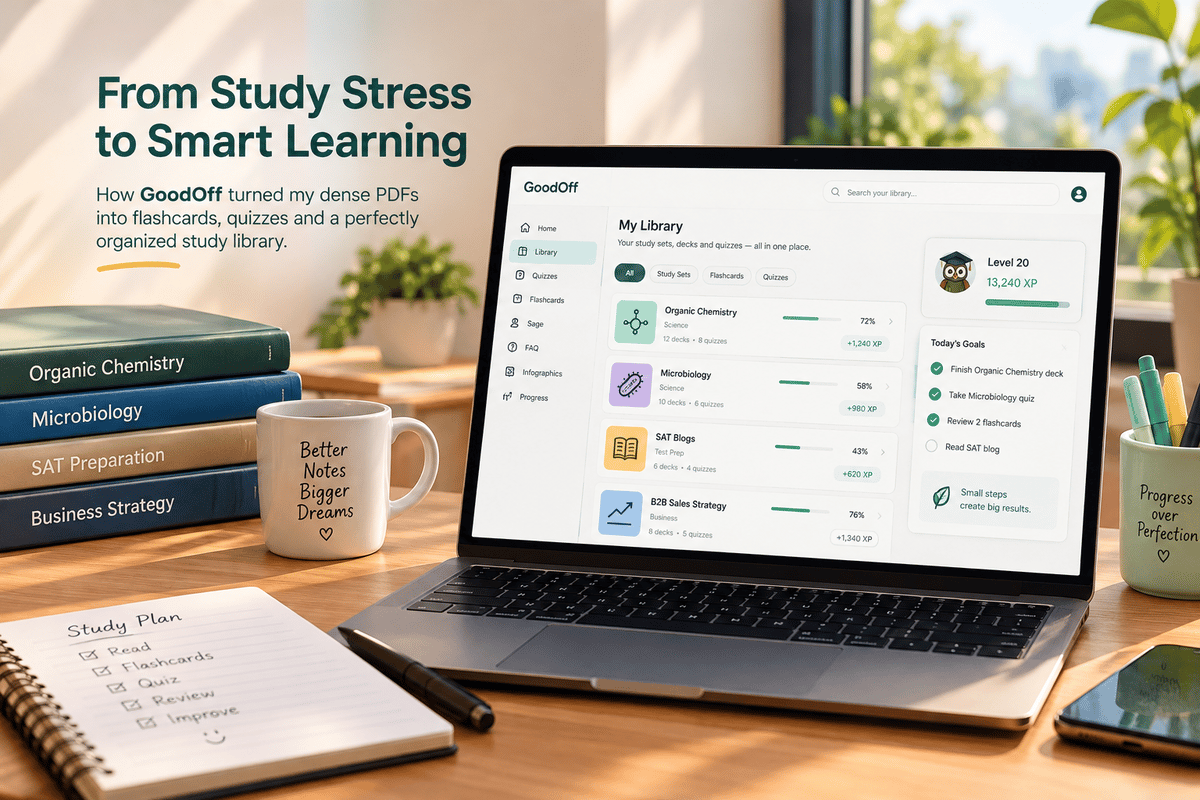
GoodOff is built around the same loop blurting uses: Learn → Practice → Track → Improve. Break notes or PDFs into short decks, blurt each one, then let GoodOff turn your gaps into flashcards and quick quizzes, schedule reviews with spaced repetition, and track your accuracy so you can see which topics are still fragile. Built-in focus timers keep each session short and on task.
Try it with your next topic at goodoff.co.
The Bottom Line
If you can't write it down from memory, you don't know it yet, and that's useful information. Blurting turns a blank page into a map of exactly what to study next. Ten minutes, one topic, one colour pen. Start today.
References: Roediger, H. L., & Karpicke, J. D. (2006). Test-enhanced learning. Psychological Science. Dunlosky, J., et al. (2013). Improving students' learning with effective learning techniques. PSPI. Donoghue, G. M., & Hattie, J. A. C. (2021). A meta-analysis of ten learning techniques. Frontiers in Education.