Short answer: to study for a multiple choice exam, practice with questions in the same format, but answer each one before you look at the options. Then go through every wrong option and say why it's wrong. Learn the differences between ideas that look alike, since that's what most distractors test, and keep a log of the questions you miss and why you missed them. On test day, read the stem carefully, predict the answer, eliminate, and don't be afraid to change an answer when you have a real reason.
Multiple choice feels easier than an essay because the right answer is sitting on the page. That's also the trap. Seeing the answer makes it feel familiar, and familiar isn't the same as knowing it. A good multiple choice test is built from options that all look reasonable, so the way you study has to prepare you to tell close ideas apart, not just recognize words you've seen before.
The Quick Version
- Find out the format. Number of questions, time, options per question, and whether wrong answers cost points.
- Cover the options. Answer each practice question from memory first, then check the choices.
- Explain every distractor. For each wrong option, say why it's wrong or what question it would be right for.
- Study the look-alikes. Make side-by-side lists of terms, formulas and examples that are easy to mix up.
- Log your misses. Write down why each wrong answer happened, not just what the right one was.
- Rehearse the timing. Do at least one full practice set under real time limits before the exam.
Why Multiple Choice Needs Its Own Kind of Studying
The usual criticism of multiple choice is that it only tests recognition. Research on practice tests says it's more complicated. In two experiments published in Psychological Science in 2012, Jeri Little, Elizabeth Bjork, Robert Bjork and Genna Angello found that multiple choice practice tests helped students remember the tested facts about as well as short-answer practice did. They also helped students recall facts linked to the wrong options, which short-answer practice didn't. The catch was that the wrong options had to be plausible. When the distractors were obviously wrong, that extra benefit disappeared.
That gives you a clear rule for studying. Easy practice questions with silly options don't train much. Practice where every option is close, and where you have to explain why three of them are wrong, trains exactly what the exam will test.
It also explains why rereading your notes doesn't prepare you well. When you reread, the material feels familiar, and familiar material is what a well-written distractor is designed to exploit. If you want the research on why testing beats rereading, our post on quizzing yourself while studying covers it.
Step 1: Get the Format Before You Study
Ask your teacher or check the syllabus for these details. They change how you prepare and how you answer.
| Question to ask | Why it matters |
|---|---|
| How many questions, and how long? | Tells you your pace. 50 questions in 60 minutes is about 70 seconds each. |
| Do wrong answers lose points? | If there's no penalty, never leave a blank. If there is, guess only when you can rule out at least one option. |
| Single answer or "select all that apply"? | Select-all questions need you to judge each option as true or false on its own. |
| Recall, application or data questions? | Application questions need practice with new examples, not memorized definitions. |
| Which chapters or lectures are covered? | Lets you weight your time toward the biggest sections. |
| Are past papers or practice sets available? | Real past questions show the style of distractor your teacher writes. |
Step 2: Practice With the Options Covered
This is the single most useful habit. When you do a practice question, cover the options with your hand or a sticky note, read the stem, and say or write your answer. Then uncover the options and look for it.
Doing this turns a recognition task into a recall task. If you can produce the answer without help, you'll spot it among four look-alikes. If you can't, you've found a gap before the exam does. Some questions can't be answered without the options (like "which of the following is NOT..."), and that's fine. Do it for every question where it works.
Step 3: Explain Every Wrong Option
After you answer, don't just check whether you got it right. Go through each distractor and finish the sentence "This is wrong because..." or "This would be right if the question asked about..."
Here's an example from intro biology:
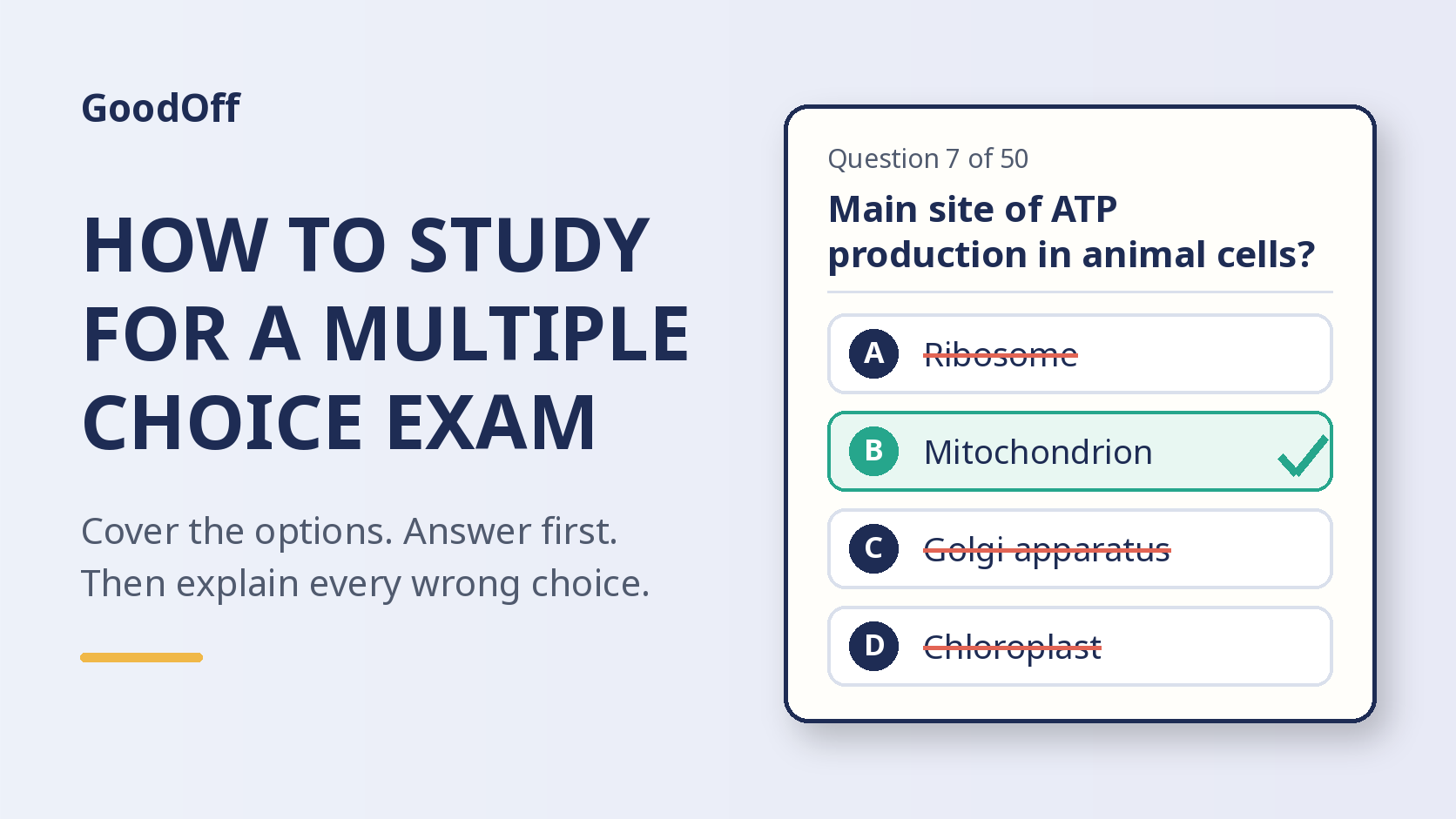
Which organelle is the main site of ATP production in animal cells? A) Ribosome B) Mitochondrion C) Golgi apparatus D) Chloroplast
- A, ribosome: wrong, it makes proteins. Right for "site of protein synthesis."
- B, mitochondrion: correct, it's where most ATP comes from in cellular respiration.
- C, Golgi apparatus: wrong, it modifies and packages proteins for transport.
- D, chloroplast: wrong for animal cells, which don't have them. It's the trap for students who remember "energy organelle" but not which kind of cell.
One question just became four facts. This is the same benefit Little and colleagues found with plausible distractors, and you get it on purpose instead of by luck. The University of North Carolina Learning Center suggests a version of this too: take each incorrect option and rewrite it so it becomes correct.
Step 4: Build Look-Alike Lists
Most multiple choice questions don't test whether you've heard of something. They test whether you can tell it apart from the thing next to it. So study in pairs and groups.
| Subject | Easy to mix up | The difference to know |
|---|---|---|
| Biology | Mitosis vs meiosis | Two identical diploid cells vs four genetically different haploid cells |
| Psychology | Negative reinforcement vs punishment | Removing something unpleasant to increase a behavior vs adding or removing something to decrease it |
| Economics | Change in demand vs change in quantity demanded | The whole curve shifts vs a movement along the curve after a price change |
| Chemistry | Accuracy vs precision | Close to the true value vs close to each other |
| History | Cause vs context | What made the event happen vs the background it happened in |
Make your own table for each unit. Write the two terms side by side, the one difference that matters, and an example of each. Then quiz yourself by mixing them up on purpose. Mixing related topics in one session, called interleaving, helps for the same reason. Our guide to interleaving practice shows how to set that up.
Step 5: Keep a Mistake Log
After each practice set, write down every question you missed and sort it by cause. The cause tells you what to fix.
| Why you missed it | What it looks like | What to do next |
|---|---|---|
| Didn't know the content | You couldn't answer with the options covered | Go back to the material, then make recall questions on it |
| Confused two ideas | You picked the look-alike | Add the pair to your look-alike table |
| Misread the stem | You missed NOT, EXCEPT, BEST or MOST | Circle qualifiers on every question for the next practice set |
| Changed from right to wrong | Your first pick was right and you talked yourself out of it | Only change when you can name the reason (see below) |
| Ran out of time | Missed questions bunched at the end | Practice with a timer and a skip-and-return rule |
After two or three practice sets, one category usually stands out. That's where your next study hour should go.
Should You Change Your Answer?
Many students believe their first instinct is usually right. The evidence says otherwise. Justin Kruger, Derrick Wirtz and Dale Miller looked at the eraser marks on intro psychology midterms from 1,561 students at the University of Illinois (published in 2005). Of 3,291 answer changes, 51% went from wrong to right, 25% from right to wrong, and 23% from wrong to wrong. Most students who changed answers improved their scores.
The reason the myth sticks is that switching away from a right answer stings more and is easier to remember. So don't change answers at random, but don't freeze either. If you reread the question and notice something you missed, or a later question reminds you of a fact, change it.
Test Day: How to Work Through Each Question
- Read the stem first and cover the options. Predict the answer, then look for it.
- Circle the qualifiers. NOT, EXCEPT, BEST, MOST, ALWAYS and NEVER change the question.
- Eliminate out loud in your head. Cross out what's clearly wrong so you're comparing two options, not four.
- Read every option. Even when the first one looks right, a later one might be more complete.
- Treat absolutes with care. "Always" and "never" are wrong if you can think of one exception.
- Skip and return. Mark hard questions and move on. A later question might jog your memory.
- Check the clock at set points. For example, a quarter of the questions done by a quarter of the time.
If you tend to blank out under pressure even when you knew the material, our post on how to stop blanking during exams covers why that happens and what helps.
A 5-Day Plan for a Multiple Choice Exam
| Day | What to do | Time |
|---|---|---|
| 5 days out | Get the format, list topics, do one untimed practice set with options covered | 60-90 min |
| 4 days out | Review the mistake log, rebuild weak topics, start look-alike tables | 60-90 min |
| 3 days out | Second practice set, explain every distractor, update the log | 60-90 min |
| 2 days out | Mixed questions across all topics, focus on the biggest mistake category | 60 min |
| 1 day out | Timed full practice set, light review of look-alike tables, early night | 60 min |
Short on time? Our one-day exam plan squeezes the same ideas into a single day.
Common Mistakes
- Doing practice questions with the options visible. You'll score higher in practice and lower on the exam.
- Checking the answer and moving on. The learning comes from explaining why the other options are wrong.
- Only memorizing definitions. Many questions describe a new example and ask which concept it shows.
- Skipping the timed run. Pacing is a skill, and the exam is a bad place to learn it.
Where GoodOff Fits
Finding good practice questions is often the hardest part, especially when your class doesn't give out past papers. GoodOff can turn a PDF, your notes, slides or a lecture into multiple choice and open-ended quizzes, with an explanation for each answer. You can take a practice test with a score and a pass mark, review the questions you missed, and retake them to see if you've improved. Quizzes work on iOS, Android and the web, and the free plan includes them with usage limits.
Generated questions are a starting point. Check them against your notes, and still do the distractor exercise yourself.
FAQ
What's the best way to study for a multiple choice exam?
Practice with questions in the same format, answer them before looking at the options, and explain why each wrong option is wrong. Spend extra time on ideas that are easy to confuse, since that's what most distractors test.
Are multiple choice tests easier than written exams?
Not always. You don't have to produce the answer from scratch, but well-written options are designed to look right, so you need to know the material precisely enough to tell close ideas apart.
Is it better to go with your first answer?
Research suggests not as a rule. In one large study, answer changes went from wrong to right about twice as often as from right to wrong. Change an answer when you have a specific reason.
Should I guess on a multiple choice test?
If wrong answers don't cost points, always answer every question. If there's a penalty, guess when you can eliminate at least one option.
How do I make my own multiple choice practice questions?
Take a key fact or concept, write the question, then write three wrong options that a confused student might pick, such as a related term or a common mix-up. Writing plausible distractors is a study session in itself.
Try It on Your Next Practice Set
Pick ten practice questions from your current unit. Cover the options, answer each one, then explain every wrong choice. Write down every miss and why it happened. That one set will tell you more about what to study than another hour of rereading. If you don't have practice questions, you can generate a quiz from your own notes with GoodOff for free.