Short answer: to make a study guide, first find out exactly what the exam covers and what kind of questions it uses. Then sort your notes by topic, pull out the key terms, ideas and examples for each one, and rewrite them as questions you can answer from memory. Keep it to about one page per topic, mark the parts you're shaky on, and spend most of your study time quizzing yourself with the guide instead of rereading it.
A study guide is only useful if it changes how you study. Plenty of students spend three evenings copying their notes into a neat document, then read it twice and feel ready. That's a summary, and rereading a summary doesn't do much for recall. A good guide is shorter, organized around what the exam will ask, and full of questions. Making it should take a few hours. Using it takes the rest of your study time.
The Quick Version
- Get the scope. Topics, readings, question types and how much each part is worth.
- Gather and sort. Notes, slides, readings, homework and old quizzes, grouped by topic.
- Rank the topics. Mark each one by weight on the exam and how well you know it.
- Condense to one page per topic. Key terms, main ideas, one worked example each.
- Turn it into questions. Facts, connections and application, at three levels.
- Test yourself and update it. Answer from memory, check, and rewrite what you missed.
Step 1: Find Out What the Exam Actually Covers
Start with the syllabus, the unit outline or any review sheet your teacher handed out. Write down every topic and reading that's in scope. Then answer three questions at the top of your guide:
- What's the format? Multiple choice, short answer, problems, essays, or a mix?
- Where do the questions come from? Lectures, the textbook, labs, or all three?
- What did the teacher repeat? Anything said twice in class, or written on a slide titled "key points," usually shows up.
If you don't know the answers, ask. "Will the exam lean more on lectures or readings?" is a normal question, and the answer can save you hours.
Step 2: Gather Your Material and Sort It by Topic
Put everything in one place: lecture notes, slides, textbook sections, homework, labs and any past quizzes. Then sort by topic, not by date. A topic that ran across three lectures and one chapter should end up in one pile.
Old quizzes and homework are the most valuable things in that pile. They show you how your teacher asks questions, which is the closest thing you'll get to a preview of the exam. If your notes are scattered, our guide on how to organize notes for learning covers a simple way to sort them first.
Step 3: Rank Every Topic Before You Write Anything
Not every topic deserves the same space. Give each one two quick ratings: how much it's likely to be worth, and how well you know it right now. This takes ten minutes and decides where your guide gets detailed.
| You know it well | You're shaky | |
|---|---|---|
| Worth a lot | Short page, mostly practice questions | Full page, worked examples, most of your study time |
| Worth a little | A few lines, quick check only | Key terms and one example, then move on |
Most students do the opposite. They write long, careful pages on the topics they already like and rush the hard ones at the end.
Step 4: Condense Each Topic to One Page
For each topic, write only what you'd need to rebuild the idea from scratch. Use your own words. If you can't put something in your own words, that's a sign you don't understand it yet, so flag it.
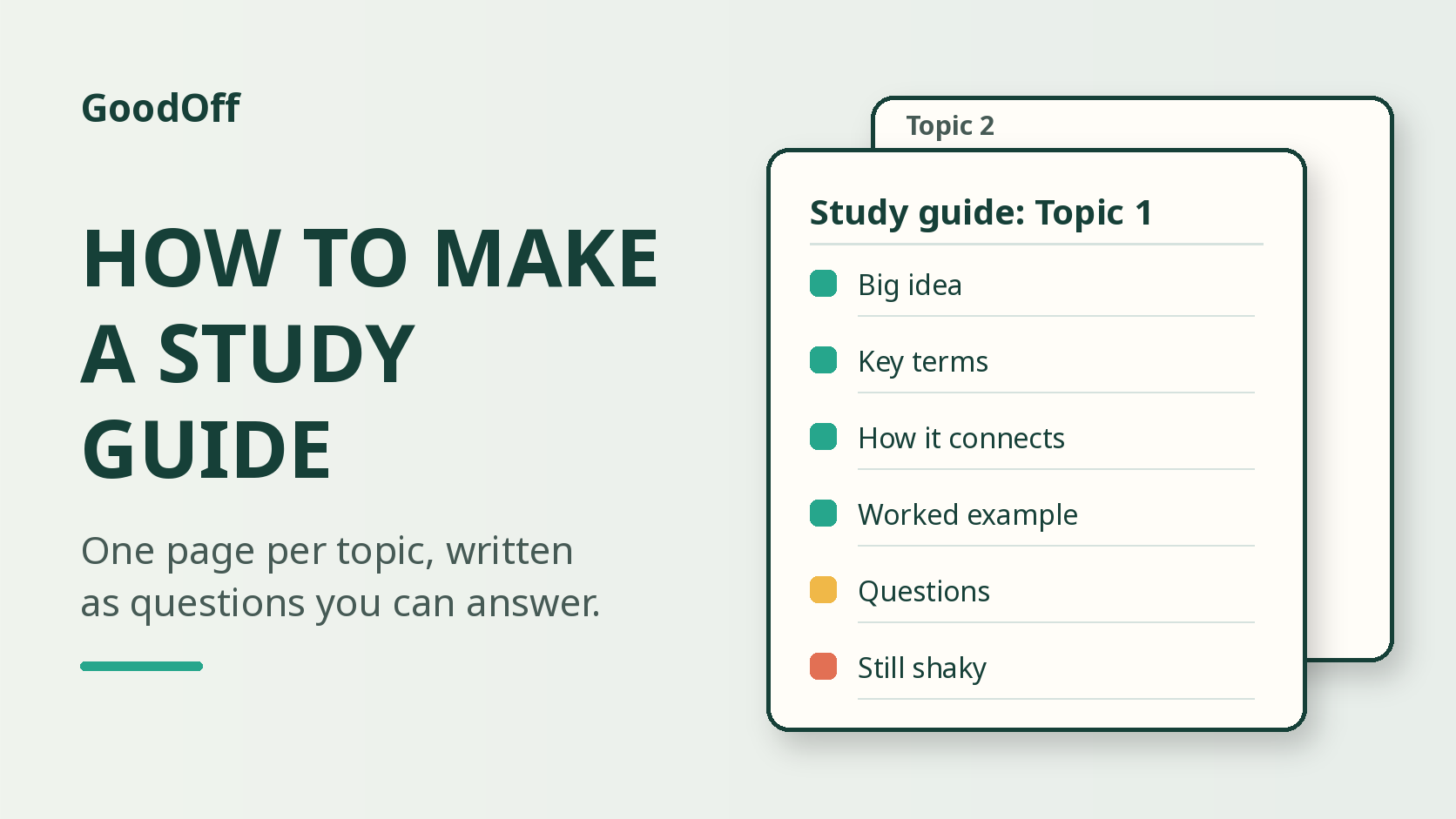
Each page can use the same layout:
| Section | What goes in it |
|---|---|
| Big idea | One or two sentences: what is this topic about? |
| Key terms | Term, a short definition in your words, one example |
| How it connects | What causes it, what it causes, what it's often confused with |
| Worked example | One problem, case or diagram, done step by step |
| Questions | Five to eight questions to answer from memory (Step 5) |
| Still shaky | Anything you got wrong or can't explain yet |
One page is a limit, not a goal. If a topic spills over, you're probably copying instead of condensing.
Step 5: Turn the Guide Into Questions
This is the step that makes a study guide work. A page of statements is easy to read and easy to forget. A page of questions forces you to pull the answer out of memory, and that retrieval is what makes it stick. In a well-known study, Roediger and Karpicke (2006) found that students who practiced recalling a passage remembered more of it a week later than students who spent the same time rereading it.
Write questions at three levels, a framework many university learning centers use:
| Level | What it tests | Example (biology, cell respiration) |
|---|---|---|
| Recall | Facts, terms, steps | Where in the cell does the Krebs cycle happen? |
| Connection | How or why ideas link | Why does glycolysis keep going without oxygen when the electron transport chain stops? |
| Application | Using the idea on something new | A poison blocks the electron transport chain. What happens to ATP output, and why? |
Aim for a mix. Recall questions are quick to write and good for flashcards. Connection and application questions are closer to what earns marks on most exams, so make sure every topic has at least two of them. For more on why this beats rereading, see our post on quizzing yourself while studying.
A Worked Example: One Page of a Study Guide
Here's what a single topic page might look like for an intro psychology unit on memory. It's short on purpose.
- Big idea: memory has stages (encoding, storage, retrieval), and forgetting can happen at any of them.
- Key terms: encoding (getting information in, for example by linking it to something you know); short-term memory (small, brief); long-term memory (large, lasting); retrieval (getting it back out).
- How it connects: "I studied it but forgot" can be a weak encoding problem, not a retrieval one. Often confused with: short-term memory vs working memory.
- Worked example: a student who reads a definition once while texting probably never encoded it well. Rereading later feels familiar, but recall fails on the test.
- Questions: Name the three stages of memory. Why might cramming feel effective the night before but fail a week later? A friend says they "have a bad memory." What would you ask to find out which stage is the problem?
- Still shaky: difference between short-term and working memory.
That page took about twenty minutes to make. The questions at the bottom are what you'll come back to.
Step 6: Use the Guide, Then Keep Editing It
Once the guide exists, stop reading it straight through. Cover everything except the questions and answer them out loud or on scrap paper. Check your answers. Anything you missed goes into the "still shaky" box, and you come back to it the next day.
A simple way to schedule it for an exam about a week away:
| Day | What to do | Time |
|---|---|---|
| 1 | Scope, gather, sort and rank topics (Steps 1 to 3) | 45 to 60 min |
| 2 to 3 | Write topic pages, high-value shaky topics first | 60 to 90 min a day |
| 4 | Answer every question from memory, mark misses | 60 min |
| 5 | Redo the misses, plus a timed set of practice questions | 60 min |
| 6 | Mixed questions across all topics, update "still shaky" | 45 to 60 min |
| 7 (day before) | Only the "still shaky" boxes, then sleep | 30 to 45 min |
If you have less time, squeeze Steps 1 to 3 into an hour and write shorter pages. Our 7-day exam study plan goes deeper on spreading the work out.
Common Mistakes
- Copying instead of condensing. If your guide is as long as your notes, it's just a second copy of your notes.
- Making it pretty. Colors and fonts feel productive. They don't help you remember.
- No questions. A guide without questions turns studying back into rereading.
- Finishing it the night before. The guide is a tool for studying, not the studying itself. Leave days to use it.
- Never updating it. The "still shaky" box should change every time you test yourself.
Can AI Make a Study Guide for You?
Yes, and it can save time on the sorting and condensing. Tools like ChatGPT or NotebookLM can summarize a reading or pull out key terms, and some study apps turn a PDF straight into a guide. The catch is that you skip some of the thinking that makes a homemade guide useful, and an AI summary can miss what your teacher emphasized or get a detail wrong.
A good middle ground: let a tool draft the guide from your own material, then check it against your notes, cut what's not on the exam, and add your own connection and application questions. If you're starting from a PDF, our post on turning a PDF into a study guide walks through that workflow.
Where GoodOff Fits
GoodOff can do the drafting part. Upload a PDF, slides or an image, paste your notes, or record a lecture, and GoodOff makes a study guide, flashcards and a quiz from it. You can edit all of them, so you can cut, correct and add your own questions. The flashcards are scheduled with spaced repetition, and if you tell it your exam date, it builds a plan that counts back from that day. It's free to start.
It won't know what your teacher said twice in class. Add that yourself.
FAQ
What should a study guide include?
For each topic: the big idea, key terms in your own words, how the idea connects to others, one worked example, and a set of questions to answer from memory. Add a short list of what you still find confusing.
How long should a study guide be?
About one page per major topic is a good limit. A whole unit usually fits in four to eight pages. If it's longer than your notes, you're copying, not condensing.
Is making a study guide a good way to study?
Making one helps you sort and understand the material, but the bigger payoff comes from using it to test yourself. Spend more time answering its questions than writing it.
Should I handwrite or type my study guide?
Either works. Typing is faster to edit and reorganize. Handwriting can slow you down enough to make you condense. Pick whichever you'll actually keep updating.
How do I make a study guide for a test tomorrow?
Skip the full pages. List the topics, write three to five questions for each of the most important ones, answer them from memory, and spend the rest of your time on what you missed.
Start Your Guide
Open your syllabus and list the topics on your next exam, then rank them by weight and by how well you know them. That's step one done in ten minutes. If you'd like a first draft of the guide made from your own notes, you can try it with GoodOff for free.