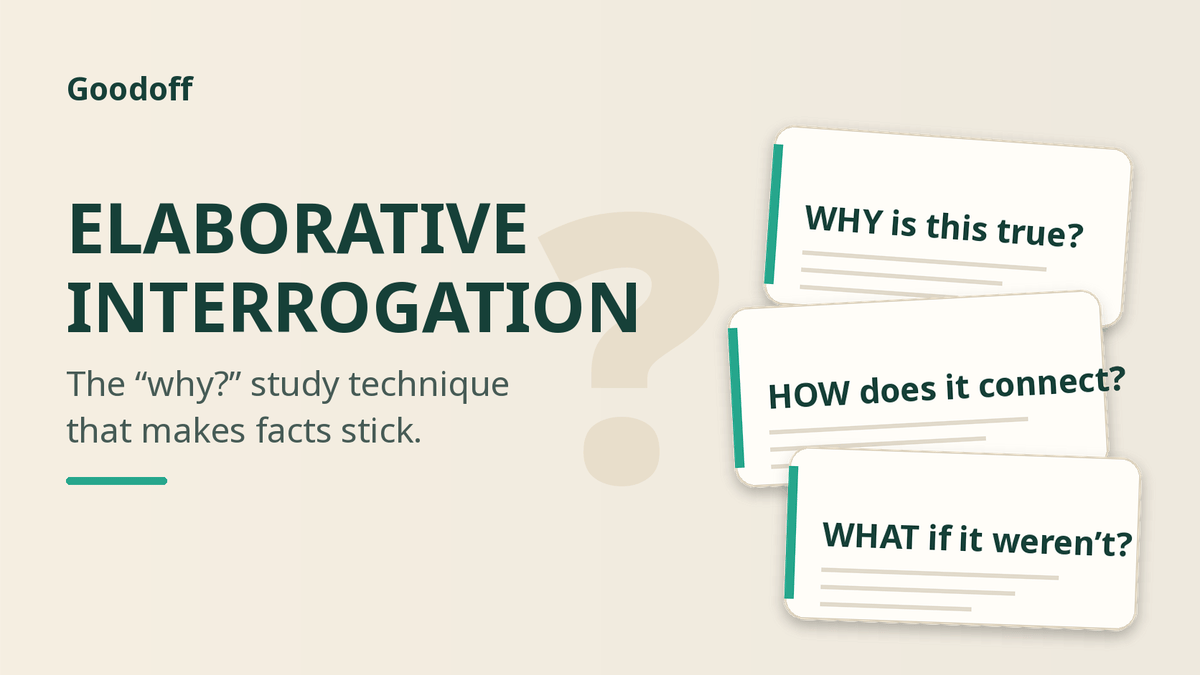
Elaborative interrogation is a study technique where you keep asking "Why is this true?" and "How does this connect to what I already know?" about each fact you learn, then answer in your own words. Because you have to link a new fact to things you already understand, it sticks far better than reading it again. Research reviews rate it as a moderately effective strategy, and it works best when you already know a bit about the topic.
Most students try to remember facts by reading them over and over. The trouble is that a bare fact, like "the mitochondria has its own DNA," has nothing to hold on to. Elaborative interrogation gives it something to hold on to: a reason. This guide explains what the technique is, why it works, how to do it step by step, and how to pair it with other methods so the knowledge lasts until exam day and beyond.
What Is Elaborative Interrogation?
The name sounds complicated, but the idea is simple. "Elaborative" means adding detail and meaning. "Interrogation" means questioning. Put together, it means questioning a fact until you can explain why it makes sense.
Instead of reading "Hot air rises" and moving on, you stop and ask: Why would hot air rise? Then you answer: "When air heats up, its molecules move faster and spread out, so it becomes less dense than the cooler air around it. Less dense things float on denser ones, so it rises." Now the fact is tied to ideas you already have about density and floating. You are not memorizing one sentence anymore. You are building a small web of understanding.
The key difference from simple rereading is that you generate the explanation yourself. The textbook may already explain it, but the benefit comes from the effort of producing the answer from your own head before you check.
Why Elaborative Interrogation Works
Learning scientists have studied this technique since the late 1980s. In early experiments by Michael Pressley and colleagues, students who were prompted to explain why each statement made sense remembered far more of the facts than students who simply read the same statements. Later studies with real school content, such as facts about animals and geography, found similar gains.
In 2013, John Dunlosky and a team of researchers published a well-known review of ten popular study techniques. They rated elaborative interrogation as having moderate utility: clearly better than rereading or highlighting, though with less evidence behind it than practice testing and spaced practice. That is a useful way to think about it: a strong supporting technique, not a replacement for testing yourself.
Three things explain why it helps:
It connects new information to old knowledge. Memory works by association. A fact linked to five things you already know has five paths back to it. A fact linked to nothing has none.
It forces deeper processing. You cannot answer "why?" without actually thinking about meaning. Shallow reading lets your eyes move while your brain stays idle.
It exposes gaps. If you cannot answer the "why," you have found something you do not truly understand yet. That is valuable information before an exam, not during one.
How to Use Elaborative Interrogation: Step by Step
You can use this technique with any textbook chapter, lecture notes, or slide deck. Here is a simple routine that takes about 15 to 20 minutes per section.
Pick a small chunk. Choose one section, one page, or five to ten key facts. Trying to question a whole chapter at once gets overwhelming fast.
Read each fact and pause. After every key statement, stop before reading on.
Ask a "why" or "how" question. Good prompts are "Why is this true?", "Why does this happen here and not somewhere else?", "How does this relate to what I learned last week?", and "What would happen if this were not true?"
Answer from memory first. Say it out loud or write a one or two sentence answer without looking at your notes. Use plain words.
Check and correct. Now look at the source. Was your explanation right? If it was wrong or missing a piece, fix it in a different color so the gap stands out.
Turn it into a question for later. Write the "why" question on a flashcard with your corrected answer on the back. This lets you practice retrieving the explanation, not just the fact, in future review sessions.
Examples Across Subjects
Elaborative interrogation fits almost any subject where facts have reasons behind them.
Biology: "Red blood cells have no nucleus." Why? Without a nucleus there is more room for hemoglobin, so each cell can carry more oxygen.
History: "Many early cities grew up next to rivers." Why? Rivers provided drinking water, fertile soil for farming, and an easy way to move goods and people.
Chemistry: "Noble gases rarely react." Why? Their outer electron shells are already full, so they have little to gain by sharing or swapping electrons.
Economics: "Prices usually rise when supply falls." Why? When there is less of something and the same number of buyers want it, sellers can charge more and still sell everything.
Notice that each answer links the fact to a bigger idea: oxygen transport, human needs, electron structure, or scarcity. That link is what makes the fact easy to rebuild later.
Common Mistakes to Avoid
Using it on topics you know nothing about. The technique depends on prior knowledge. If a topic is brand new, first read an overview or watch a short lecture, then start asking why.
Accepting vague answers. "Because that's how it works" is not an explanation. Push until your answer mentions a real cause or mechanism.
Skipping the check. A confident but wrong explanation can stick just as well as a right one. Always compare with your source.
Questioning every tiny detail. Save it for important facts and concepts. Dates and vocabulary lists are better handled with plain flashcards.
Using it only once. Understanding fades like everything else. Come back to your "why" questions over the following days and weeks.
Elaborative Interrogation vs. Self-Explanation and the Feynman Technique
These three methods are close cousins. Elaborative interrogation focuses on individual facts and asks why each one is true. Self-explanation focuses on processes, such as working through a math solution and explaining each step to yourself. The Feynman Technique zooms out further and has you teach a whole concept in simple language to find the gaps.
You do not have to choose one. A good study session might start with elaborative interrogation on key facts, use self-explanation on worked problems, and finish with a quick Feynman-style explanation of the big idea. All three build what researchers call metacognition: an honest sense of what you actually understand versus what only feels familiar.
How to Combine It With Retrieval Practice and Spacing
Elaborative interrogation helps you understand and encode information. To keep it, you still need to practice pulling it back out of memory over time. That is where practice testing and spaced repetition come in, the two techniques with the strongest evidence in the Dunlosky review.
A simple combined workflow looks like this:
Day 1: Study a section with elaborative interrogation and turn your best "why" questions into flashcards.
Over the next weeks: Review those cards on a spaced schedule, so each one comes back just before you would forget it. If you want to know how modern schedulers decide those intervals, read our guide to FSRS spaced repetition.
Before the exam: Mix questions from different topics together instead of studying one topic at a time. This is called interleaving practice, and it trains you to pick the right idea under exam conditions.
Using GoodOff With Elaborative Interrogation
The slowest part of this method is turning your "why" answers into something you can review. GoodOff can take care of that setup. Upload a PDF or your notes and GoodOff generates flashcards and quizzes from them, which you can then edit into "why" and "how" questions. Your cards come back on an FSRS-style spaced review schedule, and built-in focus timers help you keep each questioning session short and focused.
You still do the thinking, which is the part that makes the technique work. GoodOff handles the cards and the review timing so the explanations you build today are still there at exam time.
Key Takeaways
Elaborative interrogation means asking "why is this true?" about each key fact and answering in your own words.
It works by linking new information to what you already know, which makes it easier to recall later.
Research rates it as moderately effective, and it works best when you have some background knowledge.
Always check your explanations against your source, then turn them into flashcards.
Pair it with retrieval practice, spaced repetition, and interleaving for long-term results.