Short answer: to study for an open book exam, study almost as hard as you would for a closed book one, because the exam rewards applying ideas, not finding them. Learn the core concepts well enough to explain them without your notes, then build a short, tabbed reference (an index of topics with page numbers, a formula or definition sheet, and summaries of key readings). Practice with timed past questions using only that reference, and keep track of how often you have to look things up. On exam day, answer what you know first and use your materials to check details, not to learn the topic.
Open book sounds like a gift. You can bring the textbook, so why memorize anything? The catch is that teachers know you have the book too. Open book questions tend to ask you to compare, analyze, apply or evaluate, and the clock does not leave time to read a chapter you skipped. Students who treat the book as a backup do well. Students who treat it as the plan usually spend the exam flipping pages.
The Quick Version
- Read the rules first. Find out exactly what is allowed: printed notes, the textbook, a laptop, the internet, AI tools, or a single sheet.
- Learn the big ideas cold. You should be able to explain each main concept from memory in a few sentences.
- Cut your materials down. Less paper means faster lookups. Organize what you keep by topic, not by lecture date.
- Build an index. One or two pages that tell you where everything is, with page numbers.
- Practice with a timer. Use your reference during practice exactly as you will in the exam, and count your lookups.
- Answer in your own words. Use the book for evidence and exact details, not for paragraphs to copy.
Why "I Can Look It Up" Is a Trap
There is research on exactly this. In a study by Pooja Agarwal and Henry Roediger published in 2011 in the journal Memory, students who were told to expect an open book test spent less time studying the material and did worse on a delayed test of comprehension and transfer than students who expected a closed book test. Expecting to have the answers nearby changed how seriously they studied.
An earlier study by Agarwal and colleagues (2008, Applied Cognitive Psychology) found something useful on the other side: open book practice tests still improved long-term retention compared with simply rereading, and after a week they worked about as well as closed book tests with feedback. So practicing with your notes open is fine. Planning to learn the material during the exam is not.
The time math makes the same point. If an exam has 4 essay questions in 2 hours, you have about 30 minutes for each one. If you spend 10 of those minutes searching, a third of your writing time is gone before you make your first argument.
Step 1: Find Out Exactly What Kind of Open Book It Is
"Open book" covers very different exams. Check the syllabus or ask your instructor which one you have, because it changes how you prepare.
| Format | What is usually allowed | How to prepare |
|---|---|---|
| Open textbook, in class | The course book, sometimes with your own margin notes | Tab the chapters, write a page-number index, add short notes in the margins if allowed |
| Open notes or one cheat sheet | Your own notes, or one page (often double-sided) | Treat the sheet as a study task: decide what earns a place on it |
| Online, timed, at home | Course materials on your computer, sometimes the internet | Organize files in clearly named folders, test your setup, avoid having 30 tabs open |
| Take-home exam over days | Most resources, with a strict rule on working alone | Plan your writing time like a short paper, cite sources, don't over-answer |
Also check whether AI tools, calculators, search engines or classmates are allowed. Many open book exams still ban AI chatbots and any collaboration, and using them can count as academic misconduct even if the books are open. When in doubt, ask in writing.
Step 2: Learn the Core Concepts Without the Book
List the main topics from the syllabus or learning outcomes. For each one, close everything and try to explain it in a few sentences: what it is, why it matters, and how it connects to one other topic. Then open your notes and check what you missed.
This is ordinary self-testing, and it works the same way it does for any exam. Our guide to quizzing yourself while studying explains why pulling an answer from memory beats rereading. The goal here is not to memorize every number in the book. It is to know the ideas well enough that the book only fills in details.
A useful rule: if a topic would take you more than a minute to find and understand in the exam, you need to learn it before the exam.
Step 3: Cut Your Materials Down and Organize Them by Topic
More paper feels safer, but every extra page is one more place to search. Keep only what you will actually use: your condensed notes, key readings, worked examples, and the textbook if it is allowed.
Then reorganize by topic. Lecture order is how the material was taught. Topic order is how exam questions are asked. If your notes are scattered across weeks, a topic-based study guide does most of this work for you.
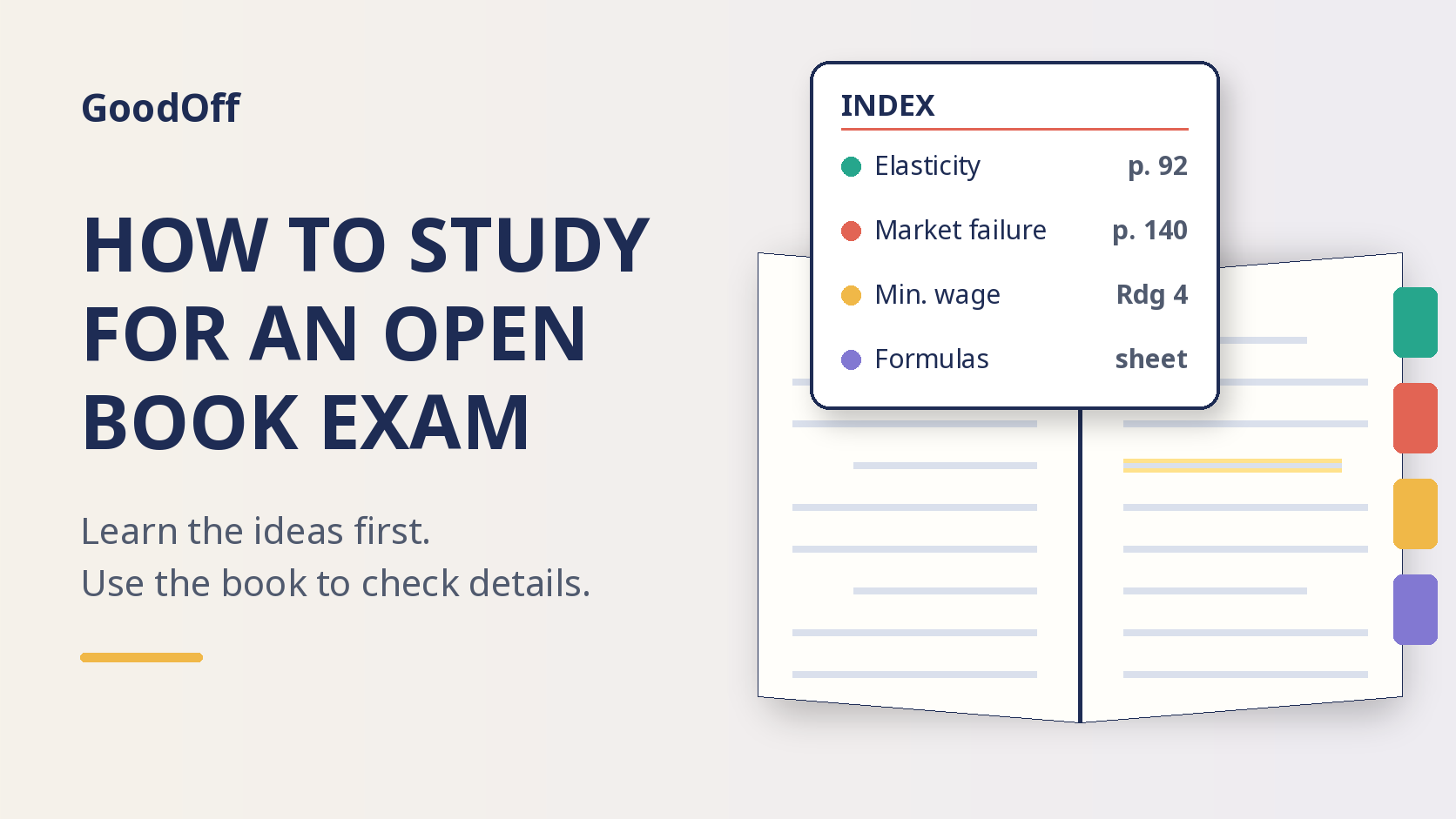
- Use colored tabs or sticky notes for each major topic, labeled on the edge so you can see them with the book closed.
- Write short summaries of long readings (a paragraph or two) with the page numbers of the key passages.
- Keep formulas, definitions and constants on one separate sheet so you never search a chapter for them.
- For digital exams, name files and folders by topic and keep one searchable document with your summaries.
Step 4: Build an Index You Can Use in 10 Seconds
The single most useful thing you can bring is an index: a list of topics and terms with where to find each one. Making it is also a good review session, because you have to decide what matters and where it lives.
| Topic or term | Where | One-line reminder |
|---|---|---|
| Price elasticity of demand | Textbook p. 92 to 95, notes week 3 | Formula on formula sheet; elastic if greater than 1 |
| Minimum wage evidence | Reading 4 summary, p. 2 | Card and Krueger vs. competitive model prediction |
| Market failure types | Notes week 6 | Externalities, public goods, information problems |
Sort it alphabetically or by topic, whichever matches how the questions are likely to be worded. Keep the reminder column short. If you can't write a one-line reminder for a topic, that is a sign you don't understand it yet.
Step 5: Practice Under Real Conditions and Count Your Lookups
Find past papers or sample questions. If there are none, write your own from the learning outcomes, using the question words your instructor uses: compare, explain, evaluate, apply. Then set a timer and answer with your reference materials laid out exactly as they will be in the exam.
Keep a tally every time you open a book or file. After each practice question, look at the tally:
- Lots of lookups on one topic: you don't know it well enough. Go back to Step 2 for that topic.
- Slow lookups: your index or tabs need work.
- Lookups you didn't need: you are checking out of habit. Practice trusting what you know.
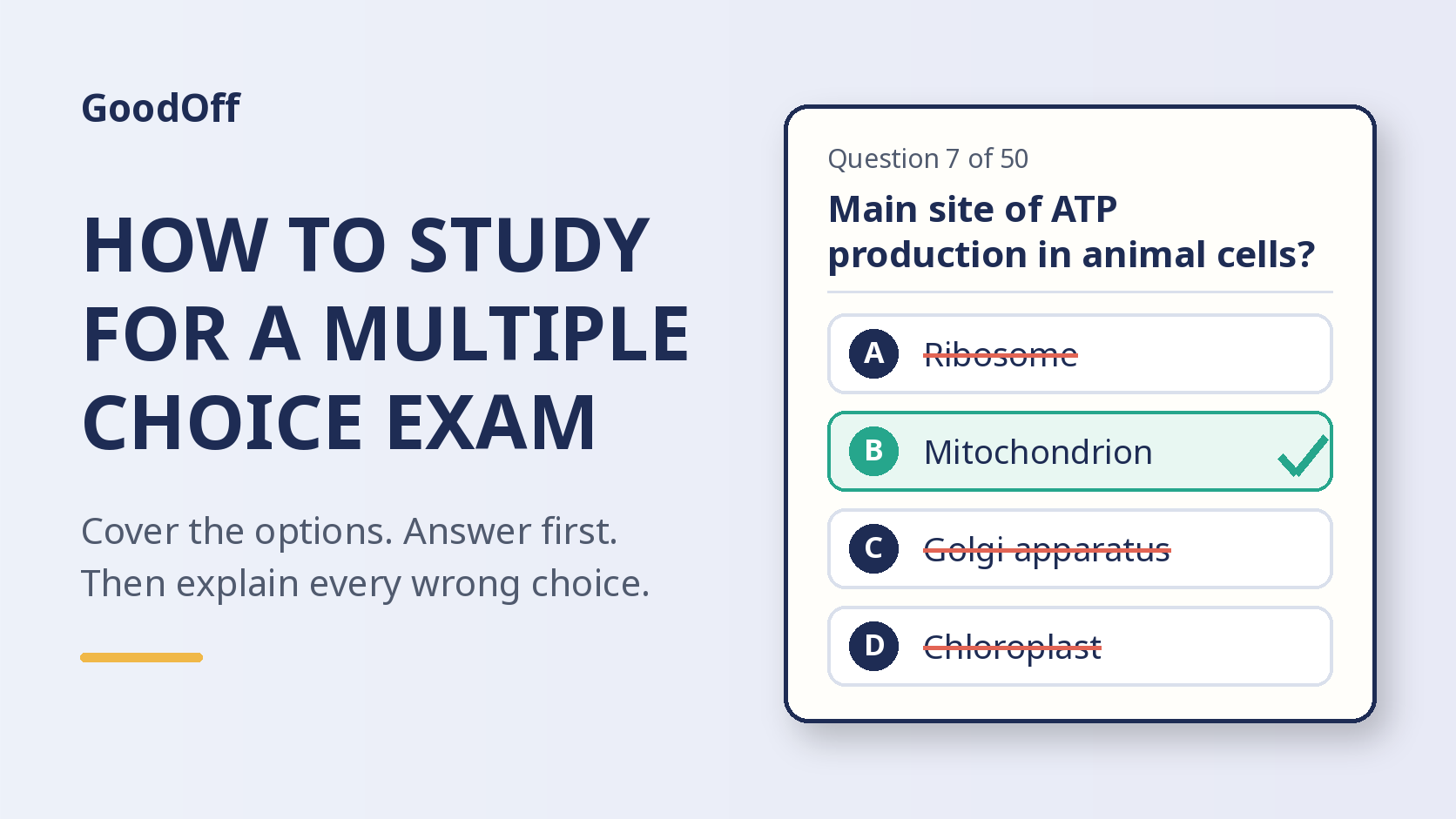
Short practice tests also help for the parts of the exam that are multiple choice, and the method in our post on how to study for a multiple choice exam works with the book open too: answer first, then check.
Step 6: Plan How You Will Use the Time on Exam Day
- Read every question first and mark which ones you can answer without help.
- Answer those first. Use the book only to confirm a quote, a number or a formula.
- Move to the harder questions with the time you saved. Go straight to your index instead of flipping.
- Write in your own words. Paraphrase and cite. Long copied passages use time and rarely earn the marks, which go to your analysis.
- Stop polishing. Being able to check everything makes it tempting to keep adding detail. Answer the question asked, then move on.
A Worked Example: The Same Question, Two Approaches
Say an economics exam asks: "Evaluate whether raising the minimum wage reduces employment. Use evidence from the course."
Student A skimmed the readings, planning to look things up. They spend 12 minutes finding the right chapter, re-read the section on labor markets, and copy two long paragraphs. The answer describes the theory but never weighs it against the evidence, so it earns few of the evaluation marks.
Student B already knows the argument: the simple competitive model predicts job losses, some empirical studies found small or no effects, and the answer depends on how large the increase is and on the local labor market. They use their index to find the exact study names and one figure in under a minute, then spend the rest of the time building the argument. The book supplied the details. The thinking was done before the exam.
A 5-Day Plan for an Open Book Exam
| Day | Focus | Time |
|---|---|---|
| Day 1 | Check the rules, list topics, explain each from memory, mark weak ones | 60 to 90 min |
| Day 2 | Relearn weak topics, start cutting and reorganizing notes by topic | 60 to 90 min |
| Day 3 | Write summaries of key readings, build the formula sheet and the index | 60 to 90 min |
| Day 4 | Timed practice with your reference set, count lookups, fix gaps | 90 min |
| Day 5 | One more timed question, final tidy of tabs and files, pack or set up | 45 min |
Leave the night before for packing and sleep, not for new material. If your notes are a mess, our guide on how to revise from notes shows how to turn them into something you can review in passes.
Common Mistakes
- Not studying at all. The most common one, and the research above shows why it backfires.
- Bringing everything. Five binders feel safe but slow you down.
- Organizing by lecture date. Questions are asked by topic.
- Copying instead of answering. Quotes support an argument. They aren't the argument.
- Skipping the tech check. For online exams, test your internet, battery, files and exam platform the day before.
- Assuming AI is allowed. Open book rarely means open chatbot. Check the rules.
Where GoodOff Fits
GoodOff can help with the preparation days, not the exam itself. Upload your PDFs, slides or lecture recordings and it can make a study guide with the key ideas organized for review, plus flashcards and a quiz with an explanation for each answer, so you can test whether you know a topic without the book. The free plan includes decks, quizzes and study guides with daily, weekly and monthly limits.
On Pro, Sage answers questions about your own material and shows the page it used, which is handy while building your index and checking where a topic lives in a long PDF. Use it to prepare, and only use any AI tool during an exam if your instructor clearly allows it.
Frequently Asked Questions
Are open book exams easier?
Usually not. Because you can look up facts, the questions tend to test application and analysis instead, and the marking expects more depth. The time limit also makes heavy searching costly.
How do you organize notes for an open book exam?
Organize by topic, not by lecture. Keep condensed notes, summaries of key readings with page numbers, a separate formula or definition sheet, and a one or two page index. Label tabs so you can see them with the book closed.
How long should I study for an open book exam?
Plan roughly the same time as for a closed book exam in the same course. A few days of spaced sessions, like the 5-day plan above, works better than one long session the night before.
Can I use ChatGPT or other AI in an open book exam?
Only if your instructor explicitly allows it. Many open book and take-home exams ban AI tools and collaboration, and using them can be treated as misconduct. Check the exam instructions and ask if they are unclear.
What should I bring to an open book exam?
Only what is allowed and what you have practiced with: your index, formula sheet, condensed notes, key reading summaries, and the textbook with tabs if permitted. Bring the same layout you used in your practice runs.
Start With Your Index Tonight
Pick the course with the next open book exam, list its topics, and try explaining each one without your notes. Mark the weak ones, then start your index with page numbers. That one session tells you what to learn and builds the tool you will use in the exam. If you want practice questions from your own material, you can make a quiz from your notes with GoodOff for free.