Short answer: to study for an essay exam, don't try to memorize everything. Organize your notes around the big themes of the course, predict the questions you're likely to get, and write a one-sentence answer (a thesis) plus three or four pieces of evidence for each. Then practice by outlining from memory and writing a few answers under a timer, and check each one against your notes. Essay exams reward a clear argument backed by specific examples, so the goal is to be able to build that argument quickly without your notes.
Most students prepare for essay exams the same way they prepare for multiple choice: reread, highlight, hope. Then the question arrives and it asks them to compare two theories or evaluate a policy, and the facts they "know" won't line up into an answer. This guide shows how to prepare for the thing you'll really be asked to do.
The Quick Version
- Find out the format. How many essays, how many marks each, and whether you get a choice.
- Group your notes by theme. Themes become essay topics; chapters don't.
- Predict 5 to 8 questions. Use the syllabus, lecture emphasis and past papers.
- Write a thesis and 3 or 4 evidence points for each one.
- Practice from memory. Outline first, then write two or three timed answers.
- Check against your notes and fix what you missed.
- Budget your time by marks on exam day and plan before you write.
What an Essay Exam Actually Tests
An essay question is rarely asking "what do you know?" It's asking you to do something with what you know. The verb in the question tells you what. If you've only studied facts, you've prepared for about half of it.
| Question word | What it wants | How to prepare |
|---|---|---|
| Describe, outline | Main features, in order | A short list you can say from memory |
| Explain, why | Causes and how they connect | Cause and effect chains in your notes |
| Compare, contrast | Similarities and differences on the same points | A two-column table with matching rows |
| Analyze, discuss | Break a topic into parts and weigh them | Three or four angles for each major theme |
| Evaluate, assess, to what extent | A judgement with evidence for and against | A position, best evidence, and one counterpoint |
Look at old exams or sample questions and underline those words. You'll notice the same few repeating, which tells you what kind of notes to make.
Step 1: Find Out the Format and the Marking
Before you study anything, get the facts about the exam. Check the syllabus or ask your instructor how many essays there will be, how long you get, how much each is worth, and whether you choose from a list. A single 60-minute essay and three 20-minute answers need different preparation.
If past papers or sample questions exist, get them now. They show you the style, the wording, and how broad or narrow the questions run. The UNC Writing Center also suggests finding out what you can about the exam form early, because it lets you forecast the questions you'll be asked.
Step 2: Organize Your Notes Around Themes, Not Chapters
Notes arranged by lecture date are good for learning and bad for writing essays, because essay questions cut across the course. A question about causes of a war might use material from five different weeks.
Go through the course and pull out the big ideas that keep coming back. Most courses have somewhere between five and ten. Give each its own page or section, and move facts, quotes, names and examples under the theme they support. If one fact belongs under two themes, write it in both.
This is also where a good study guide helps. If you haven't built one, our guide on how to make a study guide walks through a template you can organize by theme instead of by chapter.
Step 3: Predict Questions and Write Your Thesis for Each
Now turn each theme into one or two likely questions. Use the syllabus learning goals, anything your instructor stressed more than once, and the wording of old exams. Aim for five to eight questions. You won't guess every one, but writing them forces you to practice the skill the exam tests, and the themes carry over even when the exact wording doesn't.
For each question, write two things on one card or one page:
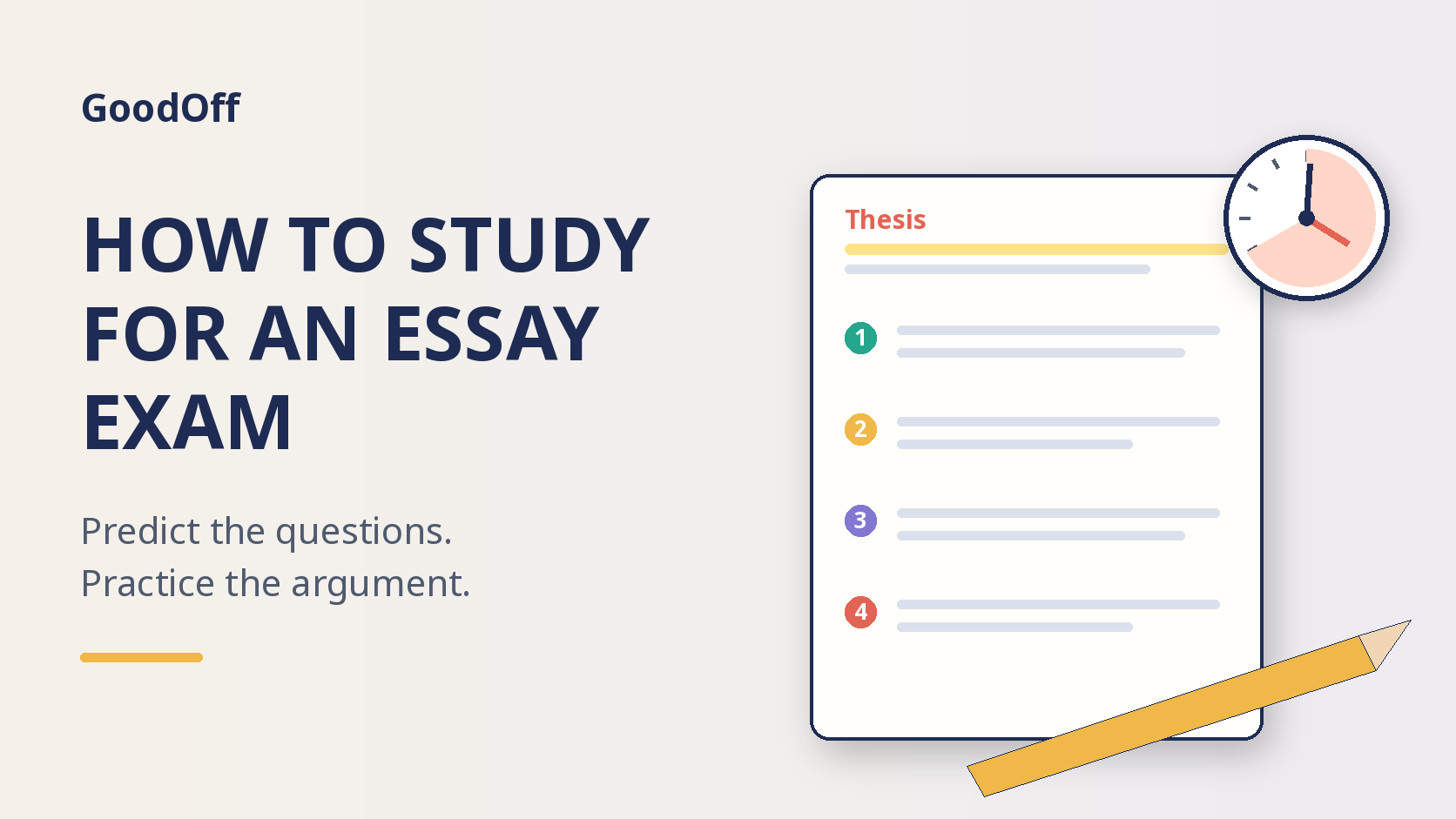
- A thesis: one sentence that answers the question directly.
- Three or four evidence points: specific facts, examples, names, dates or data that support it.
Purdue OWL suggests starting each exam answer with a one or two sentence thesis that restates the question's key terms as a statement. Having that sentence ready for each likely question is a big head start when the clock is running.
Step 4: Practice From Memory, Then Under a Timer
Reading your thesis cards doesn't prepare you to write an essay. Writing one does. Do it in two stages.
Stage one: outline from memory. Pick a question, close your notes, and write the thesis and evidence points on a blank page. Then open your notes and see what you missed. This takes five minutes per question, so you can cover a lot of ground in one sitting.
Outlining is worth the effort. In a 1988 experiment, Ronald Kellogg found that writers who prepared an outline produced higher-quality documents than those who didn't, and that a mental outline helped as much as a written one. The benefit seems to come from organizing your ideas before you start writing sentences.
Stage two: write a full answer under time. Choose two or three of your predicted questions and write them in the time you'll have on exam day, with your notes closed. It will feel harder than rereading, and that's the point. Kang, McDermott and Roediger (2007) found that when students got feedback afterward, short-answer practice led to better performance on a test three days later than multiple-choice quizzing or rereading the answers. Producing an answer is stronger practice than recognizing one.
If you tend to go blank in the exam, this stage matters most. Our post on how to stop blanking during exams covers why recall fails under pressure and how timed practice helps.
Step 5: Check Your Answer Against Your Notes
Feedback is what makes practice count. After each timed answer, compare it with your notes and ask four things:
- Did my first sentence actually answer the question?
- Did I use specific evidence, or just general statements?
- What important point did I forget?
- Did I run out of time, and where did it go?
Fix the gap right away. If you missed a point, add it to the thesis card. If you ran long on the introduction, shorten it next time. If you can, swap answers with a classmate. Another person will spot an unclear argument faster than you will.
Step 6: Plan Your Time for Exam Day
Essay exams are lost to time more often than to knowledge. These habits help:
- Read every question first. If you have a choice, jot a few ideas for each before you pick.
- Split your time by marks. A question worth a quarter of the marks gets about a quarter of the time.
- Plan before you write. The UNC Writing Center suggests giving as much as a quarter of a long answer's time to notes, a thesis and an outline.
- Pick the question you can explain, not just the one you recognize. Knowing the answer and being able to say why are different things.
- Number multi-part questions so you don't skip a part.
- Leave a few minutes at the end to proofread, and add a line to any answer you rushed.
If part of your exam is multiple choice or open book, those formats need their own plan. See our guides on how to study for a multiple choice exam and how to study for an open book exam.
A Worked Example: From Question to Outline
Say your history course has this practice question: "Assess the causes of the 1929 stock market crash."
The verb: "assess" means weigh the causes, not list them. A good answer says which mattered most.
Thesis (written in advance): The 1929 crash had several causes, but heavy speculation financed by borrowing made the market fragile, and weaknesses elsewhere in the economy meant a sell-off could spread.
Evidence points:
- Buying on margin: investors borrowed to buy shares, so falling prices forced more selling.
- Uneven income: spending power was concentrated, limiting how long consumer demand could keep up.
- Weak sectors: farming and some industries were already struggling.
- Banking system: many small banks had little protection when losses hit.
- Counterpoint: some historians stress policy choices after the crash more than the crash itself.
Notice how short this is. It fits on an index card. In the exam you'd expand each point with a name, number or example from your notes, which is why Step 2 matters: the evidence has to be filed where you can find it. Check the points above against your own course materials, because different instructors stress different causes.
A 5-Day Plan for an Essay Exam
| Day | Focus | Output |
|---|---|---|
| Day 1 | Find the format, gather past questions, group notes by theme | A list of themes and a marks-and-time summary |
| Day 2 | Predict questions, write thesis and evidence for the first half | 4 thesis cards |
| Day 3 | Finish thesis cards, outline three from memory | 8 total cards, 3 checked outlines |
| Day 4 | Write two full answers under time, then check them | 2 timed essays with notes on gaps |
| Day 5 | Outline the weakest questions again, one more timed answer, then rest | Fixed cards and a calm night |
With less time, keep the same order but cut the number of questions. A smaller set of themes you can write about well beats a broad set you only half know.
Common Mistakes
- Memorizing facts without a point. Evidence needs a claim to support.
- Only rereading. It feels like progress, but it doesn't practice writing an answer.
- Writing a full practice essay without a timer. Untimed writing hides the exam's real problem.
- Skipping feedback. A practice essay you never check teaches you little.
- Retelling the course. Answer the question asked, not the one you wish you'd been asked.
- Burying the thesis. If the marker has to hunt for your argument, you lose marks.
Where GoodOff Fits
GoodOff can help with the preparation stage. Upload your lecture notes, PDFs or slides and it can build a study guide with the key ideas organized for review, plus flashcards and quizzes with multiple-choice and open-ended questions. Each reviewed question comes with an explanation, which is handy for checking whether you really know a theme. The free plan includes these tools with daily, weekly and monthly limits.
It won't write your essay for you, and you shouldn't use any AI tool in the exam unless your instructor clearly allows it. The best use is to turn your notes into questions, answer them from memory, then review what you missed before you do your timed writing.
Frequently Asked Questions
How long should I study for an essay exam?
Plan about the same time as for any exam in that course, but spend more of it practicing answers. A few days of short sessions, like the 5-day plan above, works better than one long session the night before.
Should I memorize my essay word for word?
No. Memorize your thesis, your evidence points and any key names or numbers, not full paragraphs. Memorized essays rarely match the question that's asked, and they break down if you lose your place.
How many essays should I practice?
Outline as many predicted questions as you can, and write two to four in full under timed conditions. Outlining is quick, so it covers more topics. Full writing is slower but shows your timing problems.
How do I know what the essay questions will be?
You usually can't know exactly, but you can narrow it down. Use the syllabus, the topics your instructor repeated, past papers and the question words they use. Prepare themes, not just questions, so a reworded prompt doesn't throw you.
What if I run out of time during an essay?
Switch to a short outline of what's left, with one sentence per point, so the marker can see your argument. Partial credit for a complete plan is better than a perfect first half and nothing after it. Timed practice is the best fix for this.
Start With Your Themes Tonight
Take your syllabus and list the five to ten big themes of the course. Write one likely question for each, then try to say a one-sentence answer without looking. The ones you can't answer are where to spend your time. If you'd like practice questions drawn from your own notes, you can make a quiz from your material with GoodOff and use it to find your gaps before you start writing.