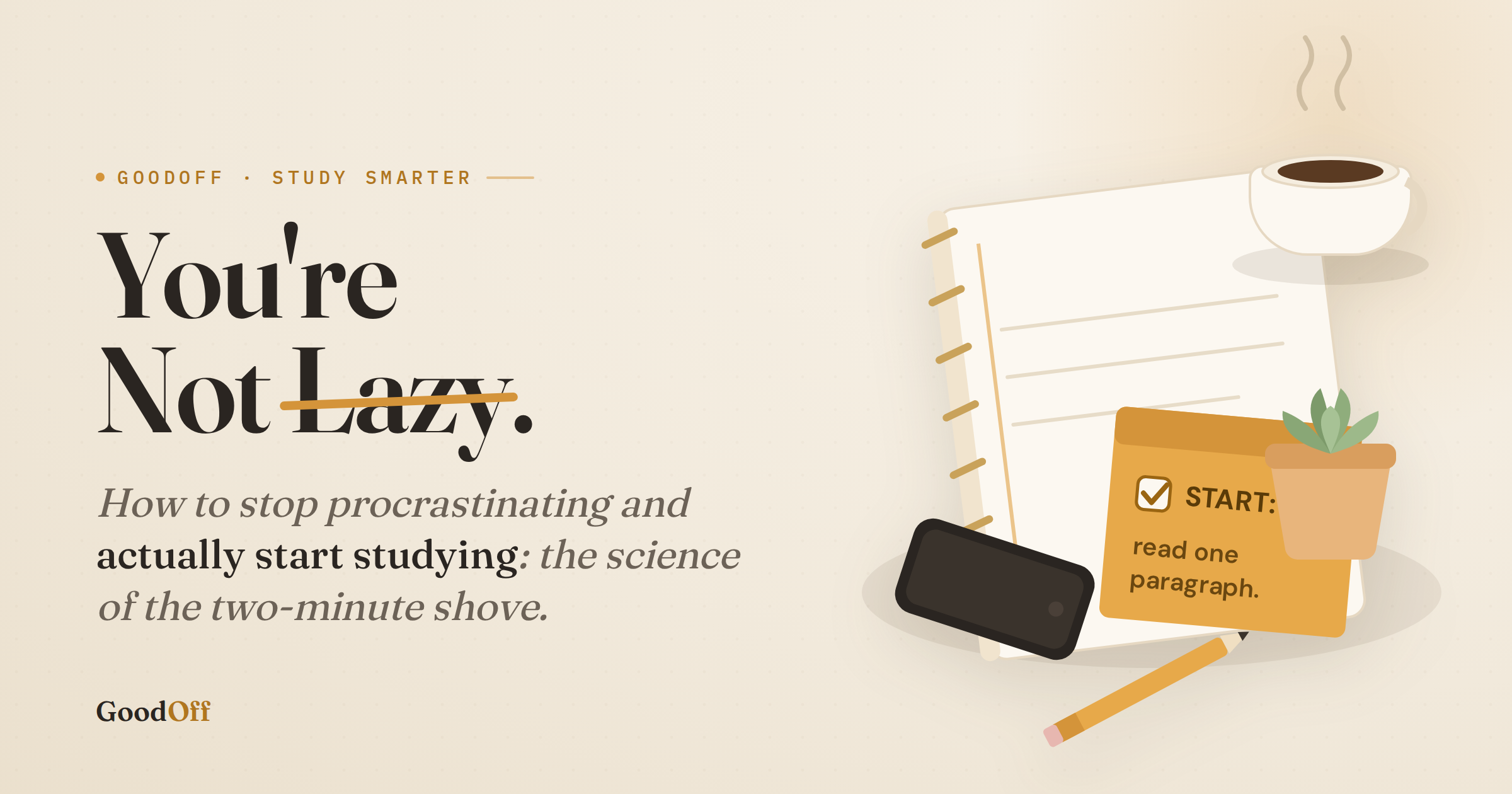
Short answer: to stop procrastinating on studying, make the first step tiny and specific ("open chapter 4 and answer three practice questions"), decide in advance exactly when and where you'll do it, and drop the self-blame after a bad day. Research suggests procrastination is mostly about avoiding an unpleasant feeling, not about laziness, so the fixes work by making the start feel smaller and clearer.
If you've ever sat down to study and ended up reorganizing your desk for an hour, you're not unusual. Psychologist Piers Steel's 2007 review of procrastination research estimated that 80 to 95 percent of college students procrastinate, and that around half do it consistently and problematically. This guide explains what's actually going on and gives you a plan you can use tonight.
Why You Procrastinate (It's Not Laziness)
Laziness means not caring about the outcome. Most procrastinators care a lot. That's part of the problem.
Researchers Fuschia Sirois and Timothy Pychyl describe procrastination as a short-term mood repair strategy. The task makes you feel something unpleasant, like boredom, confusion or worry about doing badly. Avoiding it brings quick relief. Your future self pays for it later.
Steel's review found that procrastination is more likely when:
| Factor | What it looks like when studying | What lowers it |
|---|---|---|
| Low expectancy | "I won't understand this anyway." | Start with something you can finish, like five easy questions |
| Low value | "This chapter is boring and pointless." | Link it to the exam: which questions will this cover? |
| High impulsiveness | Your phone wins every time | Put distractions out of reach before you start |
| Distant deadline | "The exam is three weeks away." | Create near deadlines: a self-quiz every Friday |
Each fix targets one factor. You don't need all four. Pick the row that sounds most like you.
The Cycle That Keeps It Going
Procrastination tends to repeat in the same loop:
- The task feels bad, so you avoid it.
- Avoiding feels better, for a while.
- Guilt builds, which makes the task feel even worse.
- Deadline pressure finally wins and you cram.
- You get through it, and your brain learns that waiting until the last minute "works."
The last step is why the habit sticks. Cramming can get you through a test, but it doesn't hold up for long-term memory or a cumulative final. If you're already behind, our guide on how to catch up on schoolwork sorts the pile into must, should and skip.
How to Stop Procrastinating on Studying: 6 Steps
1. Make the first step embarrassingly small
"Study biology" is too vague to start. "Open the slides from Tuesday and write three questions about them" is concrete. The goal of the first step is to start, not to finish. Once you're working, keeping going is usually much easier than starting was.
2. Decide when and where with an if-then plan
Write your plan as "If it's [time and place], then I will [specific action]." For example: "If it's 4 p.m. and I'm back from class, then I'll sit at the library table and do 10 practice problems." Psychologists call these implementation intentions. A 2006 meta-analysis by Peter Gollwitzer and Paschal Sheeran, covering 94 studies, found they had a medium-to-large effect on reaching goals (d = 0.65). For more on building these into your week, see why your study schedule falls apart.
3. Start with testing, not reading
Reading a chapter has no clear finish line, which makes it easy to put off. A short self-quiz does. Answer five questions from last lecture before you open anything new. You'll see right away what you know and what you don't, and that clarity makes the next step obvious.
4. Remove the easiest escape
If your phone is where every study session goes to die, put it in another room or a bag across the room before you start. Make the distraction take effort to reach. You're not relying on willpower if the temptation isn't within arm's reach.
5. Set a short, fixed session
Commit to 20 or 30 minutes, then stop and decide whether to continue. A short session with a clear end is easier to agree to than "study until I understand everything."
6. Forgive yesterday
This one sounds soft, but there's evidence for it. In a 2010 study, Michael Wohl, Timothy Pychyl and Shannon Bennett followed first-year students across two midterms. Students who forgave themselves for procrastinating before the first exam procrastinated less before the second one. Self-criticism adds to the bad feeling you're trying to escape, which can make the next start harder.
A Plan for Tonight
Here's what this looks like for one evening with an exam three days away:
| Time | What you do |
|---|---|
| Before dinner (2 min) | Write tonight's if-then plan and the first tiny step on a sticky note |
| 7:00 p.m. (25 min) | Phone in another room. Answer 10 questions on chapter 1 without notes |
| 7:25 p.m. (5 min) | Break. Check which questions you missed |
| 7:30 p.m. (25 min) | Re-learn only the missed topics, then make cards for them |
| 7:55 p.m. (5 min) | Write tomorrow's first tiny step. Stop |
One hour of this beats four hours of avoiding the textbook. If the hardest part is that everything is due at once, try our 7-day exam study plan.
When It's More Than Procrastination
Sometimes chronic avoidance has another cause. If you've had trouble starting and finishing tasks across many areas of life since childhood, it may be worth asking a doctor about ADHD. Our ADHD study tips include a task breakdown table. If you're avoiding studying because you feel low, hopeless or overwhelmed most days, talk to your campus counseling center. Procrastination tactics won't fix those on their own.
Where GoodOff Fits
GoodOff can make the first step smaller. It won't make you study, but it can remove the blank page.
- A first question instead of a first page: upload your notes or a PDF and GoodOff drafts editable flashcards and a quiz, so your session can start with "answer question one." Quizzes are auto-graded with explanations. Both are on the Free plan within daily, weekly and monthly AI limits.
- Review that's already scheduled: flashcards are scheduled with FSRS spaced repetition, so you can open the app and see what's due today.
- A timer next to your material: the focus timer has custom session lengths and keeps a history of completed sessions.
- Help when you're stuck: on Pro, the Sage tutor answers questions grounded in your uploaded material.
Check AI-made cards against your notes. They can be wrong.
Frequently Asked Questions
Why do I procrastinate even when I care about my grades?
Because procrastination is mostly about avoiding an unpleasant feeling, not about caring. The more a task matters, the more worry it can bring, which can make avoiding it more tempting.
How do I start studying when I don't feel motivated?
Don't wait for motivation. Make the first step tiny and specific, set a short session and start. Motivation often shows up after you begin, not before.
Does the 2-minute rule work for studying?
Committing to just a couple of minutes can help you start, because starting is often the hardest part. It works best when the first step is specific, like answering three questions.
Is procrastination a sign of ADHD?
Not on its own. Almost everyone procrastinates sometimes. If you've had lifelong trouble with attention, organization and starting tasks across many settings, ask a doctor about an evaluation.
How do I stop procrastinating on a big assignment?
Break it into steps you can finish in one session, put the first one on your calendar with an if-then plan, and set your own mini-deadlines before the real one.
Bottom Line
You're probably not lazy. You're avoiding a feeling, and the task looks too big and too vague to start. Shrink the first step, plan when and where, keep distractions out of reach and forgive the last slip. Then do one small thing tonight.
Want your first step ready before you sit down? Try GoodOff free and turn tonight's notes into a short quiz.