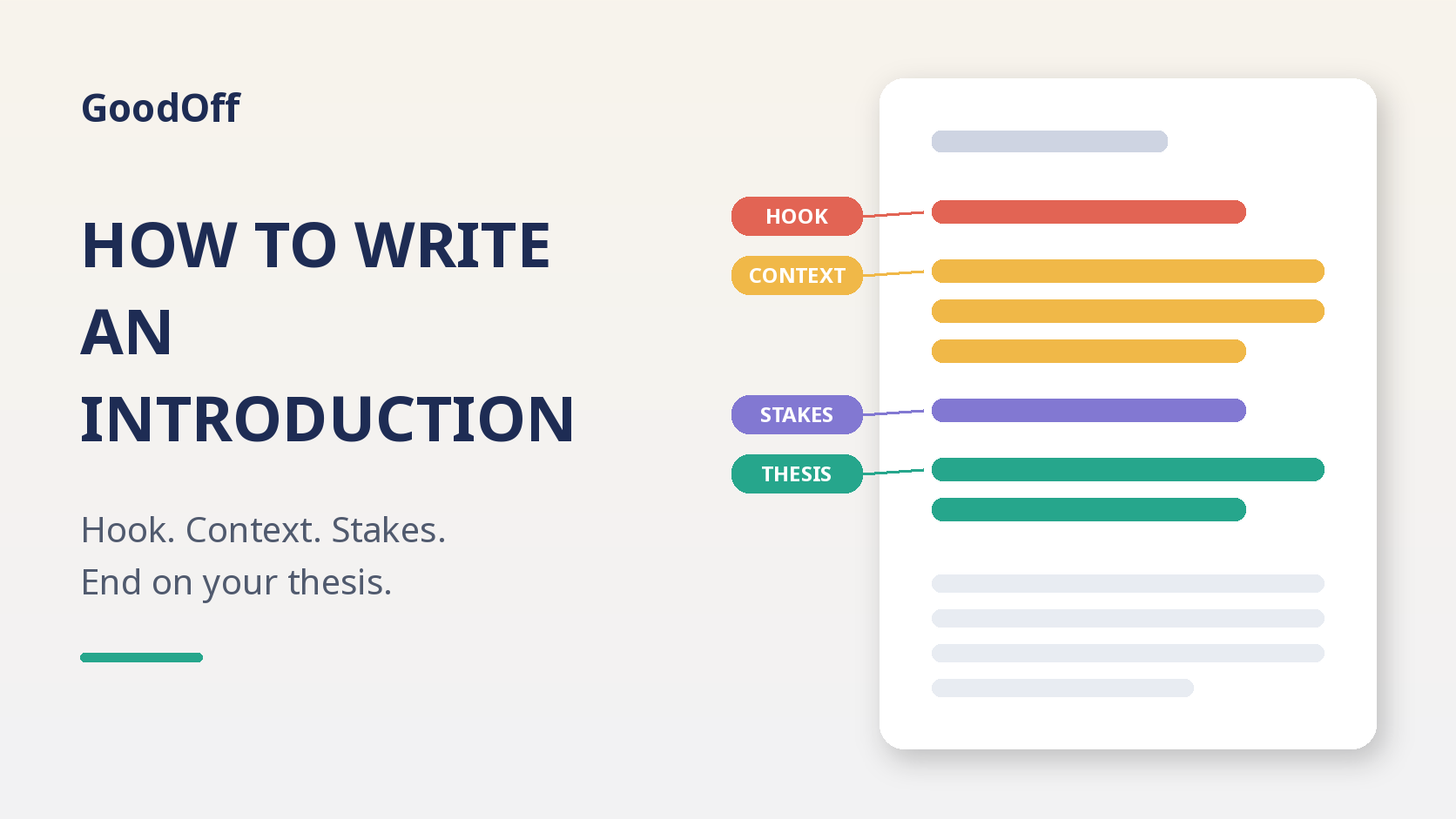
Short answer: To write an introduction, open with a specific sentence that connects to your topic, give only the background a reader needs to follow your argument, explain why the question matters, and end with your thesis or research question. Think of it as a funnel: hook, context, stakes, thesis. Write it last, or at least revise it last, so it matches the paper you actually wrote.
Most students get stuck on the first sentence. They stare at a blank page, type "Since the beginning of time," delete it, and lose 20 minutes. That's normal. The fix isn't a better hook trick. It's knowing what the introduction is for, so you can build it from parts instead of waiting for inspiration.
This guide covers the four parts of a strong introduction, a worked example built one sentence at a time, weak-to-strong rewrites, how introductions change for essays, research papers and lab reports, and a checklist you can run before you submit.
What an introduction actually does
An introduction has two jobs. It tells the reader what the paper is about, and it gives them a reason to keep reading. The Harvard College Writing Center puts it plainly: an academic introduction usually presents a question or problem and then offers an answer to it, which is your thesis.
That means a good introduction isn't decoration. It's a promise. Every body paragraph should deliver on something the introduction set up. If your introduction promises three reasons and the paper gives four, or argues something different, the reader notices.
It also helps to know what an introduction is not:
- It's not a summary of everything you'll say. Save the evidence for the body.
- It's not a history of the topic from ancient times to today.
- It's not a place for dictionary definitions unless a term is truly contested.
- It's not where you apologize or hedge ("This essay will attempt to...").
The 4 parts of a strong introduction
Writing centers describe the same basic shape with slightly different names. The University of Utah Writing Center calls it hook, background and thesis, arranged like a funnel. Harvard adds a part many students skip: what's at stake. Here's the version we'll use.
| Part | What it does | Typical length |
|---|---|---|
| 1. Hook | Gets attention with something specific and relevant to your argument | 1 sentence |
| 2. Context | Gives the background, key terms or debate the reader needs to follow you | 2 to 3 sentences |
| 3. Stakes | Explains why the question matters or what's unresolved | 1 sentence |
| 4. Thesis | States your answer or claim, sometimes with a short roadmap | 1 to 2 sentences |
Part 1: The hook
The hook is your first sentence. It doesn't have to be dramatic. Harvard's guide warns against hooks that promise too much, like claiming everyone else is wrong. A good hook is specific and leads straight to your topic.
Hooks that tend to work:
- A concrete fact or number that's surprising and relevant. Make sure you can cite it.
- A short scene or example, one or two sentences, that shows the problem.
- A tension or puzzle: two things that seem like they shouldn't both be true.
- A direct question, used sparingly, and only if your paper answers it.
- A quotation from your primary source, not a famous quote pulled from the internet.
Hooks to avoid: "Since the beginning of time," "In today's society," "Webster's dictionary defines," and anything so broad it could open a thousand different papers.
Part 2: Context
Context is the background your reader needs to understand your thesis. Not everything they'll need for the whole paper, just enough to see why your claim makes sense. Harvard's advice is to judge how much context to give by asking what a reader needs in order to appreciate the thesis.
Depending on the assignment, context might be:
- The text, author or event you're analyzing, named clearly.
- A short summary of the debate or what other scholars have argued.
- A key term defined the way you'll use it.
- The specific situation, place or time period you're focusing on.
Part 3: Stakes
This is the "so what" sentence. Why should anyone care about your question? Maybe the common view is incomplete. Maybe there's a real cost to getting it wrong. Maybe your reading of the text changes how we see a character. One sentence is usually enough, but without it, your introduction can feel like a list of facts followed by an opinion.
Part 4: Thesis
The thesis usually comes at the end of the introduction. It states your main claim in a way someone could disagree with. If you need help with this part, our guide on how to write a thesis statement walks through formulas and examples.
Some disciplines also expect a roadmap sentence that previews the order of your points. Harvard notes this is common in fields like government and economics but not expected everywhere. When in doubt, check the assignment or ask your instructor.
A worked example, built one sentence at a time
Say your essay argues that a later school start time would do more for high school grades than extra homework help. Here's how the introduction comes together.
| Part | Sentence |
|---|---|
| Hook | At 7:30 on a Tuesday morning, half the students in a first-period chemistry class are awake in body only. |
| Context | Teenagers' sleep cycles shift later during puberty, so many can't fall asleep until around 11 p.m. Yet many high schools still start before 8 a.m., and districts trying to raise grades usually reach for tutoring programs or after-school help instead. |
| Stakes | If tired students can't take in the material during class, more help after school treats the symptom rather than the cause. |
| Thesis | Moving the first bell to 8:30 a.m. would likely do more to improve grades than adding homework support, because it lets students learn during the hours they're already in school. |
Read together, that's one paragraph of about 110 words. Each sentence moves closer to the claim. Notice that the hook is a scene, not a statistic, and that the paragraph doesn't present the evidence yet. That's the body's job.
If you were writing this for a real class, you'd also check the sleep claim against a source and cite it. A hook or context sentence that sounds like a fact needs the same support as any other fact in your paper.
Weak vs strong: 5 introduction rewrites
| Weak | Why it's weak | Stronger |
|---|---|---|
| Since the beginning of time, people have argued about education. | Too broad, says nothing about your paper | Every few years, a district proposes later start times, and every few years the plan stalls over bus schedules. |
| Webster's defines "freedom" as the state of being free. | Circular and adds nothing | For Frederick Douglass, freedom began with something smaller than escape: learning to read. |
| In this essay I will talk about social media and teenagers. | Announces a topic, not a claim | Social media doesn't simply make teenagers lonelier. It changes who they compare themselves to. |
| There are many reasons why the Roman Republic fell. | Vague, no position | The Roman Republic didn't fall in a single crisis. It wore down over a century of generals who learned they could ignore the Senate. |
| Climate change is a very important issue today. | Generic, no stakes | Our city's flood maps were last updated in 2009, which means new construction is still planned around old risks. |
The pattern in every fix is the same: name something specific, and point toward an argument. The last example would need a real, citable date in your own paper. Don't invent one.
How introductions change by assignment
The funnel works for most essays, but the parts get different weight depending on what you're writing.
| Assignment | What the introduction emphasizes | Where it ends |
|---|---|---|
| Argumentative essay | The debate and the side you're taking | A clear, arguable thesis |
| Literary analysis | The text, author and the specific element you'll analyze | An interpretive claim about how or why the text works |
| Rhetorical analysis | The speaker, audience, purpose and context of the piece | A claim about which strategies the author uses and how well they work |
| Research paper | What's known, the gap, and how your paper fills it | The research question or purpose statement |
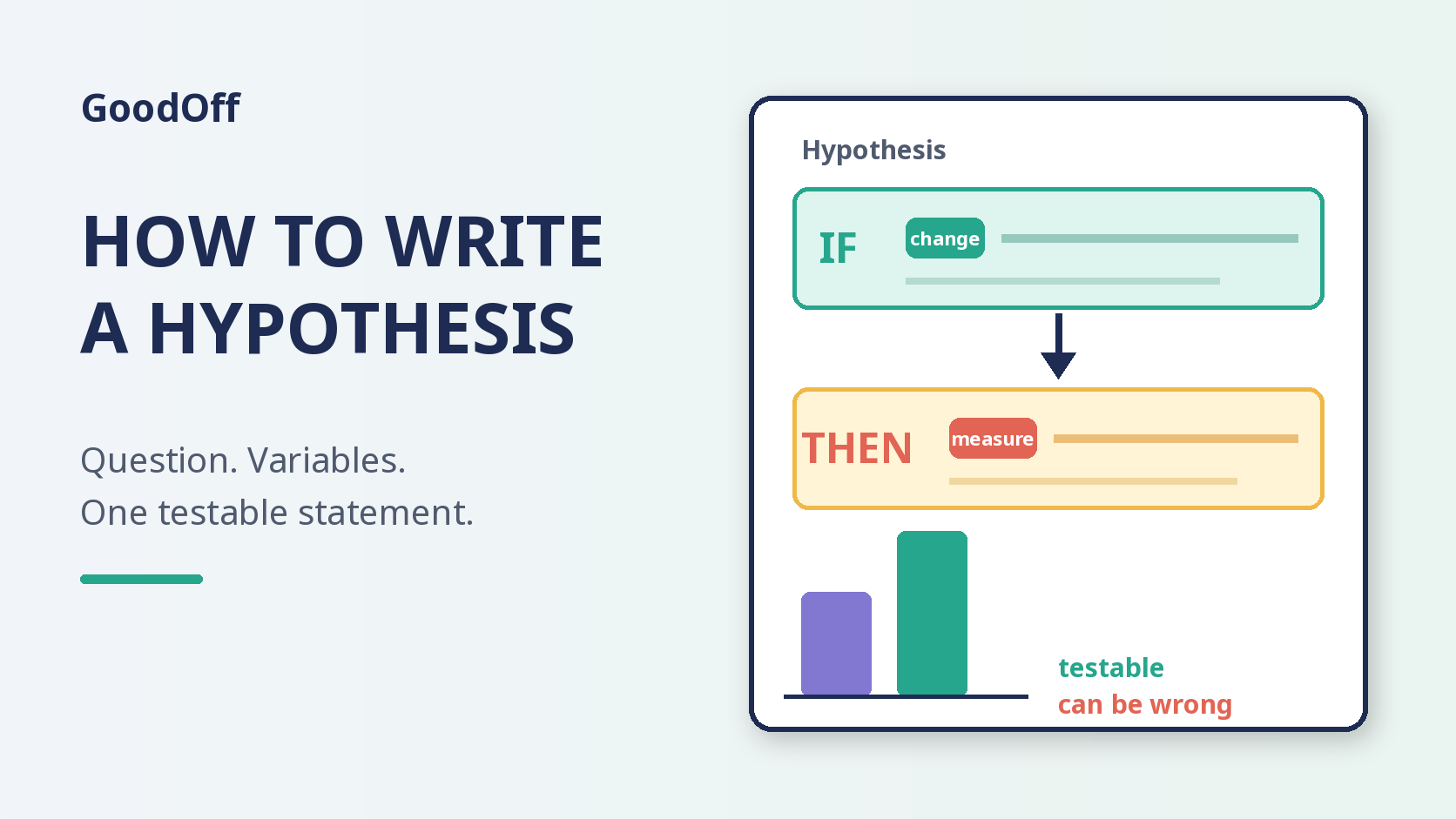
| Lab report | The scientific background and why the experiment was done | The aim and hypothesis |
Research paper introductions: the CARS model
For research papers, a useful model is John Swales's "Create a Research Space" (CARS), from his 1990 book Genre Analysis. Swales studied how published articles open and found three common moves:
- Establish the territory. Show the topic is important and summarize what earlier research has found.
- Establish a niche. Point out a gap, a limitation or an unanswered question in that research.
- Occupy the niche. Say what your paper does about it: your question, purpose or main finding, and sometimes how the paper is organized.
The gap is the research version of "stakes." If you haven't settled on your question yet, start with our guide on how to write a research question. To find the gap, you'll need a quick survey of the literature first. A literature review is the usual way to do that, grouping sources by what they found.
Lab report introductions
Lab reports skip the hook almost entirely. You open with the relevant scientific concept, explain what's already known, state the purpose of the experiment, and finish with your hypothesis. Keep it short, often one or two paragraphs. Our lab report guide covers what goes in each section.
How long should an introduction be?
A common rule of thumb is about 10% of the paper. That's a guideline, not a rule, but it gives you a sense of proportion.
| Paper length | Rough introduction length |
|---|---|
| 500-word essay | One paragraph, 50 to 80 words |
| 1,500-word essay | One paragraph, 120 to 180 words |
| 3,000-word paper | One or two paragraphs, around 300 words |
| Thesis or dissertation chapter | Several pages, often with its own subsections |
If your introduction is taking up a third of the paper, you're probably putting evidence in it that belongs in the body.
Why you should write the introduction last
You don't have to write the introduction first just because it comes first. Many writers draft a rough thesis, write the body, and then come back to the introduction once they know what the paper actually argues.
There's a practical reason for this. Your argument usually shifts while you write. If you polish the introduction on day one, you'll end up with an opening that promises a paper you didn't write. A rough working thesis is enough to start. You can fix the hook and context later.
If the blank page is the problem, try a fast, messy first draft of the body and come back. Get words down without editing as you go, then shape them.
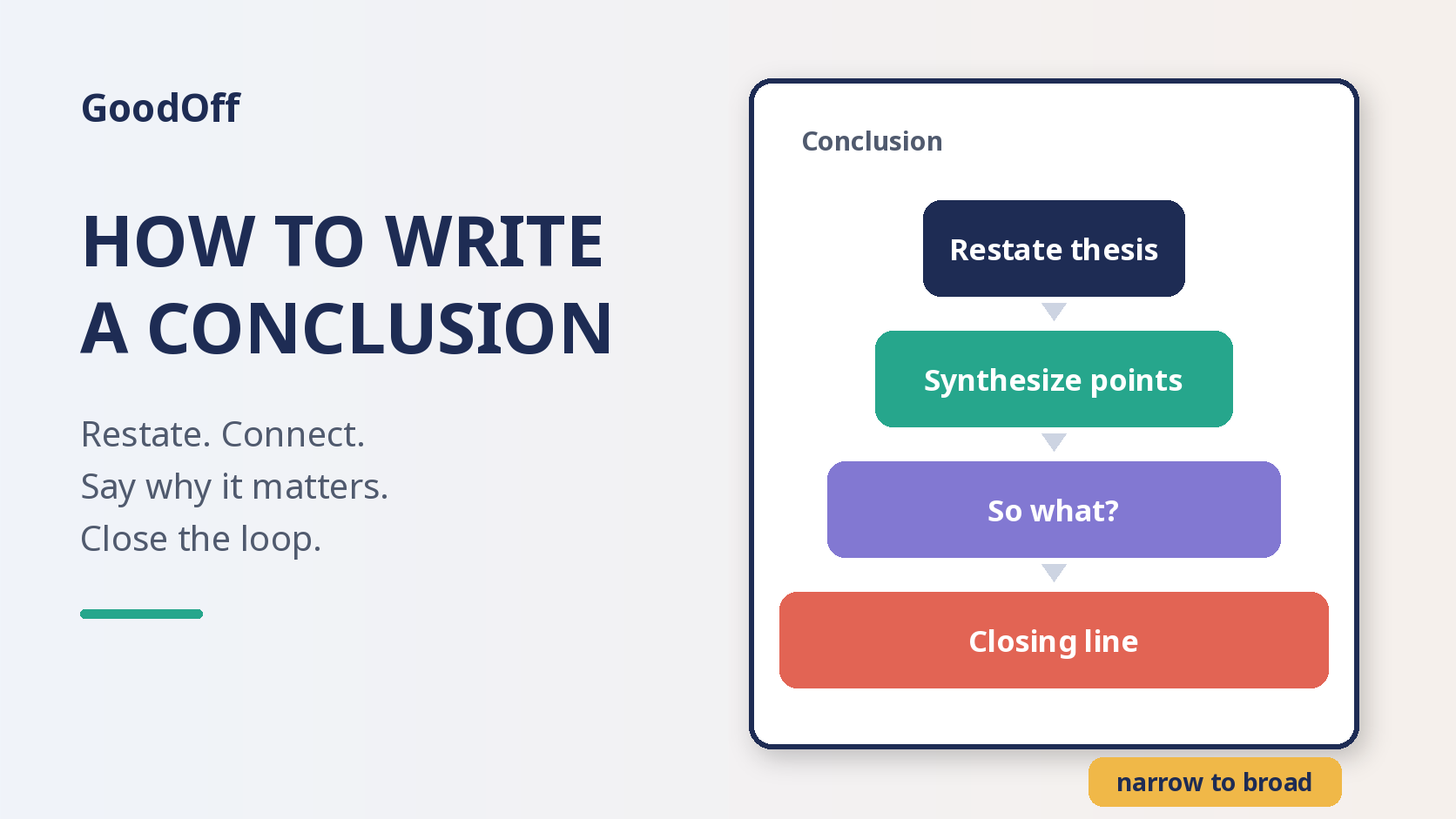
When the paper is done, read your introduction and conclusion side by side. The conclusion should answer what the introduction set up, without repeating it word for word. Our guide on how to write a conclusion shows how to close the loop.
Introduction checklist
Run through this before you submit:
- Does the first sentence connect directly to my topic, not to "society" or "history"?
- Would a classmate who hasn't read my sources understand the context?
- Have I said why the question matters, in at least one sentence?
- Is my thesis at the end, and could someone reasonably disagree with it?
- Does the introduction match what the body actually argues?
- Have I cut any evidence or examples that belong in the body?
- Is every fact in the hook or context backed by a source I can cite?
- Did I follow any discipline-specific rules, like a roadmap sentence or a hypothesis?
Common mistakes
- Starting too broad. If your first sentence could open any paper on any topic, cut it and start with your second sentence.
- Burying the thesis. Readers and graders look for it at the end of the introduction. Don't hide it in the middle.
- Announcing instead of arguing. "This essay will discuss" tells the reader your topic, not your point.
- Front-loading evidence. Quotes and data belong in the body, where you can explain them.
- A hook that goes nowhere. A clever opening that doesn't lead to your thesis just confuses the reader.
- Never revising it. An introduction written before the paper almost always needs updating after.
Where GoodOff fits
GoodOff doesn't write introductions or essays for you. Where it can help is the reading you do before you write. Upload a PDF, your notes or slides and make an AI study guide or FAQ from them, which can help you pull out the main ideas and the open questions in a source before you decide on your angle. The Free plan includes AI decks, quizzes, study guides and FAQs with daily, weekly and monthly limits. On Pro, the Sage tutor answers questions from the source you uploaded and cites the passages it used. AI answers can be wrong, so check anything you plan to cite against the original source.
Frequently asked questions
What are the 4 parts of an introduction?
A hook, context or background, the stakes (why it matters), and the thesis. Some guides combine stakes and context and list three parts. Either way, it moves from general to specific and ends with your claim.
How many sentences should an introduction paragraph have?
For a typical school essay, four to six sentences: one for the hook, two or three for context and stakes, and one or two for the thesis. Longer papers may need more than one paragraph.
Can I start an introduction with a question?
Yes, but use it carefully. A question works when it's specific and your paper clearly answers it. Rhetorical questions like "Have you ever wondered...?" usually sound weak in academic writing.
Should the thesis always be the last sentence of the introduction?
In most essays, yes, or close to it. Some fields add a short roadmap sentence after the thesis. Research papers often end the introduction with a research question or purpose statement instead.
What's the difference between an introduction and an abstract?
An abstract summarizes the whole paper, including methods and results, and stands on its own. An introduction sets up the question and argument and leads into the body. Many journals limit abstracts to about 150 to 300 words.
Is it okay to write the introduction after the body?
Yes, and it's often easier. Start with a working thesis, draft the body, then write or revise the introduction so it matches what you argued.
The bottom line
A good introduction is a funnel: a specific hook, just enough context, one sentence on why it matters, and a clear thesis at the end. Draft it early if that helps you think, but revise it last so it promises exactly the paper you wrote.
Have a stack of sources to read before you can find your angle? Try GoodOff free and turn a PDF into a study guide or FAQ you can work from.
Sources
- Harvard College Writing Center, "Introductions."
- University of Utah Writing Center, "Introductory Paragraphs."
- University of North Carolina at Chapel Hill Writing Center, "Introductions."
- Conestoga College Library, "Essay Structure: Introduction Paragraph."
- University of Maryland Global Campus, "Online Guide to Writing: Getting from Notes to Your Draft."
- Swales JM. Genre Analysis: English in Academic and Research Settings. Cambridge University Press, 1990.