Short answer: to study for a history exam, build a one-page timeline of the period first, then learn each key event as a small story: what caused it, what happened, and what changed because of it. Quiz yourself on those causes and effects instead of rereading, practice the kinds of questions you'll get (source analysis, short answer or essays), and plan an argument for each likely essay topic before the exam. Spread the work over about five days, with the most time on whatever you can't explain from memory.
History exams look like a test of dates and names, and some questions are. But most of the marks usually go to explaining why something happened, comparing two periods, or using evidence to back up a claim. A student who can recite fifty dates but can't explain why the First World War started will lose more points than one who knows twenty dates and the reasons behind them. So the plan below treats facts as the raw material and arguments as the goal.
The Quick Version
- Get the scope. List every topic from the study guide, syllabus or unit titles.
- Build a timeline. One page, in order, with the events you're expected to know.
- Learn events as cause, event, consequence. That's how most questions are framed.
- Test yourself on the "why." Flashcards for facts, blank-page explanations for causes and effects.
- Practice sources and essays. Rehearse the exact question types on your exam.
- Prepare arguments, not scripts. Plan a thesis and three pieces of evidence for each likely essay topic.
Step 1: Make a One-Page Timeline
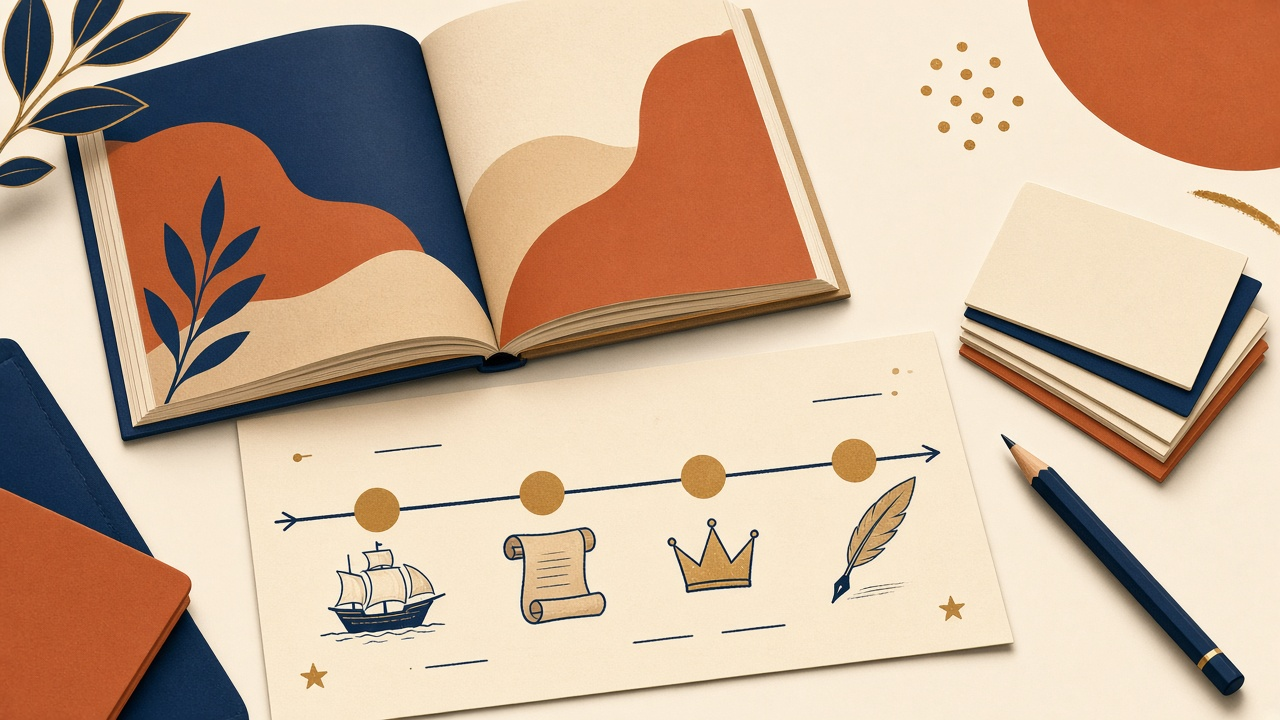
Before you learn any detail, put the whole unit in order on a single page. Draw a line, mark the start and end of the period, and add the 15 to 25 events your teacher spent the most time on. Leave space above and below the line for notes.
This does two things. It shows you the order, which matters because so many history questions hinge on sequence ("Which happened first?" or "What led to...?"). And it gives every new fact a place to attach to. A date you can't place on your timeline is hard to remember. A date sitting between two events you already know is much easier.
Group the timeline into three to five chunks with a short label for each, like "rising tensions," "the war years" and "the settlement." Exams often ask about turning points, and these chunks make them obvious.
Step 2: Learn Each Event as Cause, Event, Consequence
For each event on your timeline, write three short lines:
| Part | Question to answer | Example (the Boston Tea Party, 1773) |
|---|---|---|
| Cause | Why did it happen? | Colonists' anger at the Tea Act and taxation without representation |
| Event | What happened, who was involved, when? | Colonists dumped East India Company tea into Boston Harbor |
| Consequence | What changed because of it? | Parliament passed the Coercive (Intolerable) Acts, which pushed the colonies closer together |
Then link the chains. The consequence of one event is often the cause of the next, and seeing that chain is what turns a list of facts into an explanation. If your timeline starts to look like a row of dominoes, you're doing it right.
Ask "why" at each link. Why did that law cause a protest instead of compliance? Why did that treaty fail? Answering these out loud is a method called elaborative interrogation, and it's close to the exact thinking history essays reward.
Step 3: Use Flashcards for Facts, Blank Pages for Explanations
Some things really do need memorizing: key dates, people, laws, treaties and terms. Put those on flashcards, but make each card carry a little context. "1648: Peace of Westphalia" is weak. "1648, Peace of Westphalia: ended the Thirty Years' War and is often cited as the start of the modern idea of state sovereignty" gives you something to use in an answer.
A few card types work well for history:
- Date to event and event to date. Test both directions.
- Person to significance. Not just who they were, but why they matter for this unit.
- Cause cards. "Give three causes of..." with the answer on the back.
- Comparison cards. "One similarity and one difference between..." for topics your teacher likes to pair.
For bigger questions, use a blank page. Write "Why did the Roman Republic fall?" at the top, close your notes, and write everything you can. Then check and fill gaps in a different color. Quizzing yourself like this works far better than rereading. In a well-known study, Roediger and Karpicke (2006) found that students who practiced recalling a passage remembered more of it a week later than students who spent the same time restudying it. Our guide to quizzing yourself while studying goes deeper.
Step 4: Practice Source Analysis
Many history exams include primary sources: a speech, a cartoon, a letter, a photograph or a table of figures. Questions usually ask what the source shows and how reliable or useful it is. A simple checklist helps you say more than "it's biased":
| Check | What to ask |
|---|---|
| Context | What was happening when this was made? |
| Author | Who made it, and what was their position or interest? |
| Audience | Who was it made for, and how might that shape it? |
| Purpose | Why was it made: to persuade, record, mock, inform? |
| Content | What does it actually say or show, and what does it leave out? |
AP history students will recognize this as close to the HIPP approach (historical situation, intended audience, purpose, point of view). Practice on two or three sources from your unit. Write a short paragraph for each and you'll be far faster on exam day.
Step 5: Prepare Essay Arguments Ahead of Time
You can't know the exact essay question, but you can usually predict the topics. Look at the learning objectives and past papers, then list the five or six big questions the unit keeps coming back to. For each, plan:
- A one-sentence thesis that takes a position, like "Economic pressure did more than ideology to end the conflict."
- Three pieces of specific evidence with dates, names or numbers.
- One counterargument and a sentence on why your view still holds.
Don't memorize whole essays. Questions are worded differently on purpose, and a memorized essay rarely answers the question asked. A planned argument and a bank of evidence adapt to almost any wording. Then write at least one or two full essays under timed conditions. If writing speed is a problem, our post on how to write essays faster has a drafting method that helps.
Most history courses also reward a few kinds of thinking again and again: causation, comparison, and continuity and change over time. If you can say what caused something, how it compares with something similar, and what stayed the same versus what changed, you're covering most of what essay questions ask for.
A 5-Day History Exam Study Plan
| Day | What to do | Time |
|---|---|---|
| 5 days out | List the topics, build the one-page timeline, make flashcards for key facts | 60 min |
| 4 days out | Write cause, event and consequence for each major event, then link the chains | 60 min |
| 3 days out | Flashcard review, blank-page explanations of the three biggest "why" questions | 45 to 60 min |
| 2 days out | Source analysis practice and essay plans for each likely topic | 60 min |
| 1 day out | One timed essay or practice set, then review your misses and redraw the timeline from memory | 60 min |
| Exam day | Quick flashcard pass and the timeline from memory as a warm-up | 15 min |
For a cumulative final, stretch these steps over two to three weeks and revisit earlier units every few days. If you're short on days, our 7-day exam study plan shows how to compress them.
If Your History Exam Is Tomorrow
- Draw the timeline from memory, then fix it from your notes.
- Pick the three or four events worth the most points and write cause, event and consequence for each.
- Plan a thesis and three pieces of evidence for the essay topics you think are most likely.
- Do one quick flashcard pass on dates and names.
- Sleep. You'll recall more rested than after an extra hour of rereading.
Our one-day exam study plan has an hour-by-hour version.
Common Mistakes
- Memorizing dates without reasons. Dates earn a few marks. Explanations earn most of them.
- Rereading the textbook chapter. It feels familiar, but familiar isn't the same as recallable. If you read, use the steps in how to read a textbook and remember it.
- Telling the story instead of answering the question. Narrative is not analysis. Every paragraph should support your thesis.
- Vague evidence. "Things got worse for workers" is weaker than a specific law, date or figure.
- Skipping source practice. Source questions follow a pattern, and that pattern is easy to rehearse.
Where GoodOff Fits
GoodOff can take care of the fact-learning side so you have more time for timelines, sources and essay plans. Upload your lecture slides, a PDF of your notes or a reading, and GoodOff makes editable flashcards, a quiz and a study guide from it. Reviews are scheduled with spaced repetition, and you can ask the Sage AI tutor questions that are answered from your own material. It's free to start.
It won't write your thesis for you, and that's the part that earns the marks. Use it for the dates and names, and do the arguing yourself.
FAQ
How long should I study for a history exam?
For a unit test, four or five days of 45 to 60 minutes each works for most students. For a cumulative final, start two to three weeks ahead and review older units in short rounds.
What's the best way to memorize history dates?
Place each date on a one-page timeline first so it sits between events you already know. Then make flashcards that test date to event and event to date, with one line of context on each card.
How do I study for a history essay exam?
List the likely topics, then plan a thesis, three pieces of specific evidence and one counterargument for each. Write at least one timed essay before the exam instead of memorizing full essays.
How do I remember causes and effects in history?
Write each major event as cause, event and consequence, then connect the chains so one event's consequence becomes the next one's cause. Explain the chain from memory on a blank page and check it against your notes.
Is history more memorization or understanding?
Both, but understanding usually earns more marks. You need dates and names as evidence, but most questions ask you to explain, compare or argue.
Start Studying
Draw your timeline today and write cause, event and consequence for the first three events before you open your notes. If you'd like the dates and names turned into flashcards, you can do that with GoodOff for free.