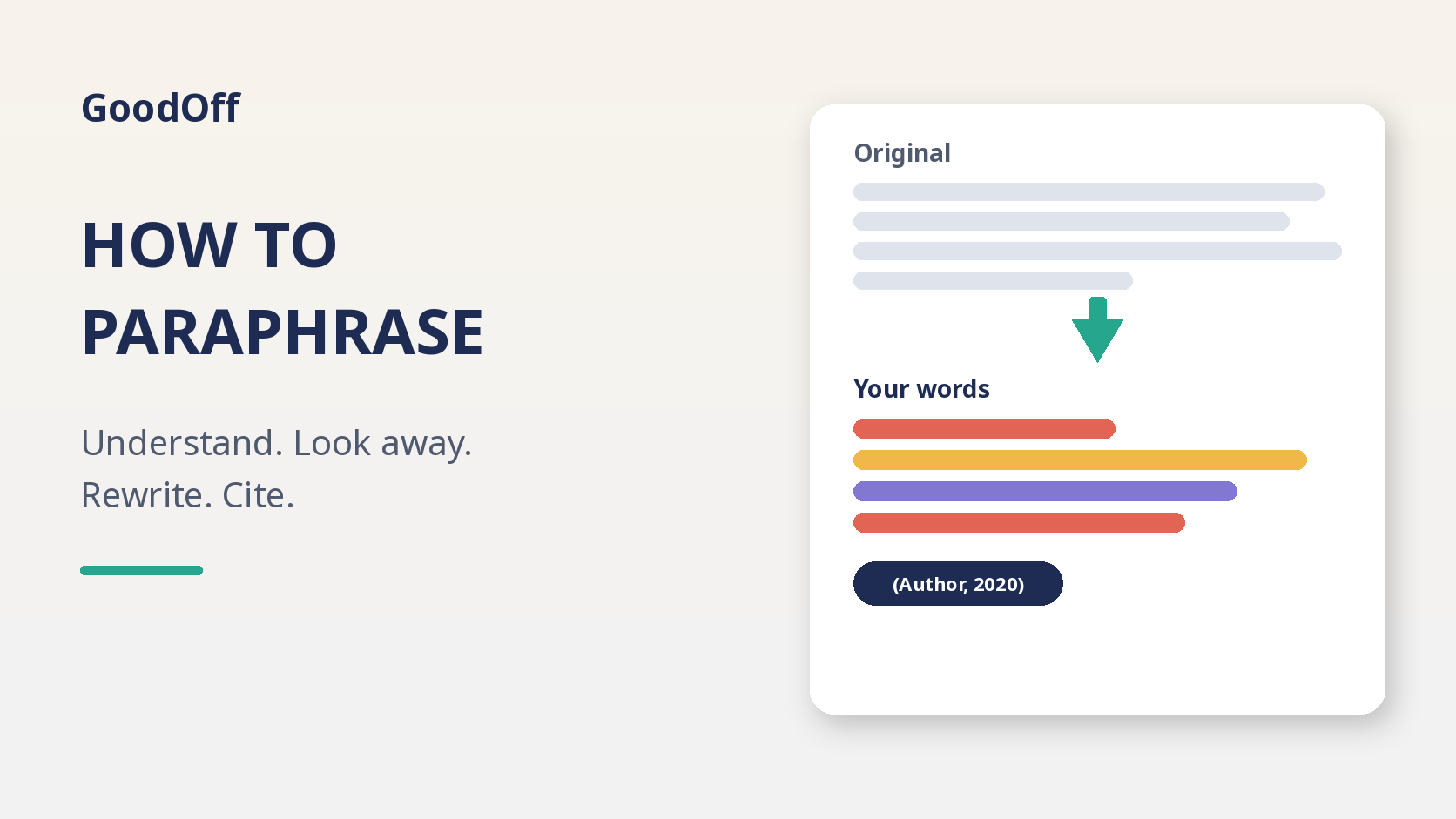
Short answer: to paraphrase, read the passage until you understand it, then look away and write the idea from memory in your own words and your own sentence structure. Compare your version with the original to check that the meaning is the same and that you didn't borrow distinctive phrases. Put quotation marks around any exact wording you kept, and cite the source, because a paraphrase still needs a citation.
The step most students skip is looking away. If the original is in front of you while you write, you end up swapping words one at a time, and that's how a paraphrase turns into accidental plagiarism. This guide walks through the method, a worked example with a good and a bad version, how to cite a paraphrase in APA and MLA, and when you should quote instead.
What is paraphrasing?
Paraphrasing means restating someone else's idea in your own words and your own sentence structure, while keeping the original meaning. The APA Style guidelines describe it as restating another person's idea in your own words, and they note that published authors paraphrase their sources most of the time rather than quoting them directly. Students are encouraged to do the same.
A paraphrase is roughly the same length as the passage it covers, or a little shorter. That's what separates it from a summary, which compresses a longer stretch of text down to its main point.
Paraphrase vs. summary vs. quotation
| Technique | Your words? | Length | Needs a citation? |
|---|---|---|---|
| Quotation | No, the exact original wording in quotation marks | Same as the original | Yes, usually with a page number |
| Paraphrase | Yes, new wording and new structure | About the same as the passage | Yes |
| Summary | Yes | Much shorter, main idea only | Yes |
Notice the last column. All three need a citation. Changing the words doesn't make the idea yours.
Why paraphrase instead of quoting?
Purdue OWL gives three good reasons. Paraphrasing is better than quoting a passage that isn't memorable on its own, it keeps you from stuffing a paper with quotations, and the effort of rewriting a passage forces you to understand it fully.
That last reason matters most for studying. You can copy a sentence you don't understand. You can't paraphrase one. If you get stuck halfway through a paraphrase, that's a sign you need to reread the source, not a sign you need a thesaurus.
How to paraphrase in 6 steps
1. Read the passage until you understand it
Read it at least twice. Look up any terms you don't know. Then try to say the main point out loud in one sentence. If you can't, you're not ready to paraphrase yet. If the passage comes from a dense journal article, it helps to know how to read a research paper first, so you know which parts actually matter.
2. Write down the key ideas, not the sentences
Jot two or three short notes: who did what, what was found, and why it matters. Use fragments and abbreviations. The goal is to capture the ideas without capturing the author's phrasing.
3. Look away and write your version
Cover the original or switch tabs. Using only your notes, write the idea as you'd explain it to a classmate. Purdue OWL's advice is the same: set the original aside before you write. This is the step that does most of the work, because your brain can't copy what it can't see.
4. Change the structure, not just the words
A real paraphrase usually reorders the ideas, splits or combines sentences, or starts from a different point. If your version follows the original clause by clause, it's still too close, even if every word is different.
5. Compare it with the original
Now put the two side by side. Check two things. First, is the meaning the same, with nothing added, dropped or exaggerated? Second, did any distinctive phrase slip through? Common words like "students" or "memory" are fine. A memorable phrase or a technical term the author coined should either be changed or put in quotation marks.
6. Cite it
Add the in-text citation right away and add the source to your reference list. Harvard's Guide to Using Sources warns against saving citations for later, because that's how students lose track of which ideas came from where. If you're also building an annotated bibliography, log the source there at the same time.
Paraphrasing example: good vs. bad
Here's a short sample passage written for this guide. Treat it as if it came from a textbook by an author we'll call Author (2020), page 45.
| Version | Text | Verdict |
|---|---|---|
| Original | Students who test themselves on material tend to remember it longer than students who simply reread it, even though rereading often feels more productive at the time. | The source |
| Word swap (patchwriting) | Learners who quiz themselves on content usually recall it longer than learners who just reread it, even though rereading frequently feels more useful in the moment. | Too close. Same structure, synonyms swapped in. Still plagiarism without quotation marks, and weak even with a citation. |
| Missing citation | Rereading feels productive, but self-testing usually leads to longer-lasting memory. | Good wording, but presenting someone else's idea with no citation is plagiarism. |
| Good paraphrase | Rereading can feel like the more productive way to study, but according to Author (2020), testing yourself tends to make information stick longer (p. 45). | New structure, new wording, same meaning, cited. |
The word-swap version is the most common mistake. Writing teachers often call it patchwriting. It usually comes from writing with the source open and replacing words one at a time. The fix is step 3: look away.
How to cite a paraphrase in APA and MLA
| Style | Basic format | Page number? |
|---|---|---|
| APA 7 | Narrative: Author (2020) found that... Parenthetical: ...over time (Author, 2020). | Not required for a paraphrase, but you may add one, for example (Author, 2020, p. 45), when it helps readers find the passage in a long work like a book. |
| MLA 9 | Narrative: Author argues that... (45). Parenthetical: ...over time (Author 45). | Yes, when the source has page numbers. Leave it out if the source has none, such as many web pages. |
Long paraphrases
If your paraphrase runs several sentences, you don't need a citation after every one. APA says to cite the work on first mention and not repeat it as long as it's clear you're still paraphrasing the same source. Reintroduce the citation if the paraphrase continues into a new paragraph or switches sources. The MLA Style Center gives similar advice: put the citation after the final sentence, and name the author at the start if readers might not see where the source's idea begins.
When to quote instead of paraphrase
Paraphrase is the default, but a direct quotation is the better choice when:
- The exact wording is the point, such as a definition, a law, or a line you're analyzing in a literature essay.
- The phrasing is so precise or memorable that any rewrite would lose something.
- You're about to disagree with the author and want to show you're not misrepresenting them.
- The passage uses technical language that has no accurate substitute.
Even then, keep quotations short and explain them in your own words afterward. In a literature review especially, you'll mostly paraphrase and compare sources rather than quote them.
Paraphrasing tips that make it easier
- Start from a different point. If the original opens with the cause, open with the effect.
- Change the voice. Switch "researchers found that X" to "X, the researchers found" or turn a passive sentence active.
- Split or join sentences. One long sentence can become two short ones, or the reverse.
- Use the author's name as a frame. Phrases like "Author argues" or "according to Author" make it clear where the source's idea starts.
- Don't paraphrase what you don't understand. Go back to the source. A confused paraphrase is worse than a short quotation.
- Keep notes and draft separate. Harvard's guide recommends paraphrasing in your notes first, then working from those notes when you draft.
Can you use a paraphrasing tool or AI?
Be careful here. Paraphrasing tools reword text, which is close to the word-swap mistake shown above, only faster. Many schools treat running a source, or someone else's work, through a rewording tool and submitting the result as academic misconduct, and some ban AI writing tools for graded work entirely. Policies differ by school and by class, so check your syllabus or ask your instructor before using one.
Even where it's allowed, a tool can't confirm that it kept the meaning right, and it won't help you understand the source. A safer use of AI is to check your understanding: ask questions about a passage, then write the paraphrase yourself.
Common paraphrasing mistakes
- Swapping synonyms into the original sentence structure.
- Forgetting the citation because "it's in my own words now."
- Changing the meaning, for example turning "tends to" into "always."
- Adding your own opinion inside the paraphrase so readers can't tell where the source ends and you begin.
- Stringing paraphrases together with no analysis of your own. Harvard's guide warns against this too.
- Keeping a distinctive phrase from the original without quotation marks.
Quick paraphrase checklist
- I can explain the passage without looking at it.
- I wrote my version with the original out of sight.
- The sentence structure is different, not just the words.
- The meaning matches the original, with nothing added or exaggerated.
- Any exact phrase I kept is in quotation marks.
- There's an in-text citation and a reference list entry.
Where GoodOff can help
GoodOff won't paraphrase or write your paper. The part it helps with is understanding the source before you write about it.
You can upload a PDF, notes or slides to GoodOff and generate an AI study guide or FAQ to see the main points. Sage, GoodOff's AI tutor, answers questions from the source you uploaded and cites the passages it used, so you can ask what a confusing paragraph means and then check the answer against the text. The Free plan includes AI decks, quizzes, study guides and FAQs with daily, weekly and monthly limits.
Once you understand the passage, close the app and write the paraphrase yourself.
FAQ
Do you need to cite a paraphrase?
Yes. A paraphrase uses someone else's idea, so it needs an in-text citation and a reference list entry, just like a quotation. Only the quotation marks are dropped.
How many words can you keep from the original?
There's no official number. Common words and basic terms like "memory" or "photosynthesis" are fine. Any distinctive phrase that belongs to the author should be reworded or put in quotation marks. Some instructors use a rough rule of three or more identical words in a row, but your school's policy is what counts.
Is changing a few words enough to paraphrase?
No. Swapping words while keeping the original structure is patchwriting, and it can still count as plagiarism. Change the structure and the wording, then cite the source.
What's the difference between paraphrasing and summarizing?
A paraphrase restates a specific passage in detail at about the same length. A summary condenses a longer text down to its main idea. Both need citations.
Do you need a page number when paraphrasing in APA?
Not required in APA 7, though you can include one when it would help readers find the passage in a long work. MLA expects a page number whenever the source has one.
How do you paraphrase a quote?
Treat it like any other passage: understand it, look away, rewrite it in your own words and structure, then cite the original speaker or author. If the exact wording matters, keep it as a quotation instead.
Bottom line
A good paraphrase keeps the meaning and changes everything else: the words, the structure and the starting point. Understand the passage, look away, write it from memory, compare, and cite. If you're tempted to swap synonyms with the source open, stop and go back to step 3. For more on turning sources into a finished paper fast, see how to write essays faster.
Want to understand your sources before you write? Try GoodOff free: upload a reading, get a study guide, and ask Sage about the parts that confuse you.
Sources
- American Psychological Association. "Paraphrases." APA Style, apastyle.apa.org (Publication Manual, 7th ed., Sections 8.23 and 8.24).
- Purdue OWL. "Paraphrasing." owl.purdue.edu
- Harvard College Writing Program. "How to Avoid Plagiarism." Harvard Guide to Using Sources, usingsources.fas.harvard.edu
- MLA Style Center. "In-Text Citations: An Overview" and "If my paraphrase consists of several sentences, should a citation for the original source appear after each sentence?" style.mla.org