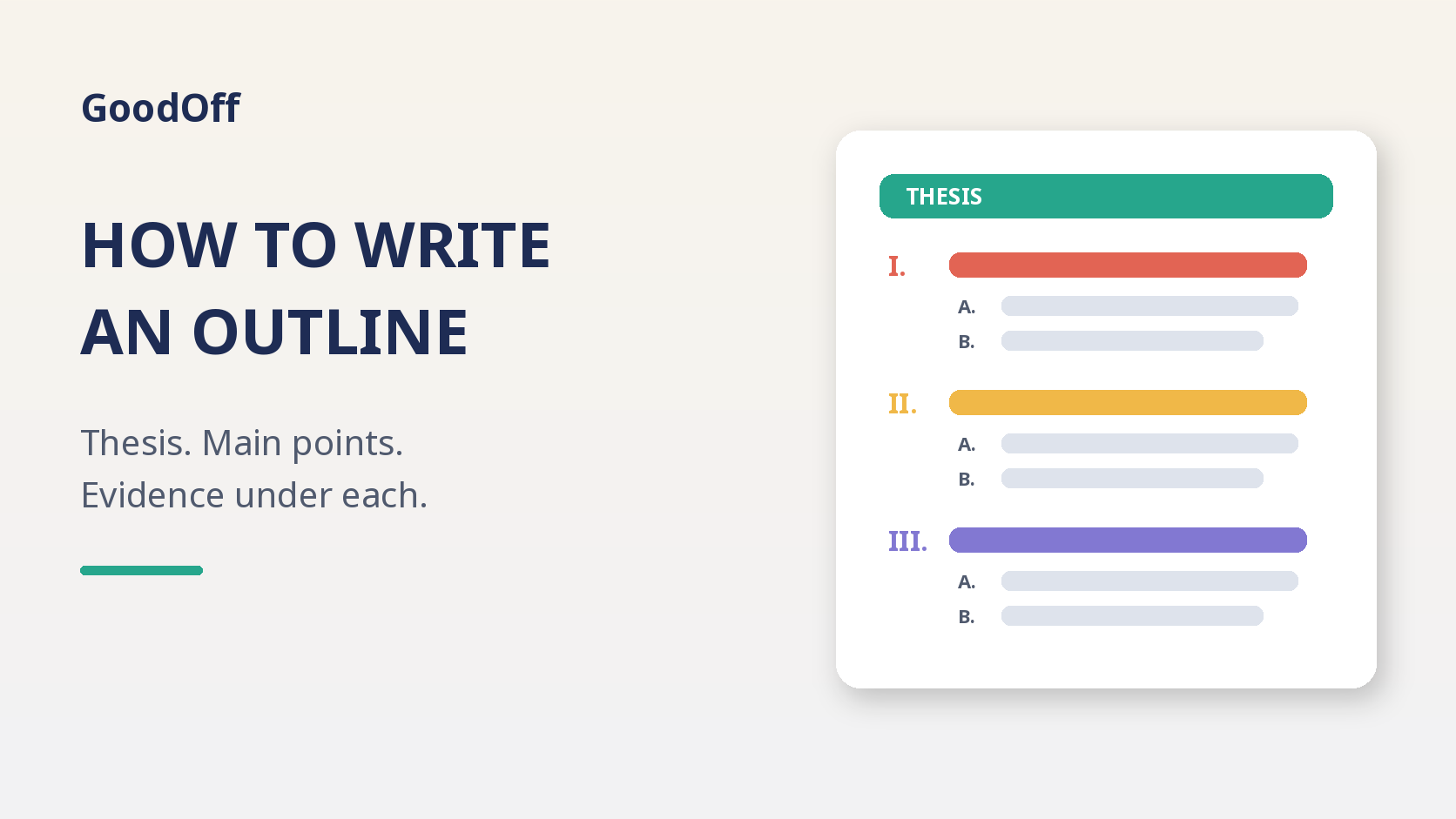
Short answer: To write an outline, start with a working thesis, list every point you want to make, group related points into three or four main sections, put the sections in a logical order, then add the evidence each section needs underneath it. Use Roman numerals for main points, capital letters for supporting points and numbers for evidence, and keep each level parallel.
An outline is the plan for your paper. It lets you see the whole argument on one page before you've written a single paragraph, which is the cheapest time to notice that point three repeats point one or that you have no evidence for point two. Fixing that in an outline takes five minutes. Fixing it in a finished draft can take an evening.
This guide walks through five steps, the three outline formats teachers usually ask for, a full worked example for a five-paragraph essay, a research paper template, and a checklist you can run before you start drafting.
What an outline is (and what it isn't)
An outline is a ranked list of your ideas. The top level holds your main points. Each level below holds the support for the point above it. The Purdue OWL describes outlines as a way to show the "hierarchical relationship or logical ordering of information," and that's the job: who supports whom, and in what order.
Here's the fuller answer. An outline isn't a rough draft, and it isn't a list of topics. "Causes" is a topic. "Cheap cotton from the South made factory work profitable in New England" is a point you can build a paragraph around. The more your outline is made of points instead of topics, the faster the draft goes, because each line already tells you what the paragraph has to prove.
| Outline level | What goes there | Becomes in the draft |
|---|---|---|
| Thesis (top) | Your one-sentence main claim | Last line or two of the introduction |
| I, II, III | Main points that prove the thesis | Topic sentences of body paragraphs or sections |
| A, B, C | Reasons or sub-points | The middle of each paragraph |
| 1, 2, 3 | Evidence: quotes, data, examples | Specific sentences with citations |
How to write an outline in 5 steps
Purdue's guide lists the setup as purpose, audience and thesis, then brainstorm, organize, order and label. Here's that process turned into steps you can do in about 20 to 30 minutes for a standard essay.
Step 1: Write a working thesis
Before you outline anything, write one sentence that answers the assignment question. It doesn't need to be final. It needs to be specific enough that you can tell which ideas belong in the paper and which don't. If you're stuck here, our guide on how to write a thesis statement has a four-step method and fill-in formulas.
Step 2: Brain dump every point
Set a timer for 10 minutes and list everything you might say: arguments, examples, quotes you highlighted, counterarguments, a statistic you remember from lecture. Don't judge or order anything yet. A messy list of 15 to 25 items is normal for a 1,000-word essay.
Step 3: Group points into main sections
Look for items that make the same case and circle them together. Most short essays end up with three groups; longer papers with four to six. Give each group a one-sentence label that makes a claim. Anything that doesn't fit any group is a candidate to cut, or a sign your thesis needs to change.
Step 4: Put the sections in order
Pick an order that helps the reader follow the argument. Common choices:
- Strongest last: start with a solid point, end with your best one. Good for argumentative essays.
- Chronological: earliest to latest. Good for history and process essays.
- Cause to effect: what happened, then why it mattered.
- General to specific: broad idea first, then narrower cases. Good for expository and informative essays.
Step 5: Add evidence under each point
Under every main point, list two or three pieces of support with a short note on where each one came from (author and page, or lecture date). If a point has no evidence under it, you've found your research gap before drafting rather than at midnight the day it's due.
The 3 outline formats teachers ask for
The Purdue OWL describes three common types. They hold the same structure; they just look different on the page.
| Format | How it looks | Best for |
|---|---|---|
| Alphanumeric | I., then A., then 1., then a., with short phrases | Quick planning, most class assignments |
| Full sentence | Same labels, but every line is a complete sentence | Essays where the teacher grades the outline, or when you want topic sentences ready to paste |
| Decimal | 1.0, then 1.1, then 1.1.1 | Long research papers, theses and technical reports with many levels |
If your assignment says "APA outline" or "MLA outline," check for a template from your teacher first. Style guides mostly govern citations and paper formatting, so the outline layout usually comes from your class instructions, not the manual.
The 4 rules that make an outline work
Purdue's "Outline Components" page names four principles. They sound technical, but each one catches a real problem.
- Parallelism: items at the same level use the same grammatical form. If I is a full sentence, II and III should be too.
- Coordination: items at the same level carry roughly the same weight. A single example shouldn't sit at the same level as a main argument.
- Subordination: each lower item supports the one above it. If a sub-point would make sense under a different heading, move it.
- Division: if you split a point, split it into at least two parts. An A with no B usually means the sub-point should merge into its heading.
Example: a full outline for a five-paragraph essay
Assignment: "Should high schools start later in the morning? Take a position." Here's a full-sentence outline. The facts in it are placeholders you'd need to confirm and cite from your own sources.
| Level | Outline line |
|---|---|
| Thesis | High schools should start no earlier than 8:30 a.m. because teens' sleep timing shifts later, later starts are linked to better attendance, and the main cost, bus schedules, can be solved. |
| I. Intro | Hook with a specific scene (a 6:15 a.m. bus stop), context on current start times, thesis. |
| II. | Teen sleep timing shifts later during puberty, so early starts fight biology. |
| A. | Sleep research on adolescent circadian timing (cite a source). |
| B. | Recommended sleep hours for teens vs what a 7:30 start allows (cite a source). |
| III. | Districts that moved start times later report better attendance and fewer tardies. |
| A. | One district case study with numbers (cite). |
| B. | A second, different kind of district, so it isn't one lucky example. |
| IV. | The strongest objection, bus and sports schedules, has workable fixes. |
| A. | Counterargument stated fairly. |
| B. | Tiered bus routes or flipped elementary schedules as a response. |
| V. Conclusion | Restate the claim in new words, answer "so what" for students and parents, end on the bus-stop image. |
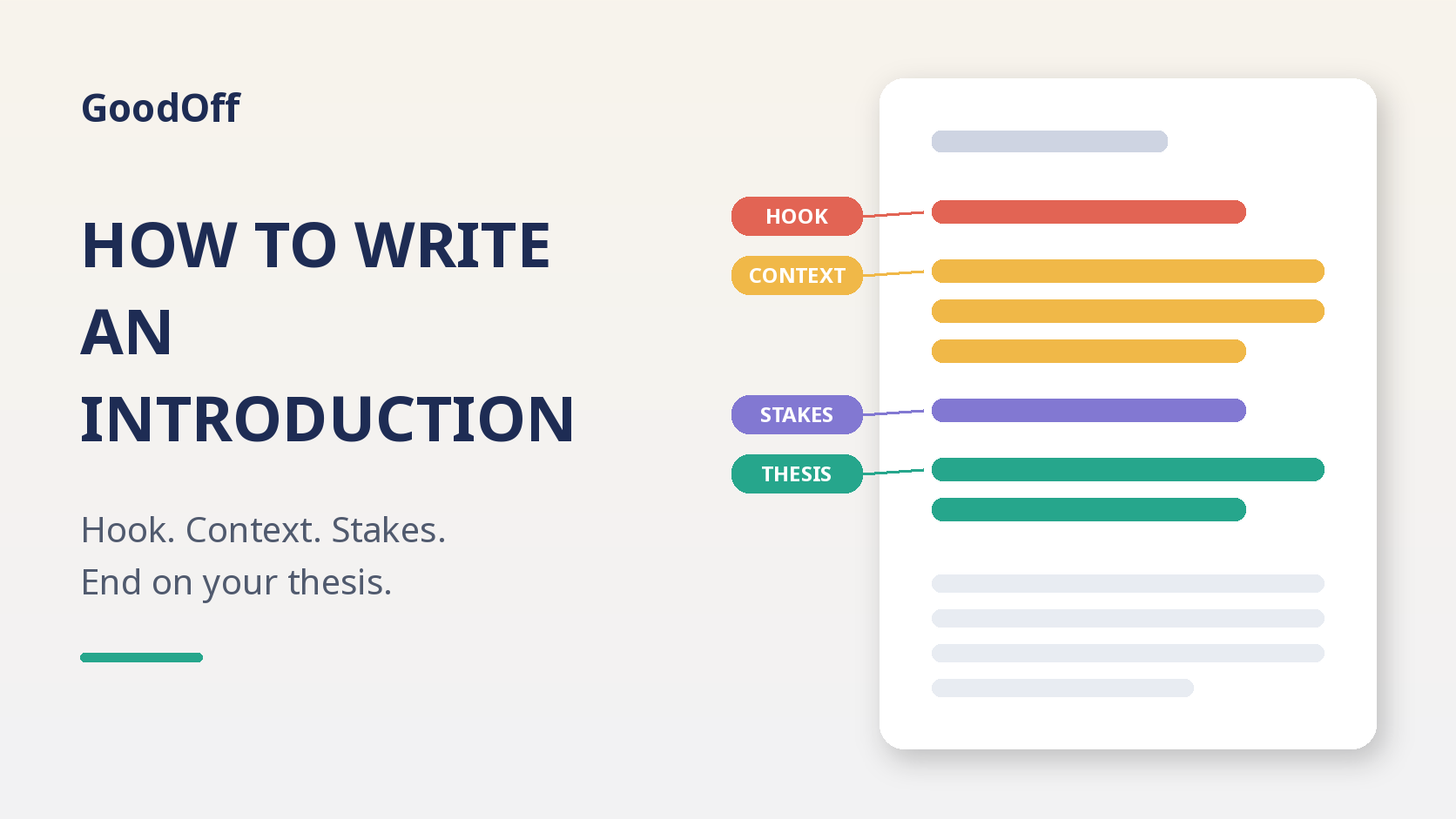
Notice that each Roman numeral line is already a topic sentence. When you draft, you can paste it in and write the paragraph around its A and B. For the opening and closing rows, see how to write an introduction and how to write a conclusion.
Research paper outline template
Research papers in the sciences and social sciences often follow a fixed section order, so the outline is mostly about what goes inside each section.
| Section | What to list in your outline |
|---|---|
| 1.0 Introduction | Topic, gap in what's known, research question or thesis |
| 2.0 Background or literature review | 3 to 5 themes from your sources, each with the key studies under it |
| 3.0 Methods (if you collected data) | Who or what you studied, how, and how you analyzed it |
| 4.0 Findings or analysis | One sub-heading per main finding or argument, evidence under each |
| 5.0 Discussion | What the findings mean, limitations, how they answer the question |
| 6.0 Conclusion | Main takeaway and what should be studied or done next |
For a humanities research paper with no methods section, replace 3.0 to 5.0 with your main arguments as numbered sections, each with sources listed underneath.
Outlines for other assignments
| Assignment | Outline focus |
|---|---|
| Argumentative essay | Claim, 2 to 3 reasons with evidence, a counterargument and your rebuttal |
| Expository or informative essay | Main subtopics in a logical order; no counterargument needed |
| Compare and contrast | Pick point-by-point (each paragraph compares both on one trait) or block (all of A, then all of B) |
| Speech or presentation | Fewer points, short phrases you can glance at, and a note where each slide changes |
| Timed essay exam | A 2 to 3 minute scratch outline: thesis plus three words per paragraph |
Already wrote a draft? Try a reverse outline
If you drafted first, outline afterward. Write one line in the margin for each paragraph saying what it argues. Then read only the margin notes. You'll quickly see paragraphs that make two points, paragraphs that repeat each other, and sections in the wrong order. UNC's Writing Center calls this a reverse outline and recommends it for checking repetition, gaps and order. It pairs well with a fast first draft like the one in our guide on writing essays faster.
Outline checklist
- Is there a one-sentence thesis at the top?
- Does every main point make a claim, not just name a topic?
- Does each main point clearly support the thesis?
- Does every main point have at least two pieces of evidence, with where each came from?
- Are items at the same level parallel in form and similar in weight?
- Does every split point have at least an A and a B?
- Is there a reason for the order, and could you say it in one sentence?
- For an argument, is there a counterargument with a response?
Common mistakes
- Outlining topics, not points. "Economy" tells you nothing when you sit down to write. "The war shifted factory jobs to women" does.
- Too much detail too early. If your outline is longer than half the paper, you're drafting in the wrong format.
- No evidence column. An outline without sources hides the weakest part of the paper until it's too late.
- Treating the outline as fixed. If the draft finds a better argument, update the outline and the thesis rather than forcing the paper back to the plan.
- Skipping it for short essays. Even a two-minute scratch outline stops a 500-word essay from wandering.
Where GoodOff fits
GoodOff doesn't write outlines or essays for you. It can help with the reading that feeds your evidence column. Upload a PDF, your notes or slides and make an AI study guide or FAQ from them, which can help you spot the main ideas in a source before you decide where each one goes in your outline. The Free plan includes AI decks, quizzes, study guides and FAQs with daily, weekly and monthly limits. The Sage tutor answers questions from the source you uploaded and cites the passages it used, which makes it easier to find the page you need when you add a citation. AI answers can be wrong, so check anything you plan to cite against the original.
Frequently asked questions
What are the main parts of an outline?
A thesis at the top, main points (usually Roman numerals), supporting points under each (capital letters), and evidence or examples under those (numbers). Essay outlines also include an introduction and conclusion entry.
How long should an outline be?
For a 1,000 to 1,500 word essay, about half a page to a page. For a 10-page research paper, two to three pages is common. If it's approaching the length of the paper, cut it back to points and evidence.
Should an outline use full sentences?
Use full sentences if your teacher asks for a full-sentence outline or if you want ready-made topic sentences. Short phrases are fine for personal planning and timed exams.
How many main points should an essay outline have?
Three is standard for a five-paragraph essay. Longer essays and research papers often have four to six main sections. Pick the number your argument needs, not a fixed count.
Do I put the introduction and conclusion in the outline?
Yes. List the hook idea, key context and thesis under the introduction, and the main takeaway under the conclusion. You don't need to write them out in full yet.
Is it better to outline before or after writing?
Before, for most students, because it catches structural problems early. If you think best by drafting, write first and then make a reverse outline to check the structure.
The bottom line
To write an outline, start from a working thesis, dump every idea, group them into three or four claims, order them on purpose, and list evidence under each one. Keep levels parallel, split points into at least two parts, and update the plan when the draft teaches you something better.
Have a pile of sources to get through before you can fill in your evidence? Try GoodOff free and turn a PDF into a study guide or FAQ you can outline from.
Sources
- Purdue Online Writing Lab, "How to Outline."
- Purdue Online Writing Lab, "Types of Outlines."
- Purdue Online Writing Lab, "Outline Components" (parallelism, coordination, subordination, division).
- University of North Carolina at Chapel Hill Writing Center, "Reorganizing Drafts" (reverse outlining).