Short answer: to write an annotated bibliography, find and read your sources, cite each one in the style your instructor wants (APA, MLA or Chicago), and write a short paragraph under each citation. That paragraph, the annotation, usually runs about 100 to 200 words. It summarizes the source, judges how reliable and useful it is, and says how it fits your research. Then put the entries in alphabetical order by author.
That's the whole job. The hard part is writing annotations that actually say something, so most of this guide is about that: what goes in one, how long it should be, how the formats differ, and a full example you can model.
What is an annotated bibliography?
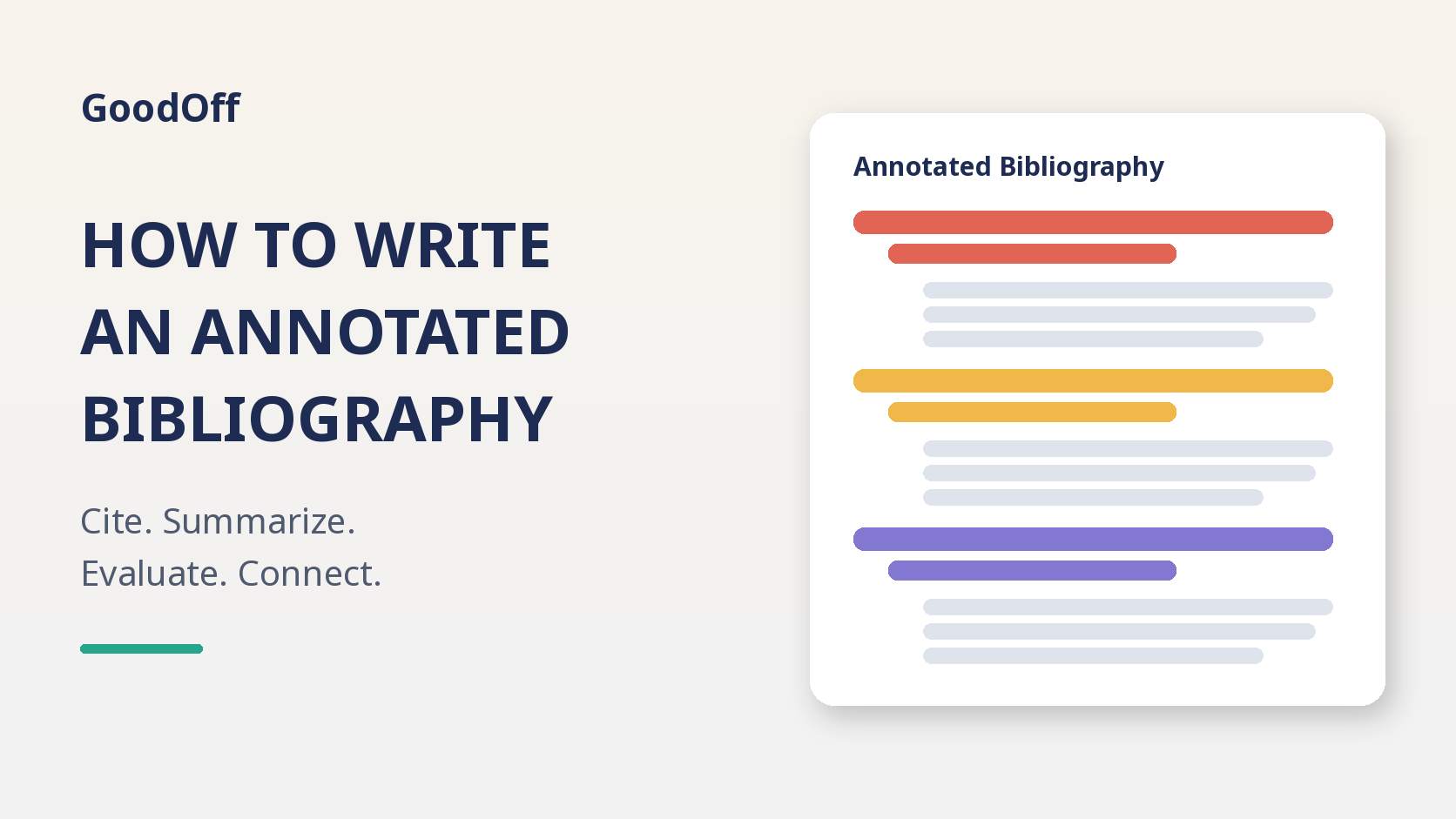
An annotated bibliography is a list of sources where every citation is followed by a short paragraph about that source. A normal reference list tells a reader where to find a book or article. The annotation tells them what's in it and whether it's worth their time.
Cornell's library guide describes the annotation as a brief descriptive and evaluative paragraph, usually about 150 words, meant to tell the reader about the relevance, accuracy and quality of the source. That's a good working definition.
Teachers assign them for a practical reason. When you have to write a few sentences about each source, you can't just collect PDFs and skim titles. You have to read, decide what each source argues, and notice where sources agree or clash. That's most of the thinking a research paper needs.
Annotation vs. abstract vs. summary
| Type | Who writes it | What it does |
|---|---|---|
| Abstract | The source's own authors | Describes their own work. Purely descriptive, no judgment. |
| Summary | You | Restates the main points in your words. |
| Annotation | You | Summarizes, and usually also evaluates the source and connects it to your topic. |
Copying or lightly rewording a journal abstract isn't an annotation. Your teacher will usually spot it, and it skips the part that makes the assignment useful. If you're curious how abstracts are built, see our guide on how to write an abstract.
What goes in an annotation
Purdue OWL boils annotations down to three jobs: summarize, assess and reflect. Most assignments want some mix of the three.
| Part | Question it answers | Typical length |
|---|---|---|
| Summary | What's the main argument or finding, and how did the authors get there? | 2 to 3 sentences |
| Evaluation | Who wrote it, how strong is the evidence, what are the limits or biases? | 1 to 2 sentences |
| Comparison | How does it relate to other sources on your list? | 1 sentence |
| Use | How will this source help your paper, or why won't it? | 1 to 2 sentences |
The UNC Writing Center's list of possible elements also includes the author's point of view or likely audience. You don't need every element in every annotation. Read the assignment for clue words. "Summarize" or "describe" points to summary annotations. "Evaluate," "critique" or "analyze" means your teacher wants judgment, not just a recap.
The three common types
- Descriptive (or informative): summary only. Common in APA-style science and social science classes.
- Evaluative (or critical): summary plus your judgment of the source's quality and usefulness. This is what most college assignments mean when they don't specify.
- Reflective: summary plus how the source fits your own project. Useful when the bibliography is a step toward a paper you're about to write.
How to write an annotated bibliography in 6 steps
Step 1: Pin down your research question
You can't judge whether a source is useful until you know what it's useful for. Write your topic as a question first, even a rough one. "How does note-taking method affect what students remember from lectures?" gives you something to measure every source against. If you're stuck here, our guide on how to write a research question walks through it.
Step 2: Gather more sources than you need
If the assignment asks for eight sources, collect twelve to fifteen candidates. Some will turn out to be off topic, outdated or weak. Cornell's guide suggests briefly examining the actual items, then picking the ones that give you a variety of perspectives. A list where every source says the same thing makes for a thin paper later.
Step 3: Read each source actively
For journal articles, you don't need to read every word in order. Read the abstract, introduction and conclusion first, then the methods and results with your question in mind. Our 3-pass method for reading a research paper works well here.
While you read, jot down four things on a scrap page or in your notes app:
- The main claim, in one sentence and in your own words.
- The evidence: study design, sample, data or type of argument.
- One strength and one limitation.
- Where it agrees or disagrees with another source on your list.
Those four notes are basically your annotation. Writing it becomes cleanup instead of rereading.
Step 4: Write the citation
Cite the source exactly as you would in a reference list or works cited page. Use the style your instructor names. If they don't name one, ask. Citation generators are fine for a first draft, but check the output. They often get capitalization, missing DOIs and author names wrong.
Step 5: Write the annotation
Start with the summary, move to evaluation, and end with how you'll use it. A simple pattern that works for most evaluative annotations:
- Sentence 1: what the source does and finds.
- Sentences 2 to 3: how, and the key details that matter for your question.
- Sentence 4: a strength or limitation, or the authors' credibility.
- Sentence 5: how it compares to another source.
- Sentence 6: how you'll use it in your paper.
Write in your own words and in full sentences, unless your teacher asks for the shorter phrase style some MLA guides mention. Don't pile quotes into an annotation. The point is to show you understood the source.
Step 6: Format and order the list
Put the entries in alphabetical order by the first author's last name, the same way you'd order a reference list. Double-space everything unless told otherwise, and apply the indent rules for your style (see the table below). Then do a final pass to make sure every annotation is about the same length and the same type.
Example of an annotated bibliography entry
Here's one evaluative entry in APA 7 style, built from a real study. In a document, the citation would have a hanging indent and the annotation would sit below it as an indented block.
| Part | Text |
|---|---|
| Citation | Mueller, P. A., & Oppenheimer, D. M. (2014). The pen is mightier than the keyboard: Advantages of longhand over laptop note taking. Psychological Science, 25(6), 1159-1168. https://doi.org/10.1177/0956797614524581 |
| Annotation | Mueller and Oppenheimer ran three experiments comparing students who took lecture notes on laptops with students who wrote them by hand. Even when the laptops were used only for notes, laptop users did worse on conceptual questions, and their notes contained more word-for-word transcription of the lecture. The authors argue that typing encourages shallow, verbatim copying, while writing by hand forces students to put ideas in their own words. The study is widely cited and the experiments are clearly described, but the participants were university students watching short recorded talks in a lab, which limits how far the results generalize to real courses. A direct replication by Morehead et al. (2019) found that performance did not consistently differ between groups. I'll use this study as the main argument for longhand notes and pair it with the replication to show the evidence is mixed. |
That annotation is about 150 words. Notice what each sentence does. The first two summarize, the third explains the authors' reasoning, the fourth evaluates, the fifth compares, and the last says how the source will be used.
Here's what a weak version of the same annotation looks like: "This article is about laptops and note taking. It found that handwriting is better. It was very interesting and helpful for my paper." It names the topic but doesn't say how the study worked, how strong it is, or what you'll do with it.
APA vs. MLA vs. Chicago formatting
Your instructor's rules always win. When they don't give any, these are the usual defaults.
| Detail | APA 7 | MLA 9 | Chicago |
|---|---|---|---|
| Page title | Set by your instructor; "Annotated Bibliography" or "References" are both common | "Annotated Bibliography" or "Annotated List of Works Cited" | Usually "Annotated Bibliography" |
| Citation | Same as a reference list entry, 0.5 in. hanging indent | Same as a works cited entry, 0.5 in. hanging indent | Same as a bibliography entry, hanging indent |
| Annotation placement | New paragraph below the reference | Below the citation | New paragraph below the citation |
| Annotation indent | Whole block indented 0.5 in., first line not extra indented | Whole block indented 1 in. from the left margin | Varies; check your instructor or school guide |
| Order | Alphabetical by author | Alphabetical by author or title, or by date or subject | Alphabetical by author |
| Spacing | Double-spaced | Double-spaced | Varies by instructor |
The APA rules come from Section 9.51 of the APA Publication Manual (7th edition), as summarized by many university library guides. APA also notes that you don't need to cite the source inside its own annotation, but you should add in-text citations if you mention other works. The MLA rules come from Section 5.132 of the MLA Handbook (9th edition). Chicago has less fixed guidance for annotations, so school-specific instructions matter more there.
How long should an annotation be?
Most student annotations land between 100 and 200 words, which is one solid paragraph. Some library guides give a wider range, like 50 to 200 words. Purdue OWL notes that length depends on the purpose: a few sentences for a quick summary list, much longer for a detailed analysis.
| Assignment | Typical annotation length |
|---|---|
| High school or intro college class | 75 to 150 words |
| Standard college research paper | 100 to 200 words |
| Graduate seminar or thesis prep | 150 to 300 words, sometimes more |
These are common ranges, not rules. If the assignment gives a word count, use it.
Annotated bibliography vs. literature review
They use the same sources, but they're organized differently. An annotated bibliography deals with one source at a time. A literature review is organized by theme or argument and weaves several sources into each paragraph. Many students write an annotated bibliography first, then use the comparison sentences in it as the skeleton for the review. Our guide on how to write a literature review shows how to make that jump.
Common mistakes
- Pasting the abstract. It's not your writing, and it has no evaluation.
- Annotating sources you haven't read. Vague annotations give this away fast.
- All summary, no judgment, when the assignment asks for evaluation.
- Inconsistent length, with one 300-word annotation and one two-liner.
- Citation errors copied straight from a generator: wrong capitalization, missing DOI, "et al." where full author names belong.
- Wrong order. Entries in the order you found them instead of alphabetical.
- Too many quotes. Paraphrase instead.
Annotated bibliography checklist
- Every source is relevant to your research question.
- Each citation matches the required style.
- Each annotation summarizes the main point in your own words.
- Each annotation evaluates the source, if the assignment asks for it.
- At least some annotations compare sources to each other.
- Each annotation says how you'll use the source.
- Annotations are a similar length and within any word limit.
- Entries are in alphabetical order, double-spaced, with correct indents.
Where GoodOff can help
GoodOff doesn't write annotations or format citations. That part should be yours anyway, since the annotation is where you show you understood the source. Where it can help is the reading.
You can upload a PDF, notes or slides to GoodOff and generate an AI study guide or FAQ from it to see the main points at a glance. Sage, GoodOff's AI tutor, answers questions from the source you uploaded and cites the passages it used, so you can check your summary against what the paper actually says. The Free plan includes AI decks, quizzes, study guides and FAQs with daily, weekly and monthly limits.
Then close the app and write the annotation yourself.
FAQ
How many sources should an annotated bibliography have?
Whatever the assignment says. Common requests are 5 to 15 sources for a class paper. If there's no number, ask, or aim for enough sources to cover the main sides of your question.
Do you write an annotated bibliography in first person?
It depends on the type. Descriptive annotations usually stay in third person. Reflective annotations often use "I" when explaining how you'll use the source, as in the example above. Check your instructor's preference.
Is an annotated bibliography one paragraph per source?
Usually, yes. APA and MLA both allow more than one paragraph, with an extra indent on the first line of later paragraphs, but most class assignments expect one.
Does an annotated bibliography need an introduction?
Not by default. Some instructors ask for a short introduction that states your topic and how you chose sources. If they do, keep it to a paragraph.
Can I use a citation generator?
Yes, for the citations, as long as you check every one against your style guide. Don't use AI tools to write the annotations themselves. That defeats the purpose and may break your school's academic integrity rules.
What's the difference between a bibliography and an annotated bibliography?
A bibliography lists sources with citation details only. An annotated bibliography adds a paragraph under each citation that describes and often evaluates the source.
Bottom line
An annotated bibliography is a list of citations, each with a short paragraph that summarizes the source, judges it and connects it to your research. Take notes on claim, evidence, strengths and connections while you read, and the annotations mostly write themselves. Get the format from your instructor first, then fall back on APA or MLA defaults.
Want to read your sources faster? Try GoodOff free: upload a paper, get a study guide, and ask Sage questions about it before you write.
Sources
- Cornell University Library. "How to Prepare an Annotated Bibliography." guides.library.cornell.edu/annotatedbibliography
- Purdue OWL. "Annotated Bibliographies." owl.purdue.edu
- The Writing Center, University of North Carolina at Chapel Hill. "Annotated Bibliographies." writingcenter.unc.edu
- American Psychological Association. Publication Manual of the American Psychological Association, 7th ed., Section 9.51 (as summarized in South Texas College, UMGC and Red Deer Polytechnic library guides).
- Modern Language Association. MLA Handbook, 9th ed., Section 5.132 (as summarized in University of Alberta and North Island College library guides).
- Mueller, P. A., & Oppenheimer, D. M. (2014). The pen is mightier than the keyboard. Psychological Science, 25(6), 1159-1168.
- Morehead, K., Dunlosky, J., & Rawson, K. A. (2019). How much mightier is the pen than the keyboard for note-taking? Educational Psychology Review, 31(3), 753-780.