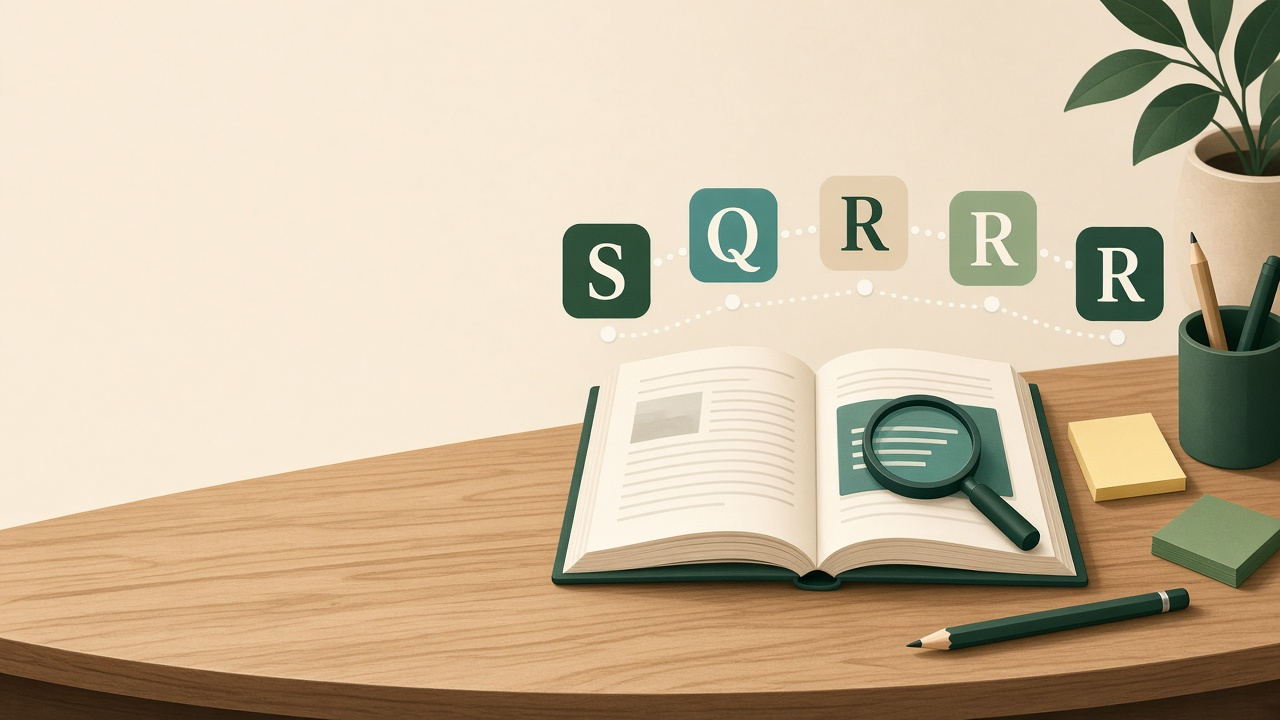
The SQ3R method is a five-step way to read a textbook chapter so you understand it and remember it: Survey, Question, Read, Recite, and Review. You preview the chapter, turn its headings into questions, read to answer them, say the answers from memory, and then review later. It turns passive reading into self-testing, which is why it still shows up in study guides from places like Stanford's Center for Teaching and Learning.
Below you'll find each step explained, a worked example, what the research actually says, and a faster version for when you're short on time.
What Is the SQ3R Method?
SQ3R was introduced by psychologist Francis P. Robinson in his 1946 book Effective Study. It was built for students who finish a chapter and can't remember what they just read. The name is a shorthand for the five steps: one S, one Q, and three Rs.
The idea is simple. Instead of reading from the first word to the last and hoping some of it sticks, you give your reading a purpose (answering your own questions) and you check yourself before you move on. Those two habits, reading with questions and recalling from memory, do most of the work.
The 5 Steps of SQ3R
| Step | What you do | Time for a typical chapter |
|---|---|---|
| Survey | Skim headings, bold terms, figures, the summary, and end-of-chapter questions | 3 to 5 minutes |
| Question | Turn each heading into a question and write it down | 5 minutes |
| Read | Read one section at a time to answer its question | Most of your session |
| Recite | Close the book and answer the question out loud or in writing | 1 to 2 minutes per section |
| Review | Test yourself on all the questions, then again on later days | 10 minutes, repeated |
1. Survey
Before you read anything closely, spend a few minutes getting the big picture. Look at the chapter title, section headings, bold and italic terms, diagrams, the summary, and any review questions at the end. You're building a mental map so new details have somewhere to land.
2. Question
Turn each heading into a question. "The Light-Dependent Reactions" becomes "What happens in the light-dependent reactions, and what do they produce?" Write the questions down. If the chapter has review questions at the end, add those too, since your teacher or textbook author is telling you what matters.
3. Read
Now read one section at a time, looking for the answer to that section's question. Read for meaning, not just for the answer, and slow down on figures and examples. Don't highlight everything. If you take notes, keep them short and in your own words.
4. Recite
This is the step most people skip, and it's the one that matters most. After each section, look away from the page and answer your question from memory. Say it out loud, explain it to an imaginary friend, or jot a few lines. Then check the book. If you couldn't answer, reread that part and try again.
Reciting is a form of retrieval practice. Pulling information out of memory strengthens it far more than reading it again, which is the same reason quizzing yourself works so well.
5. Review
When you finish the chapter, go back through every question and answer it without looking. Mark the ones you missed. Then review again a day or two later and once more about a week later. Spreading those reviews out is what keeps the chapter from fading, and it's the core idea behind spaced repetition.
SQ3R Example: A Biology Chapter
Say you're assigned a chapter on photosynthesis.
- Survey: You notice three main headings (light-dependent reactions, the Calvin cycle, and factors that affect the rate), a big diagram of a chloroplast, and five review questions.
- Question: You write "Where in the chloroplast does each stage happen?", "What goes into and comes out of the Calvin cycle?", and "How do light, CO2, and temperature change the rate?"
- Read: You read the first section with only the first question in mind and sketch the chloroplast with labels.
- Recite: You close the book and explain, in two or three sentences, where each stage takes place. You get the thylakoid right but forget the stroma, so you check and fix it.
- Review: That evening you answer all your questions from memory. Two days later you do it again, and you only miss one.
The whole chapter might take a little longer the first time than plain reading, but you walk away knowing what you know and what you don't.
Does SQ3R Actually Work? What the Research Says
The honest answer is that the full five-step method has mixed evidence, but its core steps are well supported.
- A 1989 study of introductory psychology students found that those using SQ3R scored better on recall and conceptual questions than students using their own study methods (Chastain and Thurber, Reading Improvement).
- A 1991 set of experiments with secondary students with learning disabilities found SQ3R did not produce a strong effect on literal comprehension, even with direct teacher instruction.
- A 2009 study by McDaniel, Howard, and Einstein in Psychological Science tested a stripped-down version called read-recite-review. It beat both rereading and note-taking on immediate and delayed tests and took less time than note-taking.
The takeaway: the reciting and reviewing steps are where most of the benefit comes from. Surveying and questioning help you focus, but if you're going to cut anything, don't cut those last two Rs.
A Faster Version for Busy Weeks
If a full SQ3R session feels like too much, try this shortened loop for each section:
- Glance at the heading and turn it into one question (30 seconds).
- Read the section.
- Close the book and answer the question from memory (1 minute).
- Write the question on a flashcard so you can review it later.
You still get the recite and review benefits without spending an hour on one chapter. It also pairs nicely with the blurting method when exams get close.
Common SQ3R Mistakes
- Skipping Recite. Without it, SQ3R is just reading with extra steps.
- Writing vague questions. "What is this section about?" doesn't help. Ask about causes, steps, differences, and examples.
- Copying the textbook into notes. Long notes feel productive but slow you down. Keep answers short and in your own words.
- Reviewing once. One review the same night isn't enough. Plan at least two more on later days.
- Using it on everything. SQ3R is best for dense, structured textbook chapters. A short article or a novel doesn't need all five steps.
How GoodOff Fits Into SQ3R
The Question and Review steps are where a study app can save you time. In GoodOff, you can upload a chapter as a PDF, slides, or pasted notes, and it makes flashcards, a quiz, and a study guide from it. You can edit every card, so it's easy to swap in the questions you wrote during the Question step.
For Review, GoodOff schedules your cards with FSRS spaced repetition, so each one comes back right before you'd likely forget it. If you have an exam date, the exam plan breaks your reviews into daily sessions. And if a section still confuses you after reciting, you can ask Sage, GoodOff's tutor, and it answers from your own material with a citation to the page it used.
You'll still do the reading and reciting yourself. That's the part that builds understanding, and no app can do it for you.
Frequently Asked Questions
What does SQ3R stand for?
SQ3R stands for Survey, Question, Read, Recite, and Review. It's a reading and study method created by Francis P. Robinson in 1946.
Is SQ3R good for exams?
Yes, especially for subjects with dense textbook reading like biology, psychology, history, and economics. The recite and review steps act as practice tests, which help you remember the material on exam day.
How long does SQ3R take?
Expect a chapter to take a bit longer the first time than simply reading it. Many students make that time back because they need less rereading before the test.
What's the difference between SQ3R and SQ4R?
SQ4R adds a fourth R, usually "Relate" or "Reflect," where you connect the new material to what you already know or to your own life. It's a small addition, and it works well with techniques like elaborative interrogation.
Can I use SQ3R with digital textbooks or PDFs?
Yes. Survey the table of contents and headings, type your questions into a notes app or flashcards, and close the tab while you recite. Our guide on studying from a PDF covers more tips.
Try SQ3R on Your Next Chapter
Pick one chapter you have to read this week and run through all five steps, even if it feels slow. Pay attention to the Recite step, because that's where you'll find out what you actually understood. When you're done, turn your questions into flashcards in GoodOff so your reviews come back on schedule.