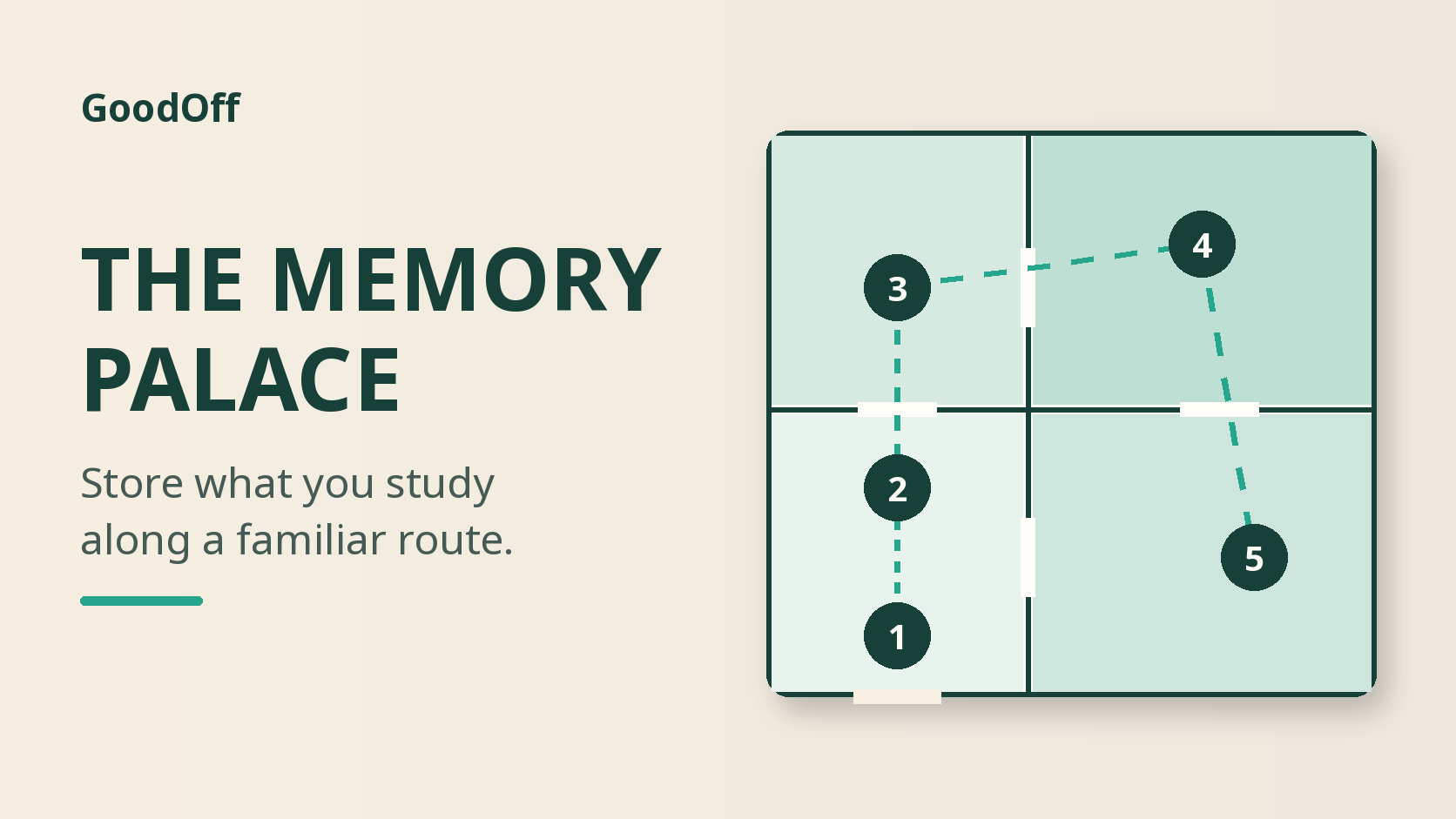
A memory palace is a memory technique where you picture a place you know well, like your home, and "store" each thing you need to remember at a specific spot along a route through it. To recall the information, you walk the route in your head and look at each spot. It's also called the method of loci, and it works best for lists, sequences, and ordered steps you have to reproduce exactly.
This guide explains how the memory palace technique works, what the research says, how to build your first one in five steps, two worked examples for studying, and where the method falls short.
What Is a Memory Palace?
A memory palace is a mental map of a familiar place that you use as a filing system. You pick a set of locations in a fixed order, such as your front door, the hallway, the kitchen table, and the couch. Then you turn each item you want to learn into a vivid image and place one image at each location.
The method is very old. Roman writers, including Cicero, tell the story of the Greek poet Simonides of Ceos. After a banquet hall collapsed, he was able to identify the guests by remembering where each person had been sitting. That idea, that location is a strong memory cue, became a standard tool for orators who had to deliver long speeches without notes.
Today, most competitive memory athletes use some version of it. You don't need to be one to benefit, though. A small palace with ten spots is enough to hold the steps of a process or the key points of an essay answer.
Why the Memory Palace Technique Works
Three things make the method effective.
Spatial memory is strong. You already know the layout of your home without ever trying to learn it. The technique borrows that existing knowledge and uses it as a set of hooks.
Images are easier to recall than abstract words. Turning "self-actualization" into a picture gives your brain a second way to find it. This is the same principle behind dual coding, where pairing words with visuals improves recall.
The route keeps things in order. Because the locations follow a fixed path, you recall items in sequence and can tell right away if one is missing.
What the Research Says
The method of loci has better evidence than most memory tricks. A 2021 meta-analysis by Twomey and Kroneisen pooled 13 randomized controlled trials, mostly with university students, and found a medium-sized benefit for recall. The authors also flagged a high risk of bias in many of the studies, so the evidence is promising rather than settled.
One of the best-known studies was published in Neuron in 2017 by Martin Dresler and colleagues. People with no memory training practiced the method of loci for 30 minutes a day over about six weeks. Before training, they recalled roughly 26 to 30 words from a list of 72. Afterward, the group recalled about 35 more words on average, and four months later they were still recalling over 22 more words than at the start.
Keep the limits in mind. Most studies test lists of words, not textbook chapters. The technique helps you hold information in order. It doesn't help you understand a concept you haven't learned yet.
How to Build a Memory Palace in 5 Steps
1. Choose what you need to memorize
Start with a short, ordered list of 5 to 10 items. Good first targets are the stages of a process, a list of causes, or the main points of an answer you expect on an exam. Write the list down before you build anything.
2. Pick a place you know well
Your home, your school, or the walk to a friend's house all work. The key is that you can picture it clearly without effort. Use one place per topic, so your biology palace and your history palace don't get mixed up.
3. Plan a fixed route with distinct spots
Walk through the place in your head and pick one spot for each item, such as the front door, coat hook, kitchen sink, fridge, and sofa. Always move in the same direction. Spots should look different from each other, since five identical chairs are hard to tell apart.
4. Turn each item into a vivid image
Make every image big, specific, and a little strange. Have it interact with the spot. If an item is abstract, use a word that sounds similar or an object that represents it. Many students find that personal or funny images stick better than plain ones.
5. Walk the route and test yourself
Close your notes and walk through the palace, saying each item out loud. Check your list only after you've tried every spot. Fix any images that didn't come back, then repeat the walk later that day.
Memory Palace Examples for Studying
Example 1: Maslow's hierarchy of needs
You need the five levels in order: physiological, safety, love and belonging, esteem, and self-actualization. Use five spots in your home.
Front door: a giant sandwich is wedged in the doorway, and you have to eat your way in (physiological needs).
Hallway: the hallway is lined with bright orange safety cones and a security guard waves you through (safety).
Kitchen: your family is having a group hug around the table (love and belonging).
Living room: a trophy on the TV stand is applauding you (esteem).
Bedroom: you're standing on your bed wearing a crown, looking at a painting of your best self (self-actualization).
Example 2: The first five U.S. presidents
Washington, Adams, Jefferson, Madison, and Monroe. Use the route from your bedroom to the bus stop.
Bedroom desk: someone is washing a tall stack of dollar bills in a tub (Washington).
Bathroom: an atom spins in the sink like a tiny planet (Adams).
Stairs: a jet plane is parked on the stairs and you squeeze past it (Jefferson).
Front porch: a mad chef yells at the mailbox (Madison).
Bus stop: a monkey is checking the bus timetable (Monroe).
Notice that each image uses a sound-alike word. You still need to know the real names. The image only reminds you which one comes next.
When to Use a Memory Palace (and When Not To)
| Type of material | Good fit? | Better option if not |
|---|---|---|
| Ordered steps or stages (mitosis, a lab procedure) | Yes | None needed |
| Lists you must reproduce in full (causes, symptoms, parts) | Yes | None needed |
| Outline of an essay or speech | Yes | None needed |
| Hundreds of separate facts or vocabulary words | Partly | Flashcards with spaced repetition |
| Math methods and problem solving | No | Worked examples and practice problems |
| Understanding why something happens | No | Explaining it in your own words or asking "why" questions |
For the last row, try elaborative interrogation, which builds understanding by asking why each fact is true. Understand first, then store the key points in a palace.
Common Memory Palace Mistakes
Making the palace too big at first. Start with 5 to 10 spots. You can add rooms once the method feels natural.
Using weak images. "A book on the table" is forgettable. "A book on fire that sings when you open it" is not.
Changing the route. Walk the same direction every time, or the order breaks down.
Overloading one palace. Reusing the same palace for several topics in the same week can blur the images together. Give each topic its own place.
Building it once and never coming back. A palace fades like any other memory if you don't review it.
How to Review Your Memory Palace So It Lasts
Plan your reviews the day you build the palace. Walk it the same day you build it, again the next day, then a few days later, and again after a week. Each walk should be a recall attempt, not a reread of your list. That combination of spacing and self-testing is what the research on spaced repetition and quizzing yourself supports.
A simple habit helps: write one flashcard per palace, such as "Walk the Maslow palace. What's at each spot?" When the card comes up, do the walk before you flip it.
Using GoodOff Alongside a Memory Palace
GoodOff doesn't build memory palaces for you. The images have to come from you, because personal images are what make the method work. Where GoodOff helps is the review side and everything that isn't a list.
You can upload a PDF, your notes, lecture slides, or a lecture recording, and GoodOff turns it into flashcards and a quiz you can edit. You can also write cards by hand, so it's easy to add a card for each palace. Flashcards are scheduled with FSRS spaced repetition, so a palace card comes back before you'd forget it. If a concept in your notes doesn't make sense, Sage, GoodOff's tutor, answers from your own material and shows the page it used.
Frequently Asked Questions
Does the memory palace technique really work?
Yes, for the right kind of material. Controlled studies show a medium-sized improvement in recall, especially for lists and sequences. It works best when you also review the palace over several days.
How many items can I put in one memory palace?
Beginners do well with 5 to 10 items per palace. With practice, you can use larger places with 20 or more spots, but more spots also means more to review.
Can I reuse the same memory palace?
You can, but leave time between uses so the old images fade first. Many students keep a few separate places, one per subject, to avoid mixing them up.
Is a mind palace the same as a memory palace?
Yes. "Mind palace" is a popular name for the same technique. Both mean placing images along a route through a familiar location, also known as the method of loci.
How long does it take to learn the memory palace technique?
You can build and use a small palace in about 15 minutes on your first try. Getting fast and reliable takes regular practice over a few weeks.
Is a memory palace good for exams?
It's useful for exam content you have to reproduce in order, such as processes, lists, and essay outlines. For problem solving and conceptual questions, combine it with practice questions and self-testing.
Build Your First Memory Palace Tonight
Pick one list from your current class, choose five spots in your home, and make five strange images. Walk the route tonight and again tomorrow morning. If you'd like your review to run on a schedule, upload your notes to GoodOff and add a card for each palace so it comes back right on time.