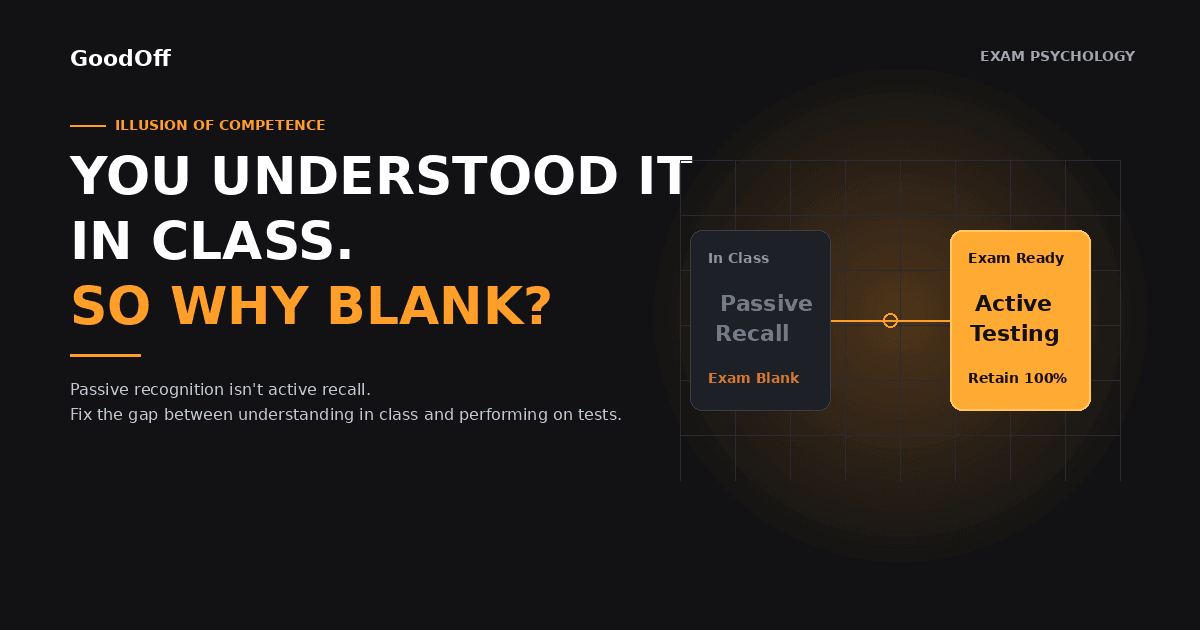
Quizzing yourself while studying, also called self-testing or retrieval practice, is one of the most effective ways to remember what you learn. Every time you pull an answer from memory, that memory gets stronger and easier to reach on exam day. Self-testing also shows you exactly what you don't know yet, so your study time goes where it's needed.
This guide covers why self-testing works, what the research shows, and practical ways to quiz yourself in any subject.
What Is Self-Testing?
Self-testing means trying to recall information without looking at your notes, then checking your answer. It can be as simple as covering your notes and explaining a concept, answering flashcards, or working practice problems without the solutions open.
The key is the attempt. Rereading lets you recognize information. Self-testing makes you produce it, which is what exams ask you to do.
What the Research Says
- Testing beats rereading. In a well-known 2006 study, Henry Roediger and Jeffrey Karpicke had students either reread a passage or take practice tests on it. After a week, the students who practiced recall remembered noticeably more, even though rereading felt more effective at the time.
- It's rated as one of the best techniques. A 2013 review by John Dunlosky and colleagues compared ten common study techniques and rated practice testing as high utility, while highlighting and rereading were rated low.
- The effect is broad. A 2017 meta-analysis by Olusola Adesope and colleagues found practice tests improved learning across ages, subjects, and test formats.
- It may calm test nerves. In a 2014 survey by Pooja Agarwal and colleagues, most middle and high school students said regular retrieval practice made them less nervous about tests.
Self-Testing vs. Rereading
| Rereading | Self-testing | |
|---|---|---|
| How it feels | Easy and comfortable | Effortful, sometimes frustrating |
| What it trains | Recognizing information | Recalling information |
| Long-term memory | Weak | Strong |
| Shows your gaps | Rarely | Every time |
7 Ways to Quiz Yourself While Studying
1. Flashcards with a real attempt
Say or write the answer before you flip. Shuffle the deck so you aren't memorizing the order.
2. Practice problems with solutions hidden
For math and science, cover the worked example, solve it yourself, then compare step by step.
3. Turn headings into questions
Rewrite each heading in your notes as a question and answer it with the page covered. This is the heart of the Feynman technique too: if you can't explain it simply, you don't know it yet.
4. Blurt it out
Write everything you remember about a topic on a blank page, then check your notes and fill in what you missed. See our full guide to the blurting method.
5. Test before you study
Try a few questions on a topic before you read about it. Research on pretesting (Richland, Kornell, and Kao, 2009) found that attempting questions first, even with wrong answers, can improve how well you learn the material afterward.
6. Use past papers
Old exams show you the question style and timing. Take them under exam conditions, then review every mistake.
7. Space your quizzes
Quiz yourself on the same material again after a few days and a week. Combining testing with spaced repetition is one of the strongest study routines you can build.
Tips to Get More From Self-Testing
- Always check your answers. Feedback stops you from practicing mistakes. Here's why studying without feedback doesn't work.
- Mix question types. Combine short answer, multiple choice, and explain-in-your-own-words questions.
- Focus on what you miss. Spend most of your time on wrong answers, not the ones you already know.
- Keep sessions short. Ten to fifteen minutes of quizzing a day adds up quickly.
How GoodOff Makes Self-Testing Easier
The hardest part of self-testing is writing the questions. GoodOff can do that first draft for you: upload a PDF, slides, notes, or a lecture recording and it creates flashcards, a quiz, and a study guide you can edit. Quizzes are adaptive and give instant feedback, and practice exams give you a timed, exam-style run with a score.
Flashcards are scheduled with FSRS spaced repetition so each one comes back when you're likely to forget it. If you get something wrong and don't understand why, Sage, GoodOff's tutor, answers from your own material and shows you the page it used.
Quizzing works even better when topics are mixed. Read our guide to the interleaving study technique to see how.
Frequently Asked Questions
Is quizzing yourself better than rereading notes?
Yes. Research consistently shows self-testing leads to better long-term memory than rereading the same material for the same amount of time.
How often should I quiz myself?
Short daily quizzes work well. Review new material within a day, then again after a few days and about a week.
Does self-testing work if I get the answers wrong?
Yes, as long as you check the correct answer afterward. Mistakes followed by feedback are a normal and useful part of learning.
What's the difference between active recall and self-testing?
They're closely related. Active recall is the act of pulling information from memory, and self-testing is any method you use to make yourself do it, like flashcards or practice questions.
Quiz Yourself Today
Close your notes and write down five questions about what you studied this week. Answer them from memory, then check. Spend the rest of your session on what you missed. To get a ready-made quiz from your own notes, try GoodOff.