Short answer: To write a research question, pick a topic you care about, read enough to see what's already known, narrow it to one specific population, place or time, and phrase it as an open "how" or "why" question that can't be answered with yes, no or a quick search. Then test it: is it clear, focused, complex enough to need analysis, and doable with the time and sources you have?
A research question does more work than it looks like. It decides what you search for, which sources you keep, and what your thesis or hypothesis will have to answer. Get it right and the rest of the paper has a direction. Get it wrong and you end up with an "all about" paper that summarizes a topic without arguing anything.
Below you'll find a six-step method, one topic narrowed from vague to usable, a table of weak-to-strong rewrites, frameworks like PICO and FINER for science and health papers, and a checklist you can run in two minutes.
What a research question is (and isn't)
A research question is the single question your paper, project or study sets out to answer. It isn't your topic, and it isn't your answer. Those are separate things, and mixing them up causes most of the trouble.
| Term | What it is | Example |
|---|---|---|
| Topic | A broad area you want to explore | Phones and sleep |
| Research question | The specific thing you want to find out | How does phone use in the hour before bed relate to sleep duration among first-year college students? |
| Hypothesis | A testable prediction (used in experiments and quantitative studies) | Students who use phones in the hour before bed sleep less than students who don't. |
| Thesis statement | The answer you argue for in an essay or paper | Late-night phone use cuts first-year students' sleep mainly by delaying bedtime, not by lowering sleep quality. |
The order matters. The question comes first, the reading and analysis come next, and the thesis comes last. If you already know the answer before you start, you don't have a research question yet. You have an opinion looking for support.
How to write a research question in 6 steps
1. Start with a topic you actually want to know about
You'll spend weeks with this question, so curiosity helps. George Mason University's Writing Center suggests starting with a broad topic you'd genuinely like to learn more about, then narrowing from there. If your instructor assigned a topic, look for the part of it that makes you ask "wait, why?"
2. Do some quick preliminary reading
Spend an hour or two skimming, not studying. Read a review article, an encyclopedia entry, or the introductions of three or four recent papers. You're looking for what researchers argue about, what's settled, and where they say more work is needed. Phrases like "little is known about" or "future research should" point straight at open questions.
If you're not sure how to skim a paper fast, our guide to reading a research paper covers a five-minute first pass.
3. Narrow it down
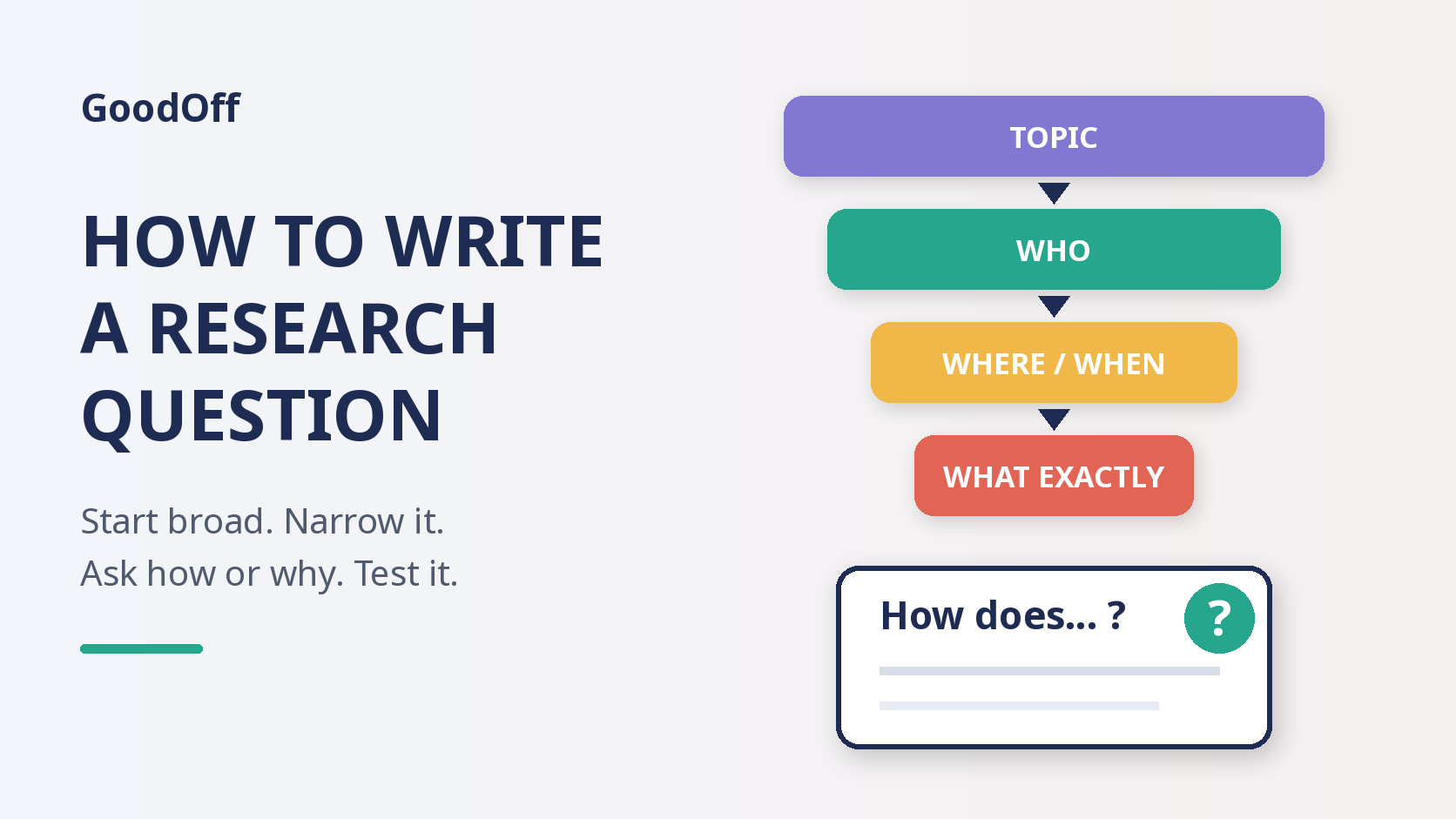
Broad topics produce questions nobody could answer in a book, let alone a ten-page paper. Narrow along one or more of these lines:
- Who: a specific group (first-year students, nurses in rural hospitals, teenagers in one country)
- Where: a place or setting (one city, online forums, public schools)
- When: a time period (the 1930s, since 2020, during exam weeks)
- What exactly: one aspect, effect or cause instead of all of them
You usually don't need all four. Two good constraints are often enough for an undergraduate paper.
4. Write it as an open question
Start drafting questions that begin with "how," "why," "to what extent" or "what is the relationship between." Write five or six. The first one is rarely the best.
Avoid questions with a yes or no answer, and avoid ones a quick search can settle. "When did the Great Depression start?" is a fact. "How did Hollywood films of the 1930s respond to the Great Depression?" needs research and an argument.
5. Test it
Run each draft through five checks: clear, focused, complex, arguable and feasible. The checklist further down turns these into yes or no questions. Cut the drafts that fail, and combine the best parts of the rest.
6. Revise as you research
Your first research question is a working draft. It's normal to narrow it again after a week of reading, or to shift the angle when you find the sources point somewhere else. What you shouldn't do is keep a question you already know your sources can't answer.
One topic, narrowed from vague to usable
Here's how a single topic changes as it goes through the steps.
| Stage | Draft | Problem or fix |
|---|---|---|
| Topic | Social media and mental health | Too broad, not a question |
| First question | Is social media bad for mental health? | Yes or no, and "bad" is vague |
| Narrower | How does social media affect teenagers' mental health? | Better, but "social media" and "mental health" are still huge |
| Focused | How does time spent on image-based apps relate to body image concerns among high school students? | Specific behavior, outcome and group |
| Feasible for a class paper | What do studies published since 2018 find about the link between image-based app use and body image concerns among adolescent girls? | Fits a literature-based paper with available sources |
Notice the last version is shaped by what's possible. A student writing a literature review can't run a survey of thousands of teenagers, but they can analyze what published studies found.
Weak research questions, rewritten
| Weak | What's wrong | Stronger |
|---|---|---|
| What is climate change? | Answered by a definition | How have coastal towns in North Carolina changed zoning rules in response to rising sea levels since 2010? |
| Is remote work good? | Yes or no, and "good" for whom? | How does fully remote work affect the promotion rates of early-career software engineers compared with hybrid work? |
| Why is the education system failing? | Assumes the answer, far too broad | What factors explain changes in community college enrollment in Illinois between 2019 and 2023? |
| How did World War II affect the world? | Book-length, unfocused | How did wartime rationing in Britain change working-class diets between 1940 and 1945? |
| Do video games cause violence? | Yes or no, heavily studied, vague terms | How have researchers measured "aggression" in experimental studies of video games, and how does the choice of measure affect their findings? |
The pattern is the same each time: replace vague words with specific ones, add a who, where or when, and turn a yes or no question into one that asks how, why or to what extent.
Types of research questions
Knowing which type you're writing helps you choose methods and sources.
| Type | What it asks | Example | Common in |
|---|---|---|---|
| Descriptive | What is happening, or how often? | How do first-year students at my university use the campus library? | Surveys, social sciences |
| Comparative | How do two or more groups differ? | How do study habits differ between online and in-person students? | Education, psychology |
| Relational or causal | How does one thing relate to or affect another? | How does part-time work affect GPA among community college students? | Sciences, economics |
| Interpretive or analytical | Why or how does something mean or work the way it does? | How does Toni Morrison use memory as a structure in Beloved? | Humanities, history |
Quantitative studies usually lean descriptive, comparative or causal. Qualitative projects often ask how people experience or explain something, for example "How do first-generation students describe their first semester?"
Frameworks for science and health research questions
If you're in nursing, medicine, public health or psychology, your instructor may ask you to use a framework.
PICO
PICO comes from evidence-based medicine (Richardson and colleagues described the "well-built clinical question" in 1995). It stands for:
- Population or patient: who are you studying?
- Intervention: what treatment, exposure or change?
- Comparison: compared with what?
- Outcome: what result do you measure?
Example: "In adults with type 2 diabetes (P), does a daily 30-minute walk (I) compared with usual care (C) lower HbA1c after three months (O)?" Clinical PICO questions are often phrased as yes or no, which is fine in that field because the answer comes from measured data, not opinion.
FINER
FINER is a test for whether a question is worth pursuing, from Hulley and colleagues' textbook Designing Clinical Research. A good question is Feasible, Interesting, Novel, Ethical and Relevant. It works as a sanity check for any subject, not just clinical research.
The "so that" sentence
For humanities and social science papers, try the formula from Booth, Colomb and Williams' The Craft of Research: "I am studying [topic] because I want to find out [question] in order to help my reader understand [why it matters]." If you can't fill in the last blank, the question may be too small or too disconnected to matter.
Research question checklist
- Clear: Would a classmate understand exactly what you're asking without you explaining it?
- Focused: Could you answer it well in the length you have?
- Complex: Does it need analysis, not just a fact or a yes or no?
- Arguable: Could reasonable people reach different answers?
- Feasible: Can you get the sources or data in the time you have?
- Neutral: Does it avoid assuming the answer ("Why is X harmful?")?
- Relevant: Does it fit the assignment and your field?
If a question fails two or more of these, rewrite it before you start serious research. Fixing it now is far quicker than restructuring a half-written paper.
Main questions and sub-questions
Longer projects such as theses and dissertations often use one main research question and two to four sub-questions. Each sub-question covers one piece the main question needs.
Main question: "How did Illinois community colleges respond to enrollment changes between 2019 and 2023?"
- Which colleges and programs saw the biggest enrollment changes?
- What changes did colleges make to admissions, scheduling and course formats?
- Which of those changes were followed by enrollment gains?
Sub-questions often map neatly onto sections or chapters, which makes outlining easier.
From research question to the rest of your paper
Once your question is solid, the next pieces follow from it:
- Literature review: organize your reading around what it says about your question. Our literature review guide walks through a synthesis matrix.
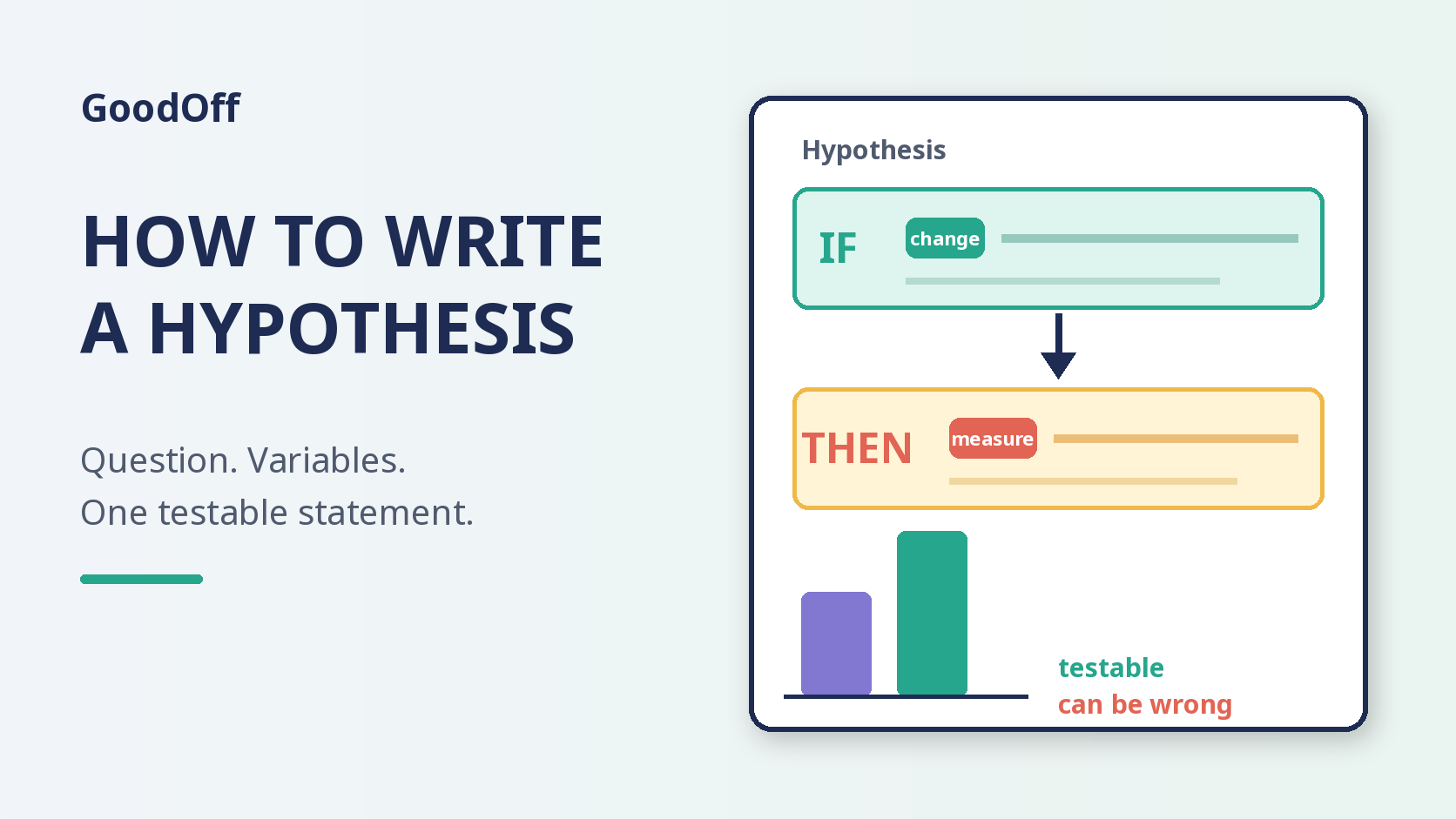
- Hypothesis: in experiments and quantitative studies, turn the question into a testable prediction. See how to write a hypothesis.
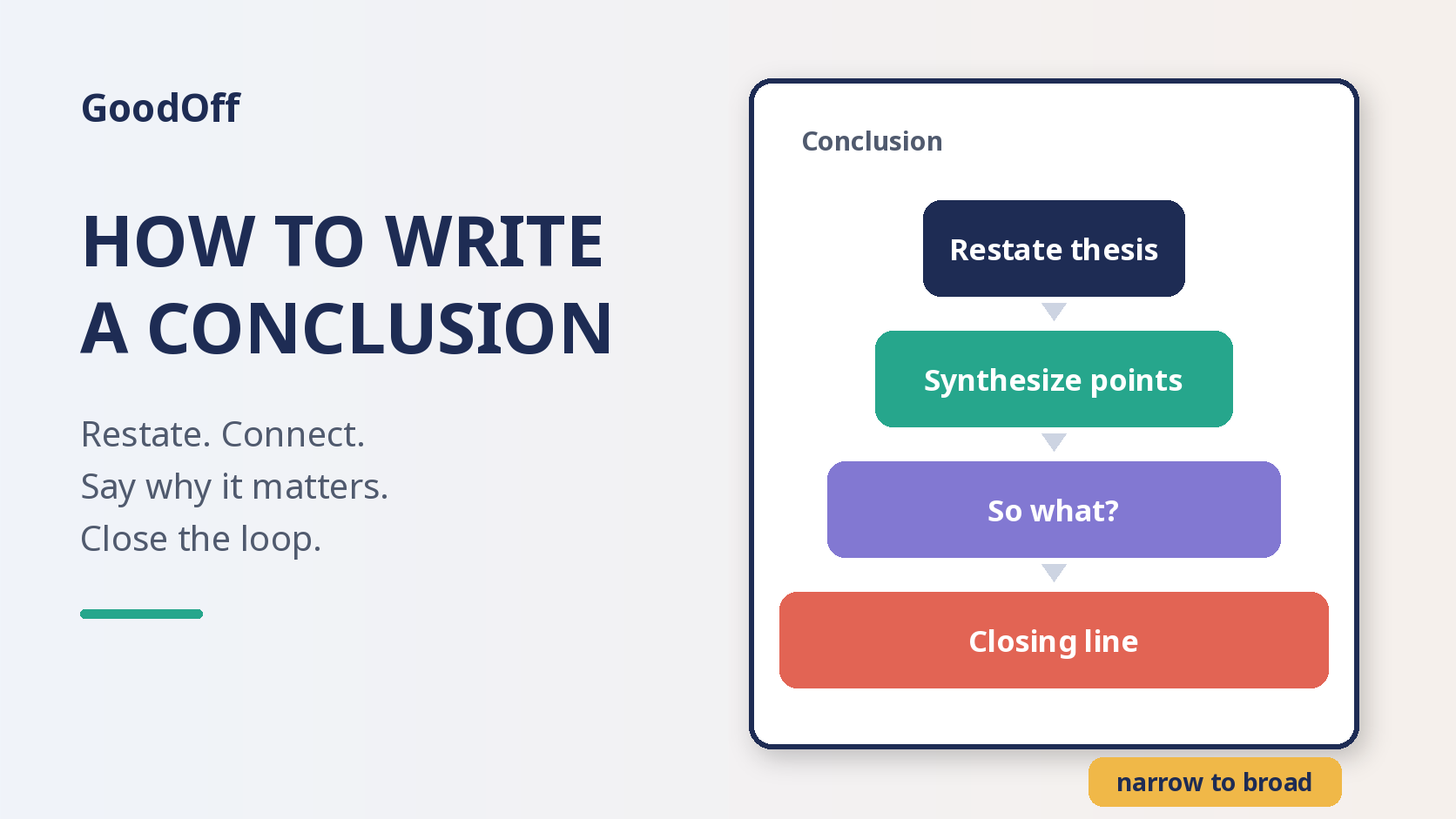
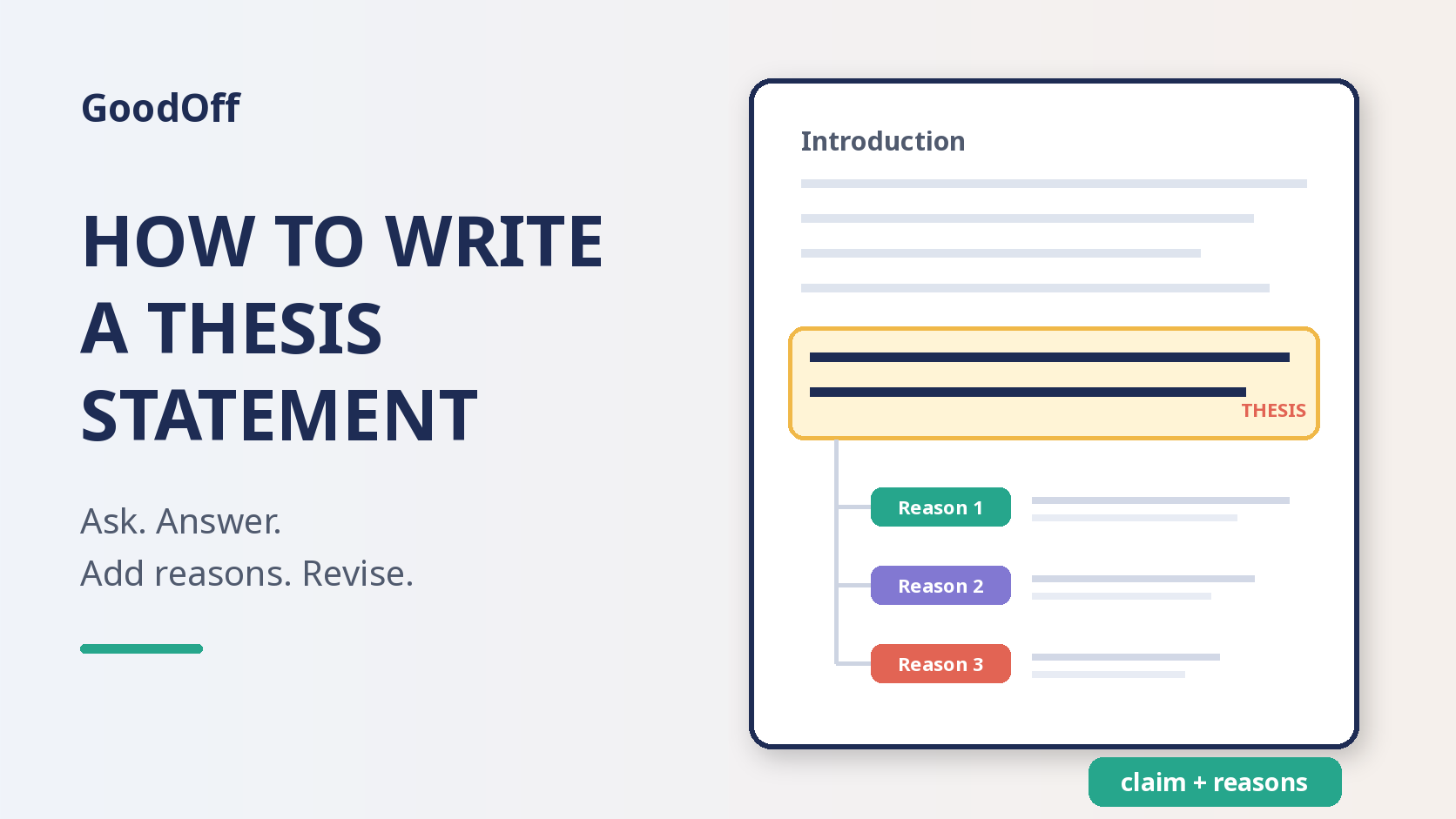
- Thesis statement: once you've done the research, your answer becomes the thesis. Here's how to write a thesis statement.
Common mistakes
- Writing a topic instead of a question. "The effects of caffeine" isn't a question. Ask something about it.
- Going too broad. If whole books exist on your exact question, narrow it.
- Going too narrow. If you can only find one source, widen the group, place or time.
- Loading the question. "Why are standardized tests unfair?" assumes the answer. Try "How do standardized test scores relate to family income in..."
- Using vague words. Swap "good," "bad," "effects" and "society" for things you can define and measure.
- Never revising it. A question that stopped fitting your sources two weeks ago will drag the whole paper down.
Where GoodOff fits
GoodOff won't pick your research question for you, and it doesn't write papers. It can help with the preliminary reading in step 2. Upload a PDF, your notes or slides and make an AI study guide or FAQ from them, which is a quick way to see the main ideas in a long article. The Free plan includes AI decks, quizzes, study guides and FAQs with daily, weekly and monthly limits. On Pro, the Sage tutor answers questions from the source you uploaded and cites the passages it used, and the Sage page describes a Research mode for working across several papers with citations. AI answers can still be wrong, so check them against the source before you build a question on them.
Frequently asked questions
What is a good research question example?
"How does part-time work affect GPA among community college students?" It's specific about the group and the outcome, it can't be answered with yes or no, and it can be studied with available data.
How long should a research question be?
Usually one sentence, often 15 to 30 words. If it needs two sentences or several commas, it's probably trying to do too much. Split it into a main question and sub-questions.
Can a research question be a yes or no question?
For most essays and papers, no. It should need analysis. The exception is clinical and experimental research, where a PICO question like "Does X reduce Y compared with Z?" is answered by measured results.
What's the difference between a research question and a hypothesis?
A research question asks what you want to find out. A hypothesis is a testable prediction of the answer. Not every project needs a hypothesis, but every research project needs a question.
Where does the research question go in a paper?
Usually at the end of the introduction, right after you explain the background and the gap in what's known. Some fields state it directly as a question. Others turn it into a purpose statement, like "This paper examines how..."
How many research questions should I have?
For a class paper, one. For a thesis or dissertation, one main question with two to four sub-questions is common. Check your program's guidelines.
The bottom line
Start broad, read a little, then narrow by who, where, when and what. Write it as a how or why question, run it through the checklist, and expect to revise it once your sources start talking back. A focused question makes the reading, the thesis and the paper itself much easier to write.
Got a stack of papers to get through before you can narrow your topic? Try GoodOff free and turn a PDF into a study guide or FAQ in your library.
Sources
- George Mason University Writing Center, "How to Write a Research Question."
- Scribbr, "Writing Strong Research Questions."
- University of Southern California Libraries, "Organizing Your Social Sciences Research Paper: The Research Problem/Question."
- Richardson WS, Wilson MC, Nishikawa J, Hayward RS. "The well-built clinical question: a key to evidence-based decisions." ACP Journal Club, 1995.
- Hulley SB, Cummings SR, et al. Designing Clinical Research. Lippincott Williams & Wilkins.
- Booth WC, Colomb GG, Williams JM, et al. The Craft of Research. University of Chicago Press.