To write a literature review, pick a narrow question, find the key sources on it, take notes in a table so you can compare them, group the sources by theme, and write each paragraph around a point the sources make together. A literature review isn't a list of summaries. It shows what's known, where studies agree or disagree, and what's still missing.
The Short Answer
A literature review discusses published research on a topic and puts the sources in conversation with each other. The UNC Writing Center describes it as a mix of summary (recapping a source) and synthesis (reorganizing what several sources say into a new picture). Purdue OWL adds that most reviews follow a simple introduction, body and conclusion structure, with the body organized by theme, by time, by method or by theory.
Here's the process in one line: narrow the question, search, read and fill in a comparison table, choose an organizing pattern, outline by idea, draft paragraphs that cite two or more sources each, then revise for flow and accuracy.
What a Literature Review Is (and What It Isn't)
Students often mix up three similar assignments. This table shows the difference.
| Assignment | Organized by | Main job | Your voice |
|---|---|---|---|
| Annotated bibliography | Source, one entry at a time | Summarize and sometimes evaluate each source | Short notes per source |
| Literature review | Ideas or themes across sources | Show what the research says as a whole, including gaps and debates | You connect and evaluate the sources |
| Research paper | Your argument | Make a new claim, using the literature as support | Your claim leads |
UNC's handout puts it plainly: a research paper develops a new argument, while a literature review summarizes and synthesizes others' ideas. A review can be a standalone assignment or a section inside a thesis, lab report or article. Purdue OWL notes that when it's a section, it usually comes after the introduction and before the methods.
Step 1: Clarify the Assignment
Before you search, get answers to the questions both UNC and USC Libraries recommend asking your instructor:
- Roughly how many sources should you include?
- What types count: journal articles, books, reports, websites?
- Should you summarize, synthesize, critique, or all three?
- Do you need subheadings, definitions or background history?
- How recent do sources need to be?
The last one matters more than it looks. UNC points out that in fast-moving sciences, even two-year-old information can be out of date, while history and social science reviews often trace how views changed over decades.
Step 2: Narrow Your Question
"Social media and students" has thousands of papers. "Does phone use during lectures affect note quality in college students?" has a manageable number. A narrow question cuts your reading list and makes themes easier to spot.
A quick test: if your search returns more relevant studies than you could skim in a week, narrow by population (high school vs college), setting (online vs in person), outcome (grades vs memory) or time period.
Step 3: Search Smart, Then Know When to Stop
- Start with existing reviews. UNC suggests adding the word "review" to your search terms. A recent review gives you the main studies and a model of how your field writes these.
- Search one or two databases for your subject, plus Google Scholar. Your library's subject librarian can tell you which databases matter.
- Chain citations both ways. Check the reference list of a key paper (backward), then use "Cited by" to find newer work that builds on it (forward). USC Libraries calls this citation tracking.
- Keep a search log: database, search terms, date, number of results. Some reviews need a short "sources used" or "selection methods" paragraph, and the log makes that easy.
When do you stop? USC's guide gives two signals: findings start repeating, and the same authors keep showing up in every reference list. At that point you've probably found the core of the conversation.
For reading each paper fast without missing the important parts, use our guide on how to read a research paper.
Step 4: Take Notes in a Synthesis Matrix
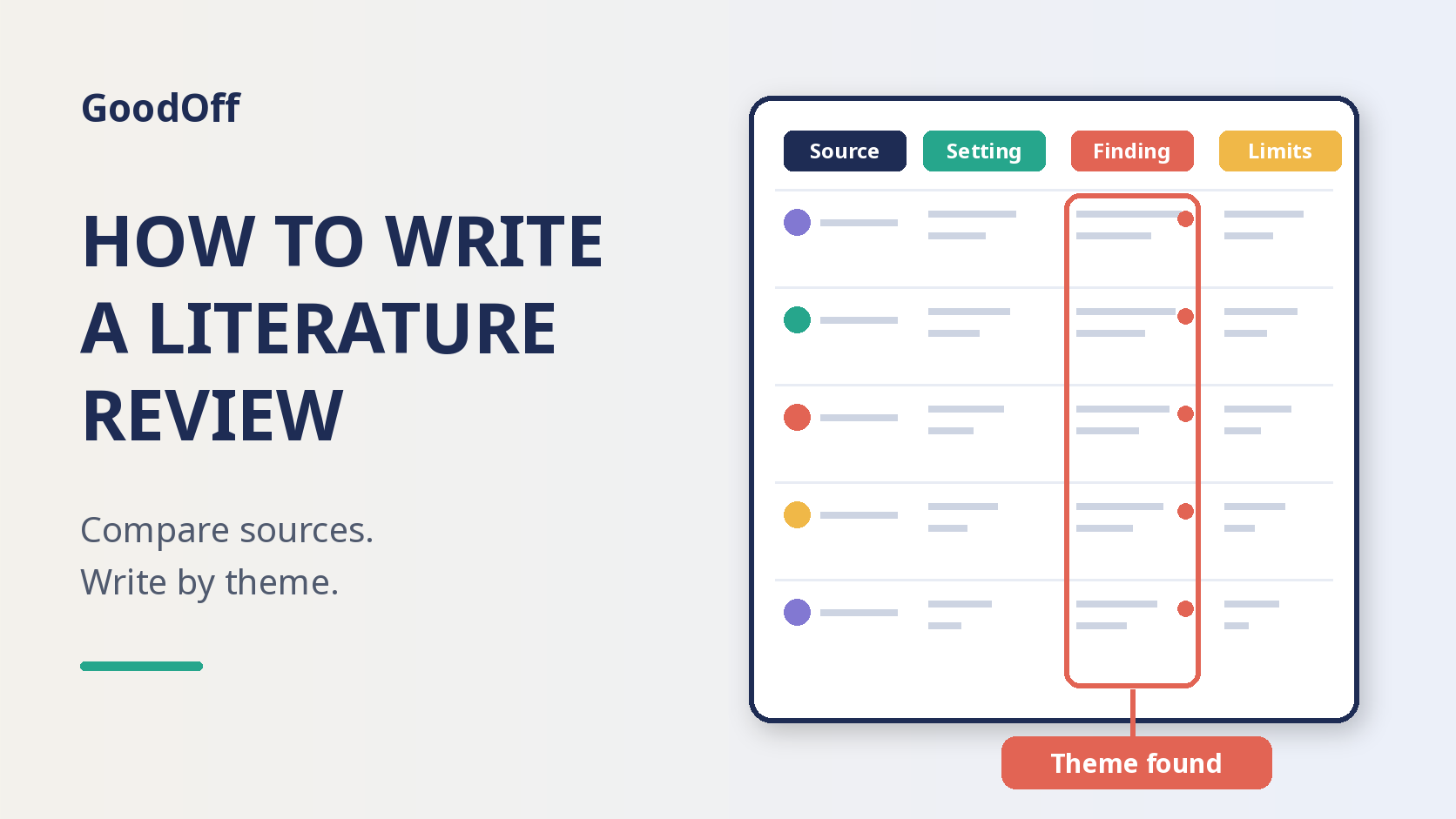
This is the step that makes the writing easier. Instead of separate notes for each article, keep one table: one row per source, one column per thing you want to compare. When you finish reading, you can scan down a column and see patterns.
Here's a real example. Say your question is "Does practice testing help students remember more than rereading?" Four well-known sources might look like this:
| Source | Setting | What they compared | Key finding | Limits |
|---|---|---|---|---|
| Roediger and Karpicke (2006), Psychological Science | College students, prose passages, lab | Restudying vs taking a recall test | Restudy won at 5 minutes (81% vs 75%), but testing won at 2 days (68% vs 54%) and 1 week (56% vs 42%) | Short passages, lab setting |
| Larsen, Butler and Roediger (2009), Medical Education | 40 pediatric and emergency medicine residents | Repeated short-answer tests with feedback vs repeated study of a review sheet | About 6 months later, 39% vs 26% on the final test | Small sample, two topics |
| Szpunar, Khan and Schacter (2013), PNAS | Students watching a 21-minute online statistics lecture | Short tests between lecture segments vs no tests | Mind wandering fell from about 40% to about 20% of probes; tested students scored 84% vs 59% on the last segment | Short lecture, lab conditions |
| Dunlosky et al. (2013), Psychological Science in the Public Interest | Review of 10 study techniques | Evidence across ages, materials and settings | Rated practice testing high utility; rereading and highlighting low | Review, not a new experiment |
Look down the "Key finding" column and a theme jumps out: testing beats restudying once there's a delay, across very different learners. Look down "Limits" and you've found your gap: most studies are short or in labs. That's the raw material for a paragraph.
If your notes tend to end up scattered across docs, our guide on how to organize notes for studying has a simple system that works for research notes too.
Step 5: Pick an Organizing Pattern
Purdue OWL and UNC describe the same main options. Choose the one that fits your question, not the order you read things in.
| Pattern | Organize by | Works well when | Watch out for |
|---|---|---|---|
| Thematic | Topics or issues | Most course assignments; USC calls it the most common approach in the social sciences | Themes that are really just one source each |
| Chronological | Time periods or turning points | The field changed clearly over time | Sliding into a list of summaries in date order |
| Methodological | How studies were done | Lab vs classroom, or qualitative vs quantitative results differ | Losing sight of what the findings mean |
| Theoretical | Competing theories or models | Humanities and theory-heavy topics | Skipping the evidence behind each theory |
For the testing example, a thematic structure could be: (1) testing vs restudying in the lab, (2) evidence from real classes and training programs, (3) why testing helps attention during lectures, (4) open questions.
Step 6: Outline, Then Write Each Section
Introduction
State the topic, why it matters, the scope (which years, which populations) and how the review is organized. A review may not have an argumentative thesis, but UNC recommends a clear sentence telling the reader your organizing principle.
Body
Each paragraph makes one point, backed by several sources. A reliable pattern:
- Topic sentence in your words: the point the sources support.
- Evidence: two or more sources, with the key details.
- Comparison: where they agree, differ, or have limits.
- Closing sentence in your words: what this means for the question.
UNC calls this keeping your own voice: start and end the paragraph with your ideas and let the sources support them.
Conclusion
Summarize what the literature shows, name the gaps, and connect back to your question or your planned research. Purdue OWL suggests tying it to your primary research question.
Summary vs Synthesis: A Before and After
This is the difference instructors grade hardest. Same sources, two versions.
Summary (weak): "Roediger and Karpicke (2006) found that testing improved recall after one week. Larsen et al. (2009) studied residents and found testing helped. Szpunar et al. (2013) tested students during an online lecture."
Synthesis (stronger): "The benefit of testing appears to grow with delay. In a lab study, restudying produced slightly better recall five minutes later, but testing led by 14 points after one week (Roediger and Karpicke, 2006). A similar pattern held for medical residents six months after a teaching session (Larsen et al., 2009), which suggests the effect isn't limited to short lab tasks. Testing may also help during learning itself, since short quizzes between lecture segments roughly halved reported mind wandering (Szpunar et al., 2013). Still, most of this evidence comes from short sessions, so less is known about whole courses."
Notice what changed: the paragraph opens with a claim, links the studies, points out a pattern and ends with a limit. Purdue OWL's quick check works here: if most paragraphs cite only one source, you're probably summarizing.
How Long Should It Be, and How Many Sources?
There's no universal number. It depends on the assignment, level and field, which is why both UNC and USC say to ask. As a rough guide, a short review section in an undergraduate paper may draw on a handful of key sources, while a thesis chapter covers far more. Quality and relevance count more than the total. USC lists sources that don't clearly relate to the research problem as a common mistake.
Common Mistakes
- One paragraph per source. That's an annotated bibliography. Group by idea instead.
- Only sources that agree with you. USC flags ignoring contrary findings as a top error.
- Accepting findings without looking at methods. Note sample size, setting and design. A 40-person study and a review of hundreds of studies don't carry the same weight.
- Too many quotes. UNC advises using quotes sparingly and paraphrasing accurately, with a citation.
- Leaning only on secondary sources. Read the key primary studies, not just other people's summaries of them.
- No gap at the end. Your reader should finish knowing what's still unknown.
A Simple Schedule for a Two-Week Deadline
| Days | Task | Output |
|---|---|---|
| 1 to 2 | Clarify the assignment, narrow the question, find one recent review | A one-sentence question and a starter source list |
| 3 to 6 | Search, chain citations, read and fill in the matrix | A matrix with your core sources |
| 7 | Scan the columns, choose a pattern, outline by theme | An outline with sources listed under each point |
| 8 to 11 | Draft body paragraphs first, then the intro and conclusion | A full rough draft |
| 12 to 14 | Revise for synthesis, check every citation against the source, format references | Final draft |
If you freeze at the drafting stage, write a fast, messy first pass and fix it later. Our guide to writing essays faster walks through that approach. If your review is part of a lab write-up, see how to write a lab report for where it fits in the Introduction.
How GoodOff Can Help With the Reading
GoodOff won't write your review, and you shouldn't let any AI tool do that. Check your school's AI policy first. Where it can help is the reading and remembering:
- Study guides from a PDF: upload a paper and get an overview, key concepts, definitions and likely questions, so you can decide fast whether it's relevant. This is on the Free plan with daily, weekly and monthly limits.
- Ask Sage about a paper: Sage, GoodOff's AI tutor on the Pro plan, answers from the material you upload and cites the passage it used, which helps you double-check a method or result before you put it in your matrix.
- Flashcards for key terms: turn a field's vocabulary into editable cards scheduled with FSRS spaced repetition, handy if the review is for a course exam too.
Always verify against the paper itself. AI summaries can miss details or get them wrong, and your citations need to point to what the authors actually wrote.
Frequently Asked Questions
What are the 5 steps of writing a literature review?
A common version is: define a narrow question, search for sources, read and take notes in a comparison table, organize the sources by theme or another pattern, then write and revise. USC Libraries describes four stages: problem formulation, literature search, evaluation, and analysis and interpretation.
How do you start a literature review introduction?
Open with the topic and why it matters, then state the scope and how the review is organized. One clear sentence about your organizing principle, such as "This review groups studies by setting: lab, classroom and online," helps the reader follow along.
What's the difference between a literature review and a systematic review?
A standard (narrative) literature review selects and synthesizes key sources. A systematic review uses a pre-set, documented method to find and appraise all the research on a tightly defined question, often in medicine and health. USC Libraries lists systematic reviews as one of several review types.
Can I use "I" in a literature review?
It depends on your field and instructor. Many social science and humanities instructors allow it for describing your approach, while some science courses prefer not. Ask, or follow the style of reviews in your field's journals.
How do I avoid just summarizing?
Organize by idea, not by source, and aim for two or more citations in most paragraphs. Start each paragraph with your own point and end it with what the evidence means.
The Bottom Line
A good literature review answers a narrow question by comparing sources, not listing them. Use a synthesis matrix while you read, pick an organizing pattern that fits your question, and write paragraphs that start and end in your own voice. Then check every claim against the original paper.
Want to get through the reading faster? Try GoodOff free and turn your PDFs into study guides and flashcards you can review anywhere.
Sources
- The Writing Center, University of North Carolina at Chapel Hill. "Literature Reviews."
- Purdue Online Writing Lab. "Writing a Literature Review."
- USC Libraries. "Organizing Your Social Sciences Research Paper: The Literature Review."
- Roediger, H. L., and Karpicke, J. D. (2006). Test-enhanced learning. Psychological Science, 17(3), 249-255.
- Larsen, D. P., Butler, A. C., and Roediger, H. L. (2009). Repeated testing improves long-term retention relative to repeated study. Medical Education, 43(12), 1174-1181.
- Szpunar, K. K., Khan, N. Y., and Schacter, D. L. (2013). Interpolated memory tests reduce mind wandering and improve learning of online lectures. PNAS, 110(16), 6313-6317.
- Dunlosky, J., et al. (2013). Improving students' learning with effective learning techniques. Psychological Science in the Public Interest, 14(1), 4-58.