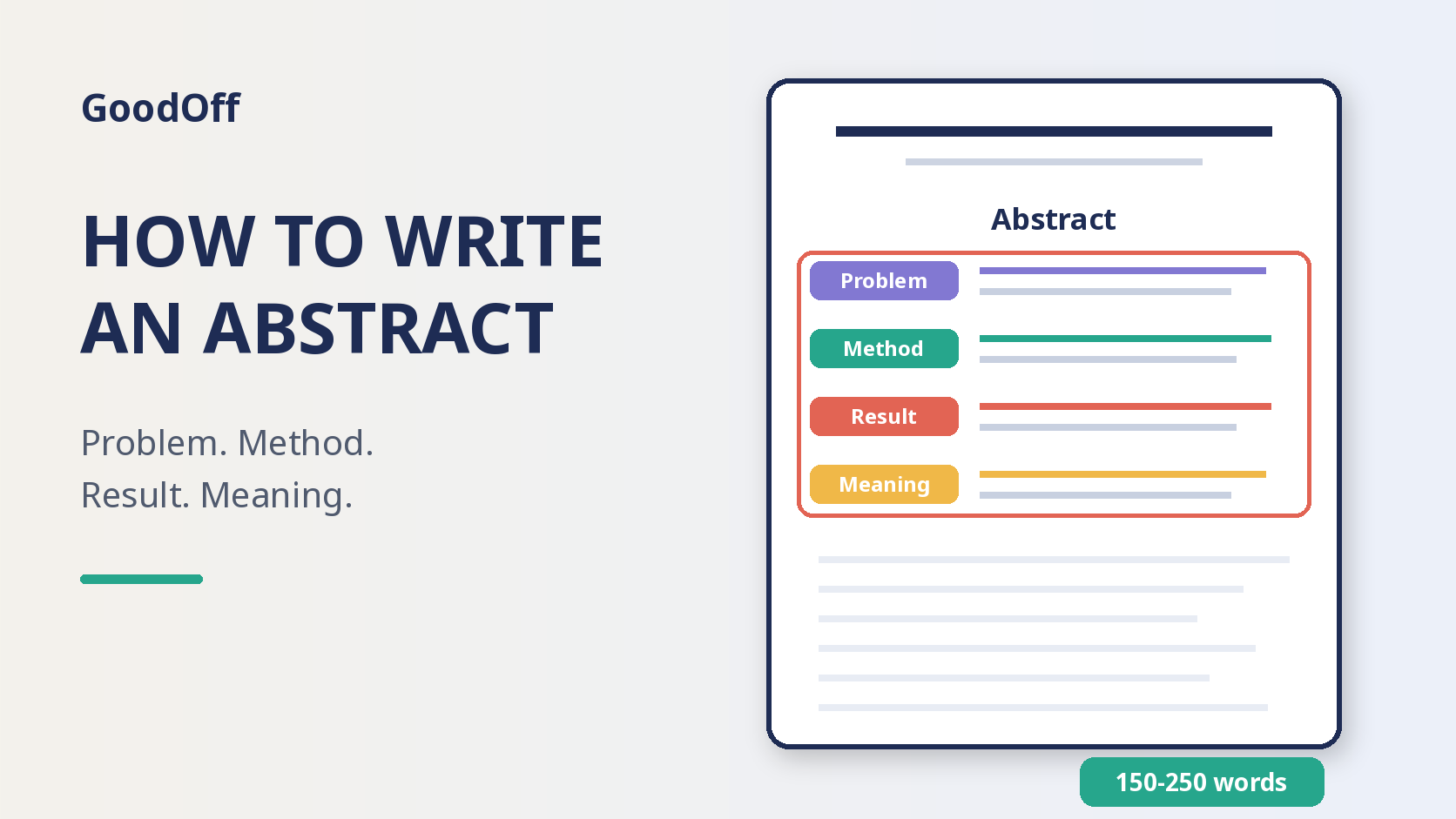
Short answer: To write an abstract, finish your paper first, then write one or two sentences for each of four parts: the problem, what you did, what you found, and why it matters. Keep it to one paragraph of about 150 to 250 words, skip citations, and make sure every claim also appears in the paper.
That's the whole job in two sentences. The hard part is cutting a 10-page paper down to a paragraph without turning it into a vague teaser. This guide gives you a sentence-by-sentence formula, two worked examples, a before-and-after rewrite, and a checklist you can run in five minutes.
What an abstract is (and what it isn't)
An abstract is a short, standalone summary of a finished piece of research. The UW-Madison Writing Center describes it as about one paragraph, roughly 6 to 7 sentences or 150 to 250 words, that lets readers grasp the essence of your paper and decide whether to read the rest.
Here's the fuller answer. A good abstract answers four questions in order: What problem or question did you tackle? How did you approach it? What did you find or argue? Why should anyone care? It should make sense on its own, because many readers will only ever see the abstract, and research databases often show it on its own. It isn't an introduction, it isn't a teaser, and it doesn't introduce anything the paper doesn't contain.
| Piece of writing | Job | Includes results? | Typical length |
|---|---|---|---|
| Abstract | Summarizes the whole finished paper | Yes, the key ones | 150 to 250 words |
| Introduction | Sets up the problem and leads into the paper | No (usually) | Several paragraphs |
| Conclusion | Interprets results and closes the argument | Refers back to them | One to several paragraphs |
| Executive summary | Briefs decision-makers on a report | Yes, plus recommendations | Often a page or more |
Do you even need one?
Check your assignment first. In APA 7, abstracts are standard for professional papers, but student papers usually don't need one unless your instructor asks for it, as both Scribbr and PERRLA point out. Lab reports, theses, capstones, conference submissions and journal articles usually do.
If the instructions are silent, ask. It takes one email and saves you a paragraph you might not need.
The 5-sentence abstract formula
Most guides agree on the same core parts. Oberlin's undergraduate research guide lists background, research question, methods, results and implications. PLOS uses background, objectives, methods, results and conclusions for journal articles. Here's that structure as a fill-in-the-blank plan you can draft in about 15 minutes.
| Sentence | What it answers | Starter you can adapt |
|---|---|---|
| 1. Context | What's known, and what's missing? | "Although X is well studied, little is known about Y." |
| 2. Purpose | What did you set out to do? | "This paper examines whether..." or "We tested..." |
| 3. Method | How did you do it, in broad strokes? | "Using [design, data, sample size], we..." |
| 4. Result | What did you find, with the key number? | "Group A scored 62%, compared with 25% for group B." |
| 5. Meaning | So what? | "These results suggest... and point to..." |
Five sentences often lands near 120 to 180 words. If your limit is 250, give the extra room to methods and results, not background. The UAMS science communication guide makes the same point: background is usually the shortest part, and results are usually the longest.
How to write an abstract, step by step
Step 1: Finish the paper first
You can't summarize something you haven't written. Drafting the abstract last also stops it from promising results your paper doesn't deliver. If you're required to submit an abstract before the work is done, as with some conference proposals, write what you plan to do and say so clearly.
Step 2: Pull one sentence from each section
Open your paper and highlight the single most important sentence in the introduction, methods, results and discussion. Paste those four sentences into a blank document. That's your raw material. Paperpal's step-by-step guide recommends almost exactly this: pick the key lines from each section, then rewrite them in your own words.
Step 3: Rewrite them as one paragraph
Copied sentences rarely flow. Rewrite them so each one leads into the next, and add the context sentence at the top if it's missing. Don't worry about word count yet. Southampton's library guide says it's fine to overwrite on the first draft and cut later.
Step 4: Make the results specific
This is where most student abstracts go soft. "Results were discussed" or "the groups differed" tells the reader nothing. The UAMS guide says to state the direction of a difference and give the numbers, for example "the treated group's response rate (62%) was greater than the control group's (25%)." If you tested a hypothesis, say whether the results supported it.
Step 5: Cut to the limit
Now trim. Delete background that a reader in your field already knows. Cut adverbs that don't change meaning, so "strongly suggests" becomes "suggests." Drop method details like software names unless they matter. Replace phrases with single words: "in order to" becomes "to."
Step 6: Run the standalone test
Give the abstract to someone who hasn't read your paper and ask them to explain your project back to you. If they can tell you what you did and what you found, you're done. If they can't, find the sentence that confused them and fix it.
Example 1: a science lab report abstract
We wrote this example for a simple pendulum lab, the same one used in our guide on how to write a lab report. It's an informative abstract, meaning it reports the actual results.
"A simple pendulum's period depends on its length and on local gravitational acceleration, which makes it a low-cost way to estimate g. This experiment measured g using a pendulum of length 0.500 m. We timed 10 complete swings in each of three trials (14.21 s, 14.18 s and 14.25 s), averaged the period, and calculated g from the small-angle period equation. The measured value was 9.77 m/s², 0.4% below the accepted 9.81 m/s². The small difference is consistent with reaction-time error in manual timing, and an electronic gate would likely reduce it."
That's 92 words. Notice what each sentence does: context, purpose, method with real numbers, the result with a comparison, and a short interpretation. There are no citations and nothing that isn't in the full report.
Example 2: a humanities or social science abstract
Papers without experiments still need the same four moves. The "method" becomes your approach or sources, and the "result" becomes your argument. Here's an example we wrote for a literature paper.
"Readers often treat the letters that frame Mary Shelley's Frankenstein as a simple device for starting the story. This paper argues that Robert Walton's letters do more: they set up a second, smaller version of Victor Frankenstein's ambition and give readers a character who chooses to turn back. Through a close reading of the four opening letters and the final chapters, I compare how Walton and Victor describe discovery, risk and responsibility to the people around them. I argue that Walton's decision to abandon his voyage works as the novel's answer to Victor, showing ambition that listens to others. Reading the frame this way shifts the novel's warning from science itself to ambition pursued alone."
This is an example of the pattern, not a summary of published scholarship. The pattern is what to copy: a gap, a focus, an approach, a clear claim, and why it matters.
Before and after: fixing a weak abstract
Here's a typical first draft for a study on practice testing, followed by a stronger version.
Before (vague): "Studying is important for students. This study looked at different study methods. Students were tested. The results showed some interesting differences between the groups. Implications are discussed."
After (specific): "Students often reread to prepare for exams, but research suggests testing yourself may help more. This study compared rereading with self-testing among 120 first-year biology students. Each group studied the same two-page text for 20 minutes, then took a recall test one week later. The self-testing group recalled 61% of key ideas, compared with 44% for the rereading group. Self-testing may be a better use of limited study time than rereading."
The "after" version is still short, but a reader now knows who, what, how, and how much. (The numbers in this example are made up to show the pattern. For real findings on this topic, see Roediger and Karpicke's 2006 testing-effect study, cited in our literature review guide.)
Abstract types and formats
| Type | What it does | Where you'll see it |
|---|---|---|
| Informative | Reports purpose, methods, results and conclusions | Lab reports, research papers, most science writing |
| Descriptive | Describes what the paper covers, often without results | Some humanities papers, proposals, short summaries |
| Structured | Uses labeled parts like Background, Methods, Results, Conclusions | Many medical and science journals |
| Unstructured | One continuous paragraph | Most student papers and APA papers |
Winthrop University's writing guide notes that descriptive abstracts are usually only 100 to 250 words. If you're not sure which type you need, an informative, unstructured paragraph is the safe default for coursework.
How long should an abstract be?
Follow your instructor, journal or conference first. Without a rule, these are common ranges:
- Student research papers: 150 to 250 words (UW-Madison, Oberlin).
- APA 7: usually no longer than 250 words, per Scribbr's summary of APA guidelines.
- Journals and conferences: often 200 to 300 words, according to the UAMS guide, but limits vary.
- Theses and dissertations: set by your school, so check the graduate handbook.
Southampton's guide puts the average around 200 words. If you're far under 150, you've probably left out methods or results. If you're far over 250, you're probably explaining background.
APA abstract format in 30 seconds
If your class uses APA 7, Scribbr and PERRLA describe the same layout:
- Put the abstract on its own page right after the title page (page 2).
- Write the label "Abstract" in bold, centered at the top.
- Start the text on the next line with no first-line indent, double-spaced.
- If you add keywords, put "Keywords:" in italics on an indented line below, followed by three to five lowercase keywords separated by commas.
Other citation styles handle abstracts differently, so check your style guide or assignment sheet if you're not using APA.
Common abstract mistakes
| Mistake | Why it hurts | Fix |
|---|---|---|
| Too much background | Leaves no room for results | One or two sentences of context, max |
| No actual results | Reader can't tell what you found | Give the key finding and its number |
| Citations in the abstract | Shifts focus away from your work | Save sources for the body |
| New information | Abstract and paper don't match | Check each claim against the paper |
| Undefined abbreviations | Confuses readers who skip the paper | Spell out terms or drop them |
| "Implications are discussed" | Says nothing | State the implication in one sentence |
| Over the word limit | Can get a submission rejected | Cut background and adverbs first |
A 5-minute abstract checklist
- Does it say what problem or question the paper addresses?
- Does it say how you approached it, in one or two sentences?
- Does it give at least one specific result or a clear main argument?
- Does it say why the findings matter?
- Is everything in it also in the paper?
- Are there no citations, tables or undefined abbreviations?
- Is it within the word limit, in one paragraph?
- Could a classmate explain your project after reading only this?
Using AI tools on your abstract
AI can be useful for checking an abstract you wrote: ask it to flag vague sentences or tell you which of the four parts is missing. Letting it write the abstract for you is riskier. It may invent results, smooth over limitations, or break your school's academic integrity policy, so check your course rules first. You're the one who knows what the paper actually found.
If you're still at the reading stage, our guide on how to read a research paper shows how to use other people's abstracts to decide what's worth reading in full.
Where GoodOff fits
GoodOff won't write your abstract, and you shouldn't want it to. Where it can help is the studying around your research. You can upload a PDF, notes, slides or a web page and make an AI study guide, quiz or flashcard deck from it. The Free plan includes AI decks, quizzes, study guides and FAQs with daily, weekly and monthly limits. On Pro, the Sage tutor answers questions from your uploaded source and cites the passage it used, which is a quick way to double-check what a paper you're citing actually says. AI-made cards and guides can be wrong, so check them against the source.
Frequently asked questions
What are the 4 parts of an abstract?
The problem or purpose, the method or approach, the main results or argument, and the conclusion or implications. Many guides add a short background sentence at the start.
Should I write the abstract first or last?
Last. It summarizes the finished paper, so writing it after everything else keeps it accurate. The exception is a proposal abstract for work you haven't done yet.
Can you cite sources in an abstract?
Usually not. Abstracts focus on your own work, and most guides, including UW-Madison and Scribbr, advise leaving citations for the body of the paper.
Is an abstract the same as an introduction?
No. An introduction sets up the problem and leads into the paper. An abstract summarizes the whole paper, including the results, so a reader could stop there and still know what you found.
How many sentences is an abstract?
Often five to seven sentences for a 150 to 250 word abstract. One or two sentences per part is a good target.
The bottom line
Write the abstract last, give each of the four parts a sentence or two, put a real number or a clear claim in the results, and cut background before anything else. Then hand it to someone who hasn't read the paper. If they can explain your project back to you, it works.
Need to study the papers behind your project? Try GoodOff free and turn a PDF into a study guide or quiz in your library.
Sources
- UW-Madison Writing Center, "Writing an Abstract for Your Research Paper."
- Oberlin College, "Abstract Writing," undergraduate research toolbox.
- University of Southampton Library, "Writing Abstracts."
- PLOS, "How to write an abstract for a journal article."
- UAMS Science Communication Group, "Writing a Scientific Abstract" (2026).
- Scribbr, "APA Abstract: Formatting, Length, and Keywords" (revised 2024).
- PERRLA, "How to Write an APA Abstract (APA 7)."
- Winthrop University, "How to Write an Abstract."
- Paperpal, "How to Write an Abstract in Research Papers."
- Roediger, H. L., and Karpicke, J. D. (2006). Test-enhanced learning. Psychological Science, 17(3), 249-255.