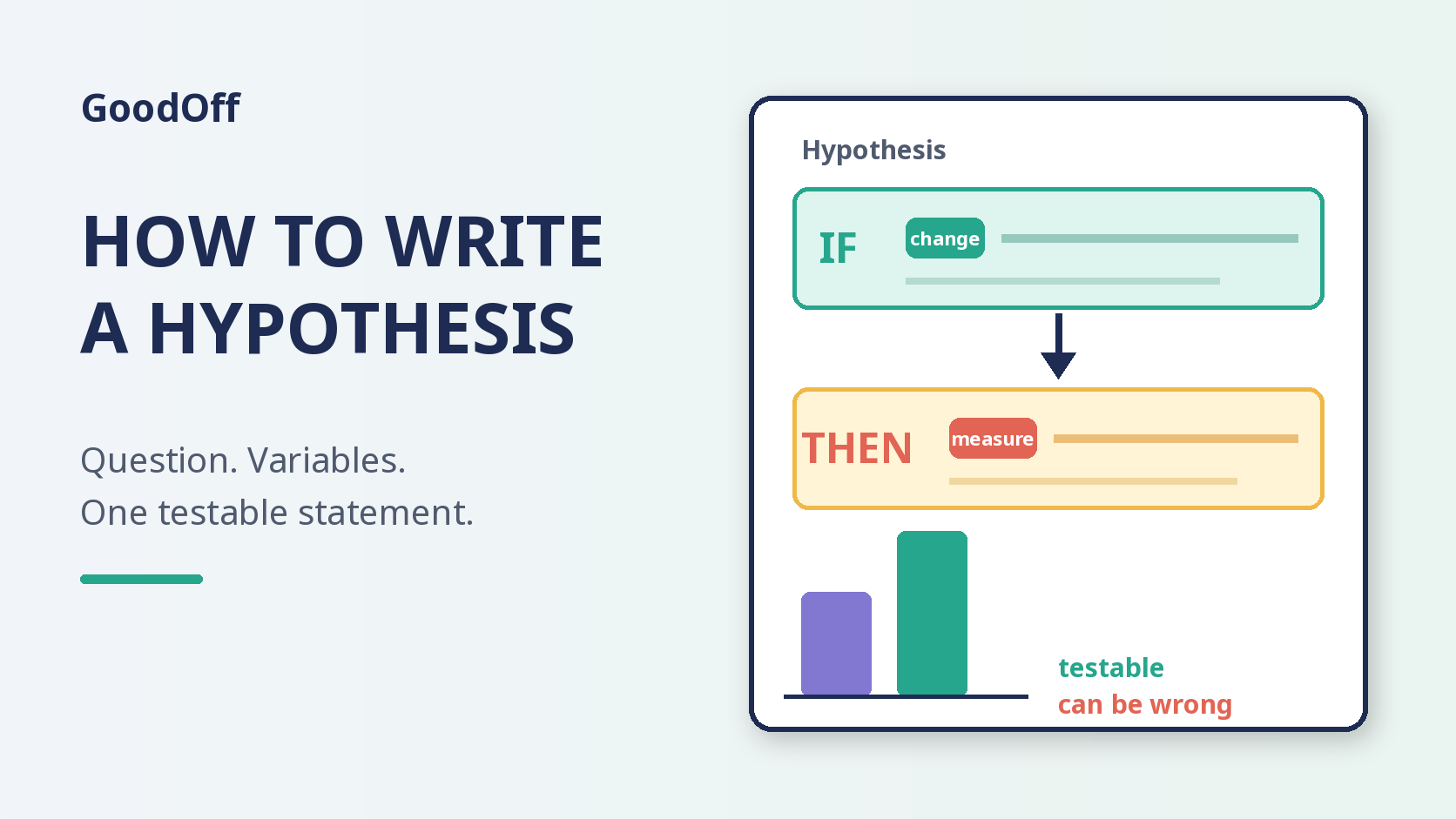
Short answer: To write a hypothesis, turn your research question into one testable statement that names what you change (the independent variable), what you measure (the dependent variable), and the direction you expect. Base it on background reading, and write it so your data could prove it wrong.
Most students lose points on the wording, not the science. "Sunlight affects plants" can't fail, so it isn't useful. "Bean plants that get 8 hours of light a day will grow taller in two weeks than plants that get 4 hours" can fail, so it is. This guide gives you a six-step method, fill-in templates for lab reports, psychology and research papers, a null hypothesis cheat sheet, and a checklist to run before you submit.
What a hypothesis is (and isn't)
A hypothesis is a tentative, testable answer to a question, based on what's already known. Science Buddies calls it a tentative, testable answer to a scientific question, and Scribbr stresses that it's not just a guess: it should rest on existing theory and research. The word that matters is testable. If no experiment or analysis could show it's wrong, it isn't a hypothesis yet.
Here's how it differs from the terms people mix up with it.
| Term | What it does | Example |
|---|---|---|
| Research question | Asks what you want to find out | Do students who attend more lectures get better exam results? |
| Hypothesis | Gives your tentative answer, with a reason | Attending more lectures leads to better exam results because students hear material explained and can ask questions. |
| Prediction | States what you'd observe if the hypothesis is true | If first-year students attend more lectures, their exam scores will be higher. |
| Theory | A broad, well-supported explanation, not a single guess | A theory of how memory forms |
The hypothesis and prediction split comes from Trent University's academic skills guide: the hypothesis explains why something happens, and the prediction is the outcome you'd see if it were correct. Many classes blur the two and call the "if, then" sentence the hypothesis. That's fine in a science fair, but check what your instructor wants (more on that below).
How to write a hypothesis in 6 steps
We'll use one running example: does studying with practice questions beat rereading?
Step 1: Start with a narrow, answerable question
Scribbr says the question should be focused, specific and researchable within your project's limits. "How do students learn?" is too wide. "Do students who take a practice quiz score higher on a vocabulary test than students who reread the list?" is workable.
Step 2: Do some background reading
Your hypothesis should come from what's known, not from nowhere. Skim a few sources and note what past studies found. If you're not sure how to read papers quickly, our guide on how to read a research paper shows a three-pass method. For a larger project, a literature review is the longer version of this step.
Step 3: Name your variables
Write down the independent variable (what you change or compare) and the dependent variable (what you measure). In the example, the independent variable is the study method (practice quiz or rereading). The dependent variable is the score on the vocabulary test. If you spot other things that could affect the result, such as study time, list them as variables to control.
Step 4: Write your first draft as one statement
Say what you expect in one clear sentence: "Students who take a practice quiz will score higher on a vocabulary test than students who reread the list." Texas A&M's University Writing Center advises writing it as a statement and avoiding hedges like should, might or could.
Step 5: Make it specific and measurable
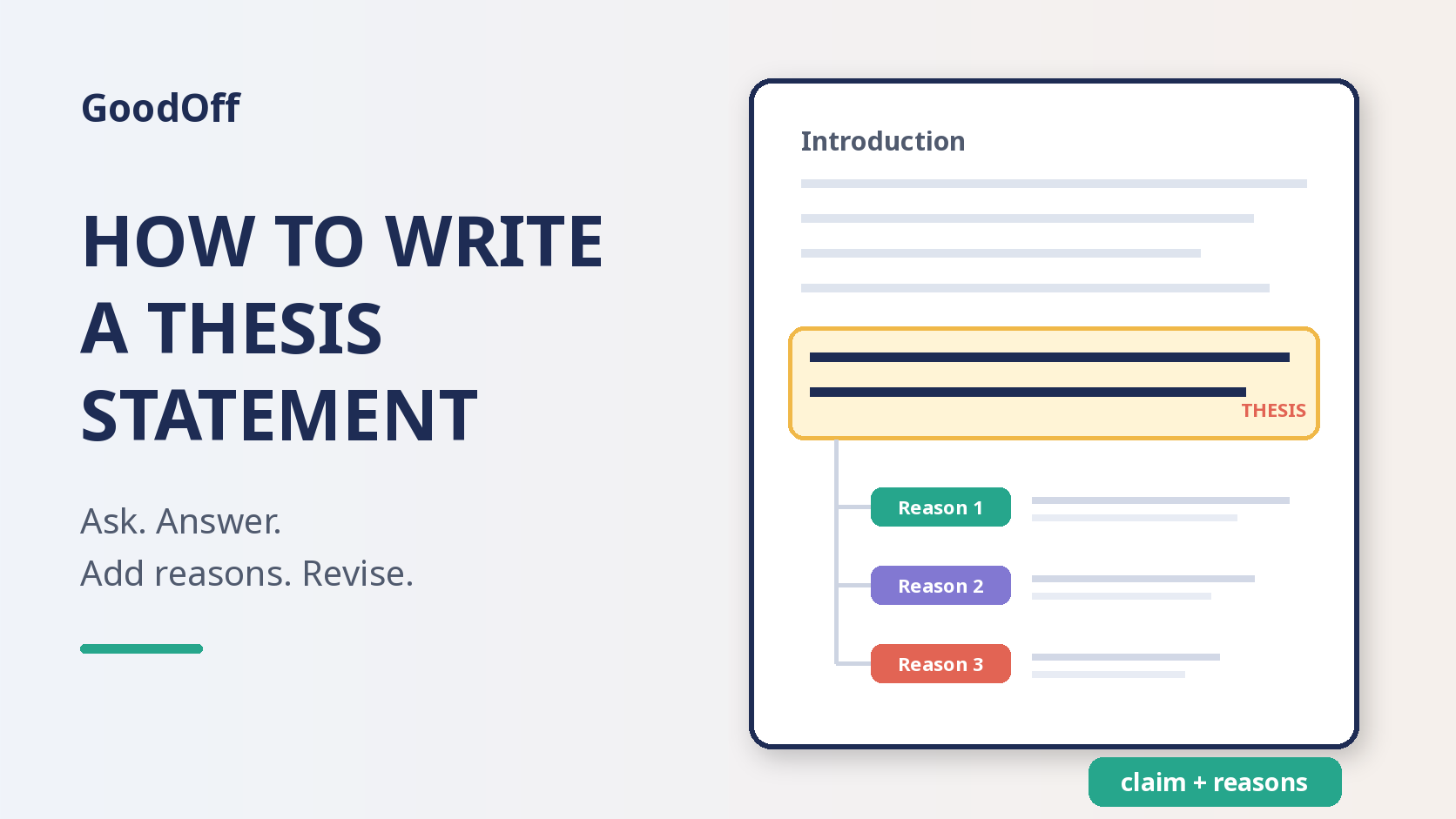
Add the group, the measure and the direction. Scribbr says a refined hypothesis contains the relevant variables, the specific group and the predicted outcome. UNC's Writing Center gives a clean before and after: "there is a significant relationship between solvent temperature and dissolving rate" is not a hypothesis, while "as the temperature of a solvent increases, the rate at which a solute dissolves increases" is, because it says how the variables relate.
Our version: "First-year students who answer 20 practice questions will score higher on a 30-word vocabulary test one day later than students who reread the same list for the same amount of time."
Step 6: Add the reason, then check it can fail
Some instructors want a "because" clause. Let's Talk Science uses "If ___ then ___ because ___," and one university lab guide asks for a rationale so the hypothesis explains something. For the example: "...because trying to recall an answer is more active practice than seeing it again." Then ask: what result would show I'm wrong? If you can name one (the rereading group scores the same or higher), the hypothesis is testable.
Hypothesis templates you can copy
These are fill-in formats, not rules. The examples are made up to show the shape.
| Format | Template | Example |
|---|---|---|
| If, then | If [independent variable changes], then [dependent variable will change this way]. | If bean plants get 8 hours of light instead of 4, then they will grow taller in two weeks. |
| If, then, because | If [change], then [result], because [reason]. | If a sports drink replaces water during a workout, then heart rate will recover faster, because the body replaces fluid and salt sooner. |
| Effect or correlation | [Variable A] has a [positive/negative] effect on [variable B] in [group]. | Hours of sleep have a positive effect on quiz scores in first-year students. |
| Group comparison | [Group 1] will have [higher/lower] [measure] than [group 2]. | Students who use practice questions will score higher than students who reread. |
| Lab report (past tense) | It was hypothesized that [change] would [result]. | It was hypothesized that fertilizer would increase the chlorophyll concentration of pea plants. |
The lab report format follows examples from UNC and the University of Vermont writing centers, which show the hypothesis in past tense in the introduction. If you're writing the full report, our section-by-section lab report guide shows where it goes.
Null and alternative hypotheses
If your project uses statistical tests, you'll usually write two hypotheses. The null hypothesis (H0) is the default position that there's no effect or no relationship. The alternative hypothesis (H1 or Ha) is your actual prediction. Scribbr's example uses lecture attendance and exam scores.
| Type | Says | Example |
|---|---|---|
| Null (H0) | No effect or no difference | The number of lectures attended has no effect on exam scores. |
| Alternative (H1) | There is an effect or a difference | The number of lectures attended has a positive effect on exam scores. |
One wording tip from Texas A&M: when you report results, you don't "accept" the alternative. You say whether you rejected the null hypothesis. If you're meeting this for the first time in a stats class, our guide on how to study statistics walks through choosing and explaining a test.
Good and weak hypotheses side by side
| Weak | Why it fails | Stronger |
|---|---|---|
| Music affects studying. | No direction, no measure, can't be wrong | Students who study with lyrical music will score lower on a reading quiz than students who study in silence. |
| Sleep is important for students. | An opinion, not testable as written | Students who sleep 8 hours before a memory test will recall more words than students who sleep 5 hours. |
| Students should use flashcards. | A recommendation, not a prediction | Students who review with flashcards will recall more terms after one week than students who reread notes. |
| Is social media bad for attention? | A question, not a statement | Higher daily social media time is associated with lower scores on an attention task in under-16s. |
Notice the last row says "associated with." If you're only measuring two things and not controlling either, don't claim one causes the other. The California Learning Resource Network lists correlation versus causation as a common slip.
Hypothesis checklist
Science Buddies publishes a yes or no checklist. Here's a version adapted from it and from the other sources:
- Is it based on background information, not a hunch?
- Is it a statement, not a question or a recommendation?
- Does it name an independent and a dependent variable?
- Does it say the direction (higher, lower, faster, no change)?
- Can you measure the outcome?
- Could your results show it's wrong?
- Is it one idea, not three joined with "and"?
Check your instructor's format first
Sources disagree on small points, and your grade follows your class. Science Buddies says predictions often take an "if, then" shape. One university lab guide (GCU) says a hypothesis should be a statement with a "because" rationale, not an "if, then" prediction, and that graded work depends on whether it's testable, not whether it's right. Texas A&M says to avoid conditional words like should or might. When in doubt, follow your syllabus or rubric, and ask your TA which version they expect.
What if your data doesn't support it?
That's a normal result. Science Buddies says the point of a project isn't to prove your hypothesis right, and that judges can be just as impressed when a project starts with a faulty hypothesis, as long as you understood it and ran a well-controlled experiment. In a lab report, say the hypothesis wasn't supported, give possible reasons, and say what you'd test next. Don't rewrite the hypothesis after the fact so it matches your data. Your original wording is part of the record.
Common mistakes
- Writing a question. Turn it into a statement.
- Being too vague. "Affects" and "is related to" hide the direction. Say increases, decreases, or higher than.
- Using several variables at once. Test one change at a time so you know what caused the result.
- Making it unfalsifiable. A claim like "good teaching is better" has no measure, so no result could ever show it's wrong.
- Picking an untestable topic. Texas A&M notes that moral or ethical questions don't suit a hypothesis because you can't test them.
- Writing it after the results. UNC recommends writing it down before you run the experiment.
Where GoodOff fits
GoodOff doesn't write hypotheses for you, and it isn't a lab report grader. It can help with the reading that comes before. Upload a PDF, your notes or slides, and make an AI study guide, quiz or flashcards from them. The Free plan includes AI decks, quizzes, study guides and FAQs with daily, weekly and monthly limits. On Pro, the Sage tutor answers questions from the source you uploaded and cites the passages it used, which helps when you want to check what a paper actually found before building a hypothesis on it. AI answers can still be wrong, so confirm them against the source.
Frequently asked questions
What is the easiest way to write a hypothesis?
Use "If [I change this], then [this will happen]." Name what you change and what you measure, and make sure a result could prove it wrong. Add "because" and a short reason if your instructor asks for one.
Is a hypothesis just an educated guess?
Science Buddies describes it as one, but with a condition: it has to be testable. Scribbr adds that it should be based on existing theories and knowledge, so it's more than a guess.
What's the difference between a hypothesis and a prediction?
The hypothesis is your explanation. The prediction is what you'd observe if the explanation is right. Some courses treat them as the same thing, so follow your rubric.
Do I need a null hypothesis?
Only if you'll run a statistical test. Then you write a null hypothesis (no effect) and an alternative hypothesis (your prediction). For a simple science fair experiment, one clear hypothesis is usually enough.
Can a hypothesis be wrong?
Yes, and it's allowed to be. A good hypothesis can be shown wrong. A hypothesis that your data doesn't support still teaches you something and can lead to a better one.
Where does the hypothesis go in a lab report?
In the introduction, after the background, usually in past tense with your predicted outcome. The University of Vermont's guide places both the hypothesis and predictions there.
The bottom line
Start from a narrow question, read what's known, name your variables, and write one specific statement with a direction. Add a reason if your class asks for it, then check it against the list: testable, measurable, and able to be wrong. A hypothesis that's clear is worth more than one that turns out right.
Need to get through the background reading first? Try GoodOff free and turn a PDF into a study guide or quiz in your library.
Sources
- McCombes, S. (revised 2025), "How to Write a Strong Hypothesis | Steps and Examples," Scribbr.
- Science Buddies, "Writing a Hypothesis for Your Science Fair Project" and "Write a Testable Hypothesis."
- Texas A&M University Writing Center, "Hypotheses."
- The Writing Center, University of North Carolina at Chapel Hill, "Scientific Reports."
- Trent University Academic Skills, "Understanding Hypotheses and Predictions."
- University of Vermont Writing Centers, "Writing a Lab Report."
- Let's Talk Science, "Developing a Hypothesis."
- Grand Canyon University, Lab Report Guide, "Hypothesis."
- California Learning Resource Network, "How to Write a Hypothesis for Science Fair."