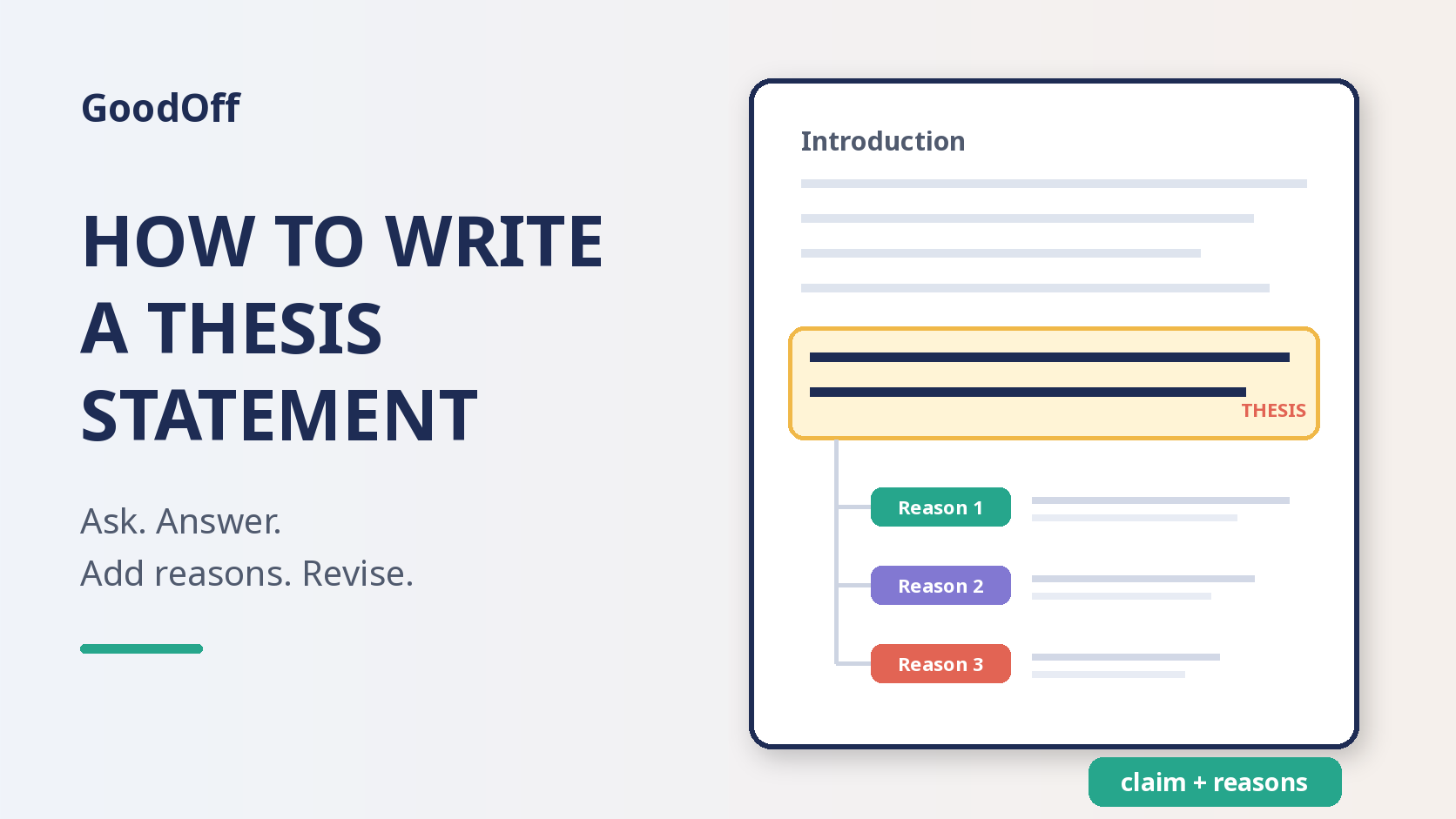
Short answer: To write a thesis statement, turn your assignment into a question, write a one-sentence answer that someone could disagree with, then make it specific by adding your main reasons. Put it at the end of your introduction and revise it after you finish your draft.
That's the method. The hard part is getting from a vague first try like "social media has pros and cons" to a sentence that actually tells your reader what you'll prove. This guide walks you through a four-step process, gives you a fill-in formula for each essay type, shows three weak-to-strong rewrites, and ends with a six-question test you can run on any thesis in two minutes.
What a thesis statement is
A thesis statement is the one or two sentences that state the main point of your essay. The UNC Writing Center puts it simply: a thesis tells the reader how you'll interpret the subject, works as a road map for the paper, directly answers the question you were asked, and makes a claim that others might dispute. It usually sits at the end of your first paragraph.
Here's the fuller answer. A topic is what your essay is about. A thesis is what you're saying about that topic. "World War II" is a topic. "Radar did more than any single battle to keep Britain from losing the air war in 1940" is a thesis, because it takes a position you'd have to defend with evidence. Everything in your body paragraphs should either support that claim or deal with an objection to it.
| It's a thesis if it... | It's not a thesis if it... |
|---|---|
| Makes a claim a reasonable person could argue with | States a fact nobody disputes ("Jane Austen wrote Pride and Prejudice") |
| Answers the question in your prompt | Announces your subject ("This essay is about climate policy") |
| Is specific enough to prove in your word count | Covers a whole field ("Technology has changed society") |
| Hints at your reasons or structure | Is a title or a question |
The "not a thesis" column comes almost straight from Purdue OWL's guide to argument papers, which warns that a thesis is not a title, not an announcement of the subject, and not a statement of absolute fact.
How to write a thesis statement in 4 steps
Scribbr's guide breaks the process into four moves: start with a question, write an initial answer, develop it, then refine it. That matches how most writing centers teach it, so here it is with a worked example running through each step.
Step 1: Turn your prompt into a question
Most essay prompts aren't phrased as questions, and that's where weak theses start. UNC suggests rephrasing them. "Discuss the effect of X on Y" becomes "What is the effect of X on Y?" Once it's a question, you can see whether your thesis actually answers it.
Example prompt: "Discuss the role of homework in middle school." Rephrased: "Should middle schools assign daily homework, and why?"
Step 2: Write a quick, rough answer
Write the first answer that comes to mind after your initial reading. Don't polish it. This is your working thesis, and it's supposed to be rough.
Working thesis: "Middle schools should assign less homework."
That's a start. It takes a side. But it doesn't say why, how much less, or what should replace it.
Step 3: Add your reasons
Ask yourself why you believe your answer, and write the two or three strongest reasons you can actually support with sources. If you can't name a reason you could find evidence for, your thesis isn't ready yet.
Developed thesis: "Middle schools should replace daily homework with two short weekly practice sets, because shorter assignments are more likely to get done, easier for teachers to give feedback on, and fairer to students without quiet space at home."
Step 4: Refine it after you draft
Your thinking will change while you write. Purdue OWL notes that your topic may shift as you write, so you may need to revise your thesis to match what you actually discussed. Once the draft is done, reread your thesis and your body paragraphs side by side. If they don't match, change whichever one is wrong. Often it's the thesis.
If your evidence turned out weaker on one reason, cut it from the thesis. If a new point became your strongest paragraph, add it. A thesis that matches the paper is worth more than one that sounded good on day one.
Thesis statement formulas by essay type
Purdue OWL sorts most academic papers into three kinds: analytical, expository and argumentative. Each needs a slightly different kind of thesis. Use these templates to get a first draft on the page, then rewrite them in your own words so they don't sound like templates.
| Essay type | What the thesis does | Fill-in formula | Example |
|---|---|---|---|
| Argumentative | Takes a position and names the reasons | [Claim], because [reason 1], [reason 2] and [reason 3]. | Cities should make buses free for students, because fares keep low-income teens from after-school programs and cost little to collect. |
| Analytical (literature, film, history) | Interprets how or why something works | In [work], [author] uses [technique or pattern] to show [meaning]. | In Frankenstein, Shelley uses nested narrators to make readers question whose version of events to trust. |
| Expository (explain or inform) | States the main point and the parts you'll explain | [Topic] depends on [part 1], [part 2] and [part 3]. | Photosynthesis depends on capturing light, splitting water and fixing carbon dioxide into sugar. |
| Compare and contrast | Says what the comparison reveals | Although [A] and [B] both [shared trait], [key difference] shows [insight]. | Although both novels follow orphans, Jane Eyre treats independence as earned while Oliver Twist treats it as luck. |
| Cause and effect | Names the main cause or effect and why it matters | [Cause] led to [effect] mainly by [mechanism]. | The printing press spread Reformation ideas mainly by making cheap pamphlets possible. |
| Research paper | Answers your research question with a supportable claim | [Answer to research question], as shown by [type of evidence]. | Later school start times improved attendance in the districts studied, based on district records. |
The examples in the table are illustrations written for this guide, not claims we're making about the research. If you use a cause-and-effect or research thesis in a real paper, the evidence has to come from your sources.
Narrative and personal essays are looser. Purdue OWL notes that even a text outside the three main types can still benefit from a clear main-point sentence early on. For a personal essay, that might be the lesson or change your story shows, stated plainly.
Three weak-to-strong rewrites
The fastest way to learn this is to watch a weak thesis get fixed. Each rewrite below solves a different problem.
Problem 1: Too vague
Weak: "Social media impacts public awareness in both positive and negative ways."
This one comes from UNC's own handout, which points out that almost nobody would disagree with it and it doesn't say which effects matter. Their stronger version: "Because not every voice on social media is reliable, people have become much more critical consumers of information, and thus, more informed voters." It picks one effect, takes a side and gives a reason.
Problem 2: Just a fact
Weak: "Shakespeare wrote Macbeth around 1606."
You can't argue with a date, so there's nothing to prove. Ask what interests you about the play. Stronger: "Macbeth's hallucinations show his guilt arriving before his crimes, which suggests Shakespeare saw conscience as something that works ahead of action, not after it."
Problem 3: Too much
Weak: "Detective stories are not a high form of literature, but people have always been fascinated by them, and many fine writers have experimented with them."
Purdue OWL uses this exact example of a thesis that isn't unified. It makes three separate claims, and a five-page essay can't prove all three. Their tighter version: "Detective stories appeal to the basic human desire for thrills." One claim, one essay.
Where to put your thesis statement
In most college essays, the thesis goes at the end of the introduction. UNC, Purdue OWL and Scribbr all give the same advice. Your intro gives the reader enough context to care, and then the thesis tells them exactly where you're going.
| Paper length | Thesis length | Where it goes |
|---|---|---|
| Short essay (about 2 to 5 pages) | One sentence | Last sentence of the first paragraph |
| Longer essay or research paper | One to two sentences | End of the introduction, which may be two paragraphs |
| Timed exam essay | One sentence | First or second sentence of your answer |
These are typical patterns, not fixed rules. Some instructors and disciplines do it differently, so follow your assignment sheet if it says otherwise. On a timed exam, get your thesis down early so the grader sees your answer right away. Our guide on how to study for an essay exam shows how to plan a thesis before you walk in.
The 6-question thesis test
UNC's handout suggests a set of questions to ask about any working thesis. Here they are as a quick checklist. If you answer "no" to any of them, revise before you write another paragraph.
| Question | If the answer is no, try this |
|---|---|
| Does it answer the question in the prompt? | Reread the prompt as a question and answer that question directly. |
| Could someone reasonably disagree? | Replace a fact with your interpretation of what that fact means. |
| Is it specific? | Swap words like "good," "important" or "successful" for what exactly makes it so. |
| Does it pass the "so what?" test? | Add why the claim matters: who it affects or what it changes. |
| Does it pass the "how and why?" test? | Name your main reasons so readers know how you'll prove it. |
| Does the essay actually support it? | Change the thesis or the body until they match. |
Common thesis mistakes
- Announcing instead of arguing. "In this essay I will discuss..." tells the reader your topic, not your point. Cut the announcement and state the claim.
- Hedging every word. "It could perhaps be argued that..." sounds unsure. You can qualify a claim ("in most cases," "for younger students") without hedging the whole sentence.
- Listing reasons you can't support. Every reason in your thesis promises a section. If you have evidence for two reasons, name two.
- Writing it as a question. A question can lead into your thesis, but it can't be the thesis. Answer it.
- Never revising. A working thesis is meant to change. Your final version will often look quite different from your first try.
Can you use AI to write a thesis statement?
Scribbr suggests AI tools can help brainstorm and refine thesis ideas, and that's the safer way to use them. Ask a chatbot to argue against your working thesis, or to tell you which of the six test questions it fails. Don't paste the prompt in and submit whatever comes out. It can produce a thesis you can't support with your sources, and your school's integrity policy may not allow it. Check your course rules first. For prompts that keep you doing the thinking, see our guide to using AI to study without cheating.
From thesis to draft
Once your thesis works, turn each reason into a topic sentence for a body paragraph. That gives you an outline in about five minutes. If you're writing a longer research paper, your thesis usually comes after you've read enough to see the pattern, which is why our guide on how to write a literature review starts with grouping sources before you take a position. And if the first draft feels slow, the vomit draft method gets words down fast so you can fix the thesis on the second pass.
Where GoodOff fits
GoodOff won't write your thesis, and it isn't an essay grader. It helps with the reading behind your argument. You can upload a PDF, notes, slides or a web page and make an AI study guide, quiz or flashcards from it. The Free plan includes AI decks, quizzes, study guides and FAQs with daily, weekly and monthly limits. On Pro, the Sage tutor answers questions from your uploaded source and cites the passage it used, which is a quick way to check that a quote or claim you want to use really says what you think. AI-made answers can still be wrong, so check them against the source.
Frequently asked questions
How long should a thesis statement be?
Usually one sentence for a short essay, and up to two sentences for a longer paper. Scribbr recommends stating your point in one or two sentences, and Purdue OWL notes that more complex papers may need a combination of sentences.
Can a thesis statement be a question?
No. A question can set up your thesis, but the thesis has to answer it. Readers should know your position after reading it.
Does a thesis need three points?
No. The three-point thesis is a common school habit, not a rule. Name as many reasons as your essay will actually develop. Two strong reasons beat three thin ones.
Should I write my thesis first or last?
Write a working thesis first so your draft has direction, then revise it last so it matches what you actually wrote. UNC calls the thesis the result of a lengthy thinking process, not the first thing you do.
What's the difference between a thesis and a topic sentence?
A thesis states the main point of the whole essay. A topic sentence states the main point of one paragraph and supports the thesis.
The bottom line
Turn the prompt into a question, answer it with a claim someone could disagree with, add the reasons you can prove, and put it at the end of your introduction. Then run the six-question test after your draft and fix whatever doesn't match. A thesis isn't a sentence you get right once. It's a sentence you keep honest.
Need to get through the readings first? Try GoodOff free and turn a PDF into a study guide or quiz in your library.
Sources
- The Writing Center, University of North Carolina at Chapel Hill, "Thesis Statements."
- Purdue Online Writing Lab, "Tips and Examples for Writing Thesis Statements."
- Purdue Online Writing Lab, "Argument Papers."
- McCombes, S. (revised 2023), "How to Write a Thesis Statement: 4 Steps and Examples," Scribbr.