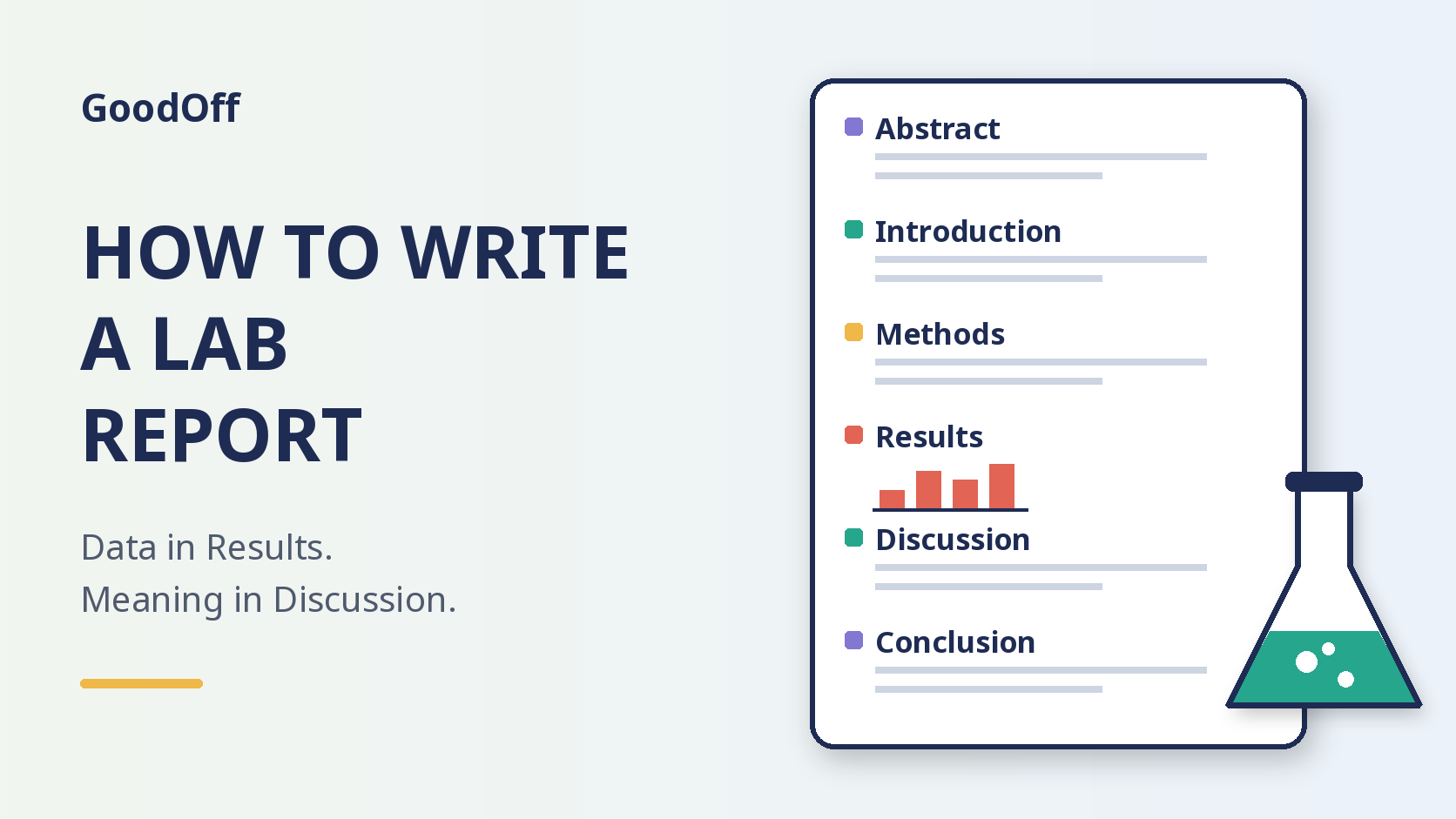
Short answer: to write a lab report, start with the Methods and Results while the lab is fresh, then write the Discussion, Introduction and Conclusion, and write the Abstract and title last. Each section answers one question: why you did it, what you did, what you found, and what it means. Keep data in Results and interpretation in Discussion.
Most lab reports lose marks for the same few reasons: results mixed with interpretation, a Discussion that just repeats the numbers, vague "human error" and an abstract with no actual data in it. This guide walks through each section, gives you a writing order that saves time, and shows a short worked example from a simple pendulum lab.
The Quick Version
A standard lab report follows the same shape as a short scientific paper, often called IMRaD (Introduction, Methods, Results and Discussion). Here's what goes where.
| Section | Question it answers | Tense | Common mistake |
|---|---|---|---|
| Title | What did you test? | None | "Lab 3" instead of a descriptive title |
| Abstract | What's the whole report in one paragraph? | Past | No numbers from the results |
| Introduction | Why does this experiment matter, and what did you expect? | Present for theory, past for your aim | Copying the lab manual's background |
| Methods | What did you do, in enough detail to repeat it? | Past | Writing it as a numbered recipe |
| Results | What did you measure? | Past (present when pointing to a figure) | Explaining the results here |
| Discussion | What do the results mean? | Present for interpretation | "Human error" with no specifics |
| Conclusion | What's the answer to your question? | Present | Introducing new data |
| References and appendices | Where did your facts and raw data come from? | None | Missing citations for background facts |
The tense guidance comes from writing guides such as George Mason University's IMRaD page and Washington State University's engineering lab report modules. Your instructor's format always wins, so check the rubric first.
What a Lab Report Is Really For
A lab report isn't a diary of what happened in lab. It's an argument. You asked a question, collected evidence and now you're telling the reader what that evidence supports and how much they should trust it.
That's why the sections are kept separate. A reader should be able to look at your Results and see the data without your opinion on it, then read the Discussion to see how you interpret it. When the two blur together, the reader can't tell what you measured from what you think.
The weighting of a typical rubric shows what instructors care about. A sample bacteriology assignment from the UW-Madison Writing Center gives 10 points to the abstract, 20 to the introduction, 30 to materials and methods (lab notes), 15 to results and 25 to the discussion, out of 100. Interpretation and method carry the most weight, not formatting.
The Best Order to Write It In
You read a lab report from top to bottom, but you shouldn't write it that way. The University of Southampton's library guide suggests starting with the Methods because it's the most concrete section. Here's an order that works for most students:
- Methods first, the same day as the lab, while you still remember what actually happened.
- Results second: build your tables and figures, then write a few sentences that point out the main pattern.
- Discussion third: this is the thinking part, so give it your best hour.
- Introduction fourth: now you know what background the reader needs to follow your Discussion.
- Conclusion fifth: two to four sentences that answer the question you set out to test.
- Abstract and title last: you can't summarize a report you haven't written.
How to Write Each Section
Title
Say what you tested and on what. "Measuring g With a Simple Pendulum" tells the reader more than "Physics Lab 4." If your course asks for a title page, it usually includes your name, lab partners, course, section and date.
Abstract
The abstract is one paragraph, often 100 to 200 words, that covers purpose, method, key result and conclusion. The UW-Madison sample assignment says the most common student mistake is leaving out summary data. Don't write "the results were discussed." Write the number.
Introduction
Give the reader the theory they need, cite where it came from and end with your aim or hypothesis. Go from general to specific: the concept, why it matters, the equation or model you're testing, then "This experiment measured..." or "We predicted that...". Two or three short paragraphs is enough for most undergraduate labs.
Methods
The test for a Methods section is simple: could another student repeat your experiment from it? Include equipment, quantities, settings and procedure, plus anything you changed from the lab manual. Write it as paragraphs in the past tense, not a numbered list of commands. Some courses let you attach lab notebook pages instead, so check.
Results
Present your data in tables and figures, then write short text that points out what the reader should notice. Don't analyze it yet. The University of Toronto Mississauga's lab report guide puts it plainly: describe your key findings in Results and save the analysis for the Discussion.
A few rules make your figures easier to grade:
- Number tables and figures separately (Table 1, Figure 1) and refer to each in the text.
- Many style guides put table titles above tables and figure captions below figures. Some courses put both below, so follow your handout.
- Label every axis and column with units.
- Report measurement uncertainty where your course expects it.
- Put long raw data tables in an appendix and keep the summary in Results.
Discussion
This is where most of the marks are. A strong Discussion does four things:
- States what the results show in one or two sentences.
- Compares them with theory or an accepted value, with a percent error or percent difference where it applies.
- Explains specific sources of error and which direction each would push your result.
- Suggests a concrete improvement to the method.
Avoid "human error" as an explanation. It doesn't tell the reader anything. Name the actual problem: reaction time when starting and stopping a stopwatch, a thermometer read at an angle, heat lost to the air. Then say whether it made your value too high or too low.
Conclusion
Answer the question from your Introduction. Restate the key result with its number and say whether it supported your hypothesis. Don't add new data or new ideas here.
References and Appendices
Cite the lab manual, textbook and any papers you used for background facts. Use the citation style your course asks for (APA is common in psychology and biology courses, and many chemistry courses use ACS). Appendices hold raw data, long calculations and anything that would clutter the main text.
A Worked Example: The Pendulum Lab
Here's how one simple experiment turns into each section. Say you timed 10 swings of a pendulum with a 0.500 m string, three times, and got 14.21 s, 14.18 s and 14.25 s.
| Section | What you'd write (short version) |
|---|---|
| Introduction | For small angles, a simple pendulum's period is T = 2π√(L/g). This experiment used the period of a 0.500 m pendulum to estimate g. |
| Methods | A 0.500 m string was attached to a clamp stand with a 50 g mass. The mass was released from about 10 degrees, and the time for 10 complete swings was measured three times with a handheld stopwatch. |
| Results | The mean time for 10 swings was 14.21 s, giving a period of 1.421 s (Table 1). The calculated value of g was 9.77 m/s². |
| Discussion | The value is 0.4% below the accepted 9.81 m/s². Starting and stopping the stopwatch by hand adds reaction-time error to each trial; timing 10 swings instead of one spreads that error across the swings. A light gate would reduce it further. |
| Conclusion | The pendulum method gave g = 9.77 m/s², within 0.4% of the accepted value. |
Notice what each row is doing. The Results row reports numbers with no opinion. The Discussion row compares, explains a specific error source and suggests a fix. That separation is the habit graders look for.
How to Write a Lab Report Faster
Most of the time in a lab report goes into staring at a blank page, not into writing. These habits cut that down:
- Write a sentence outline first. Put two or three rough sentences under each heading before you write any section properly. Southampton's guide recommends this to get past the blank page.
- Do the Methods before you leave the lab, or at least that evening.
- Build the figures before the text. Once you can see the pattern, the Results paragraph almost writes itself.
- Keep a reusable checklist from your rubric and tick it off before you submit.
- Read the Discussion out loud. If a sentence only repeats a number from Results, cut it or explain what it means.
If you're reading published papers for the Introduction, our guide on how to read a research paper shows a three-pass method that gets you the background without reading every word.
Common Mistakes to Avoid
- Interpreting in Results. Words like "this shows" or "because" usually belong in the Discussion.
- Copying the lab manual. Paraphrase the procedure and note what you actually did, including changes.
- Hiding bad data. An unexpected result with an honest explanation earns more credit than a suspiciously perfect one.
- Unlabeled graphs. No units, no axis titles, no caption.
- Vague error analysis. "Human error" and "the equipment wasn't perfect" don't count.
- An abstract with no results. Put the key number in.
Studying the Science Behind Your Labs
Labs show up on exams too. Questions often ask you to predict a result, spot a flawed method or explain an error source. After each lab, write three or four practice questions about it: what was the variable, what would happen if you doubled it, what was the biggest source of error. Then answer them from memory a few days later.
For subject-specific study plans, see how to study for a biology exam and how to study physics. If your lab analysis uses t-tests or standard deviation, how to study statistics walks through choosing the right test.
Where GoodOff Fits
GoodOff won't write your lab report, and you shouldn't want it to. Your instructor is grading your thinking. Where it can help is the studying around the lab.
- Lab manual to flashcards and quizzes: upload the lab manual PDF or your notes and GoodOff drafts editable flashcards and a quiz. Cards are scheduled with FSRS spaced repetition, and quizzes include explanations. Both are on the Free plan within daily, weekly and monthly limits.
- Questions about your sources: on Pro, the Sage tutor answers questions grounded in a file you've uploaded and points to the passage it used. You can also send it a photo of a diagram.
AI-generated cards can be wrong or miss the point, so check them against your manual before you rely on them.
Frequently Asked Questions
How long should a lab report be?
There's no standard length. It depends on the course and the experiment, so follow your rubric's word or page limit and keep each section focused on its one job. A short Methods section and a thorough Discussion is usually a better balance than the reverse.
What is the correct order of a lab report?
The usual order is title, abstract, introduction, methods, results, discussion, conclusion, references and appendices. Some courses merge results and discussion or skip the abstract, so check your instructions.
Should a lab report be written in past or present tense?
Write the methods and results in the past tense because you already did the experiment. Use the present tense for established theory, for pointing to figures ("Figure 2 shows") and for your interpretations.
Can I use "I" or "we" in a lab report?
Often, yes. APA style, for example, accepts first person ("We measured..."), and many science journals use it. Some instructors still prefer passive voice. Ask, or check a sample report from the course.
What do I write if my experiment didn't work?
Report what you got, honestly. Then use the Discussion to explain likely causes, which direction they'd push the result and what you'd change next time. A clear explanation of a failed result can still earn most of the marks.
Bottom Line
Write the Methods and Results while the lab is fresh, keep data and interpretation in separate sections, and spend your best time on the Discussion. Put a real number in the abstract, name specific error sources and write the abstract last.
Want to remember the science behind your labs for the exam? Try GoodOff free and turn your lab manual into flashcards and a practice quiz you can check and edit.