Short answer: to study physics, spend most of your time solving problems, not reading about them. Try each problem for 10 to 15 minutes before you look at a solution, use the same routine every time (draw it, name the principle, plan, solve, check), and mix problem types in a single session so you learn to pick the right tool. Then keep a short card for each formula that says when it applies. Reading the textbook and watching solutions feels productive, but it's usually the weakest way to get ready for an exam.
If you've ever followed a solution perfectly and then frozen on a new problem, that's normal. Physics exams don't ask you to repeat the homework. They ask you to recognize what a problem is really about. This guide shows how to practice that skill, with a worked example you can copy.
The Quick Version
- Do the problems. Reading and re-watching worked solutions builds familiarity, not skill.
- Struggle first. Give each problem 10 to 15 minutes before checking anything.
- Use one routine. Sketch, name the principle, plan in symbols, calculate, check units and size.
- Sort by principle, not by picture. Ask "energy, force or momentum?" before you grab an equation.
- Mix topics in practice sets instead of finishing one chapter at a time.
- Write a "when does this apply?" card for every formula.
Why Physics Feels Harder Than Other Subjects
Most subjects reward knowing facts. Physics rewards knowing which idea to use. A famous 1981 study by Michelene Chi, Paul Feltovich and Robert Glaser in Cognitive Science asked eight physics novices and eight experts to sort physics problems into groups. The novices grouped problems that looked alike on the surface, such as "blocks on inclined planes" or "rotational things." The experts grouped problems by the principle that solves them, such as conservation of energy or Newton's second law.
That's the gap you're trying to close. You don't need to be smarter than the person next to you. You need to practice looking past the picture to the principle underneath.
Step 1: Learn to Sort Problems by Principle
Here are three problems. Two of them look alike. Two of them are solved the same way.
| Problem | Looks like | Best principle |
|---|---|---|
| A. A 2 kg block slides from rest down a frictionless ramp that drops 20 m. How fast is it going at the bottom? | A block on a ramp | Conservation of energy |
| B. A roller coaster car starts from rest at the top of a 20 m hill with no friction. How fast is it going at the bottom? | A coaster | Conservation of energy |
| C. A 2 kg block sits on a frictionless 30° ramp. What's its acceleration? | A block on a ramp | Newton's second law along the ramp |
A and C share a picture. A and B share a method. If you sort by picture, you'll reach for the wrong equation. Before you start any problem, write one line: "This is an energy problem" or "This is a forces problem." Then compare your guess with the solution when you check.
Step 2: Use the Same Five-Step Routine Every Time
Stanford's Center for Teaching and Learning suggests building a routine for physics problems, and the details vary by instructor. This is a version that works for most introductory courses:
- Sketch it. Draw the situation. For force problems, draw a free body diagram.
- Name what's asked and what's given. Write the unknown and the numbers with units.
- Pick the principle. Energy, forces, momentum or something else. Say why.
- Solve in symbols first. Get an equation for the unknown, then plug in numbers at the end.
- Check. Are the units right? Is the size believable? Does the sign make sense?
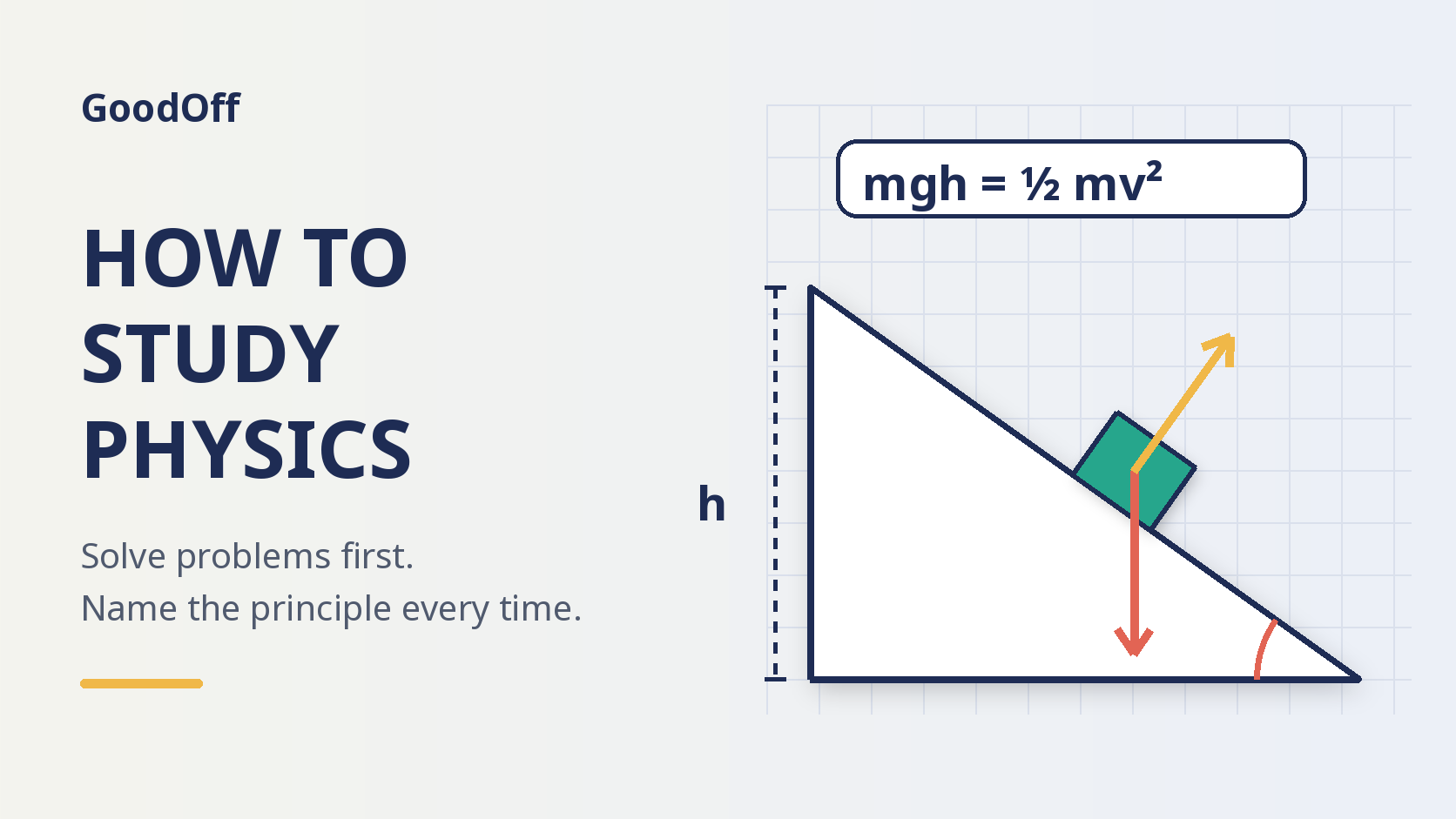
Here it is on problem A. The sketch shows a 20 m drop. The unknown is the speed at the bottom, v. The principle is energy, because friction is zero and the question asks for speed, not time. Starting from rest, the potential energy at the top turns into kinetic energy at the bottom:
m g h = ½ m v², so v = √(2 g h) = √(2 × 9.8 × 20) = √392 ≈ 19.8 m/s.
Check: the mass cancels, which makes sense because the 2 kg was a distraction. The units come out in m/s. And 19.8 m/s is about 71 km/h, which is what you'd expect after dropping 20 m. It's also the same speed an object would reach in free fall from 20 m, which is a nice confirmation that only the height matters when friction is zero.
Step 3: Struggle for 10 to 15 Minutes Before You Look
The UNC Learning Center recommends giving yourself about 10 to 15 minutes to work through a practice problem before consulting any resource. During that time, write down which ideas you think apply, even if you're not sure, and connect them to what you remember from lecture. Then check your resources to fill the gaps.
The key is what you do next. Mark the parts you got and the parts you missed, and ask why you missed them. Was it the principle, the setup, the algebra or a unit slip? That one sentence tells you what to practice next, which is far more useful than "I got it wrong."
When you read a solution afterward, don't just nod along. Stanford's advice is to be able to explain why you'd take each step, why a formula applies, and what assumptions you're making. If you can't say why, you've found the thing to work on. A prompt like "why does that step work?" is the same move as elaborative interrogation, and it fits physics well.
Step 4: Mix Problem Types Instead of Doing One Chapter at a Time
Most homework sets give you three problems of one kind, then three of the next. That's easy, because you already know which method to use. It also skips the hardest part of an exam, which is choosing the method.
In 2021, Joshua Samani and Steven Pan published a study in npj Science of Learning with 350 students in a UCLA introductory physics course. For eight weeks, homework either grouped problems by topic or alternated topics, with the same 84 problems per stage. Students did worse on the interleaved homework and rated it harder and less effective. But on surprise tests of new, harder problems, the interleaved group scored higher: mean scores of 0.54 versus 0.43 in the first stage and 0.47 versus 0.27 in the second, with effect sizes of d = 0.40 and d = 0.91.
Two honest caveats. The benefit didn't show up on the high-stakes midterms three days later, and the authors think heavy cramming may have hidden it. And it was one course, so treat it as a strong hint, not a guarantee. Still, the lesson is practical: when you practice, shuffle. Our guide to interleaving practice explains the idea in more detail.
| Blocked practice | Mixed practice |
|---|---|
| 5 energy problems, then 5 force problems, then 5 momentum problems | Energy, force, momentum, energy, force, momentum, and so on |
| Feels smooth and gives better homework scores | Feels clunky and gives worse homework scores |
| You always know which method to use | You have to decide which method to use |
Step 5: Make a "When Does This Apply?" Card for Every Formula
Memorizing equations isn't the goal, and many courses give you a formula sheet anyway. What the sheet can't tell you is when an equation is valid. Make one card per idea that answers four questions: what's the equation, what do the symbols mean, when can I use it, and when can't I?
| Front (question) | Back (answer) |
|---|---|
| When can I use v = √(2gh) for the speed after a drop? | Only if energy is conserved: no friction or air resistance, and the object starts from rest. If it doesn't, add the lost energy to the equation. |
| What do I need before I use F = ma? | The net force on one object, found from a free body diagram, with all forces in the same direction as the acceleration. |
| Which quantity is conserved in a collision when external forces are negligible? | Total momentum. Kinetic energy is conserved only in elastic collisions. |
Cards like these turn "I memorized the formula" into "I know when to reach for it." Close your notes and answer from memory before flipping each one.
Step 6: Take Notes in Class That You Can Use Later
Don't copy the professor word for word. Stanford's advice is to note the main concepts, connections between ideas and explanations in your own words, and to jot down questions. In a physics lecture, that usually means writing the principle, the condition it needs, and one example. Leave a margin for questions you'll attack in the problem session. If you do need to build a review sheet from several lectures, see how to make a study guide.
A Sample Study Week
| Day | Time | What to do |
|---|---|---|
| Mon (after lecture) | 30 minutes | Rewrite lecture notes as three or four principle cards. Answer one problem cold, without notes. |
| Tue | 45 minutes | Homework problems, 10 to 15 minutes of struggle each, with a one-line error note for any you miss. |
| Wed | 30 minutes | Mixed set: two problems from this week, two from last week, one from two weeks ago. |
| Thu | 45 minutes | Finish the homework. Sort every problem by principle and write why. |
| Fri | 20 minutes | Quiz yourself on this week's formula cards. Look over your error notes. |
| Weekend | 45 minutes | One timed, exam-style problem set. Review misses by cause (principle, setup, algebra, units). |
Common Mistakes
- Copying solutions. If you look at the answer in the first two minutes, you've skipped the part that builds skill.
- Plugging in numbers too early. Solve in symbols first. It's easier to check and easier to spot a missing term.
- Memorizing problem types. You'll never see a problem identical to a practice one. Know why each step works.
- Ignoring units. A wrong unit is a free warning. Use it.
- Skipping the "what's this problem really about?" line. That one sentence is the habit that experts have and novices don't.
- Studying only what feels easy. Mixed practice feels worse and works better.
Where GoodOff Fits
GoodOff can help with the parts of physics that are about knowing ideas and conditions. You can upload lecture notes or a PDF to your library and generate flashcards and quizzes from them, then review the cards before your next problem session. Quizzes include multiple-choice and open-ended questions, with an explanation for each answer. Free and Pro both include quiz generation, with daily, weekly and monthly limits on Free.
It doesn't replace working problems on paper. Generated cards and quiz answers can contain mistakes, especially in calculations, so check them against your textbook or instructor before you trust them. Use GoodOff for the "when does this apply?" cards and quick self-tests, and use your own pencil for the problems.
Frequently Asked Questions
How many hours a week should I study physics?
There's no single right number, because it depends on your course and your background. A useful rule is to match the structure of the course. Plan at least one session after each lecture and enough time each week to finish the problem set, plus a short review of earlier material. Ask your instructor what a typical student spends.
Should I memorize formulas for physics?
Learn the few you use constantly, and understand where they come from. Check whether your exam gives a formula sheet. Even if it does, you'll need to know when each one applies, which is why the "when does this apply?" cards matter more than the equations themselves.
What if I understand the lecture but can't solve the problems?
That's the most common physics problem, and it's fixable. Understanding a worked example is different from producing one. Start problems cold, spend 10 to 15 minutes on them, and write down what you were missing. Then try a similar problem the next day.
Is it okay to look at the solution if I'm stuck?
Yes, after a real attempt. Look at only the first step, close it, and try to continue. Then explain why that step worked. Reading the whole solution straight away is how people end up recognizing answers but not producing them.
How do I study physics for an exam?
Do mixed, timed problem sets that look like the exam, and review misses by cause. Our guide to studying for a math test covers the shared parts, like practicing under time and building an error log, since physics exams rely on the same habits.
Try One Principle Sort Today
Pick five problems from different chapters of your textbook. Don't solve them. Just write one line for each: the principle you'd use and why. Then check your answers. It takes about 15 minutes, and it's the quickest way to practice what experts do. When you're ready to practice recall, you can make a quiz from your own physics notes with GoodOff and see which concepts you can't yet explain.