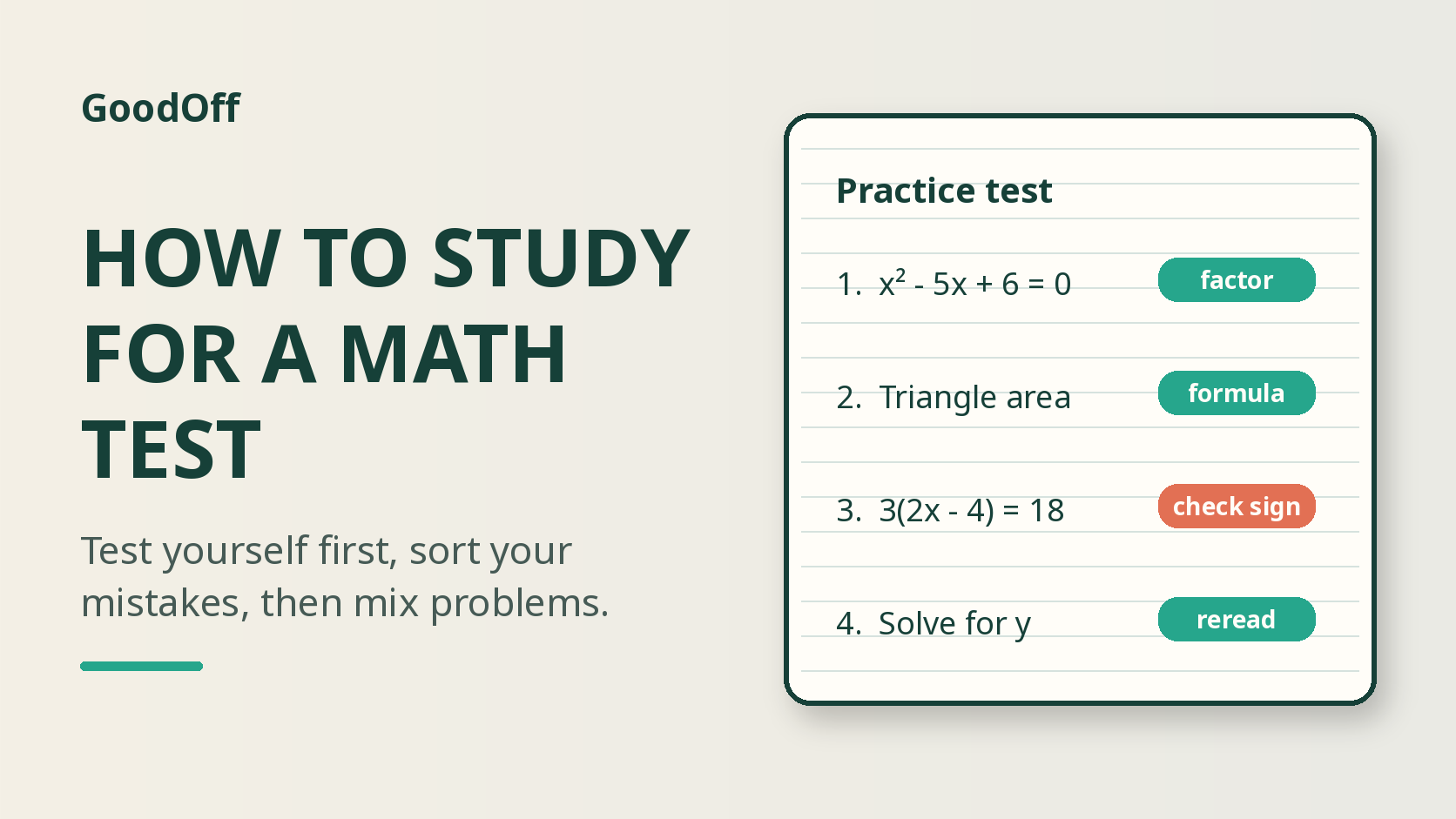
Short answer: to study for a math test, solve problems from memory instead of rereading your notes. List every topic the test covers, try one problem from each without help, sort your mistakes by type, then practice a mixed set of problems over several days. Finish with a timed practice test in the same format as the real one.
Math is a skill test. Reading a worked solution feels like progress because every step makes sense on the page, but the exam won't show you the steps. It'll show you a blank space and a problem with no chapter title above it. Your study plan should copy that.
The Quick Version
If you only have a few minutes to plan, here's the whole method:
- Get the topic list. Use the review sheet, syllabus, or the sections your teacher assigned.
- Test before you review. Close the book and attempt one problem per topic.
- Label each miss. Was it the concept, the choice of method, an arithmetic slip, or misreading the question?
- Fix the biggest gaps first. Spend most of your time on topics you can't do yet, not the ones you like.
- Mix problem types. Shuffle related problems so you have to pick the method yourself.
- Spread it out. Three short sessions on three days beat one long session the night before.
- Rehearse the real thing. Do a timed set with the same calculator rules and no notes.
Step 1: Build a Test-Specific Topic List
Don't study "all of chapter 4." Write down the exact skills: solving quadratics by factoring, completing the square, the quadratic formula, graphing parabolas, word problems with area. Most unit tests cover a handful of skills like these, and the review sheet usually names them.
Next to each one, mark where you stand:
| Status | What it means | How much time it gets |
|---|---|---|
| Ready | You can solve a new problem of this type without notes | One quick check problem |
| Shaky | You recognize the method but need a hint to start | Most of your practice |
| Missing | You don't understand the idea or a skill it depends on | Relearn first, then practice |
Be honest here. "I've seen this before" isn't the same as "I can do this."
Step 2: Try Problems Before You Look at Notes
For each topic, pick a problem you haven't solved before and attempt it cold. Even a half-finished attempt tells you more than an hour of reading, because it shows what you can actually pull out of memory.
This is the testing effect. In a well-known study, Roediger and Karpicke (2006) found that students who practiced recalling material remembered more a week later than students who spent the same time restudying it. Math works the same way: each time you set up a problem from scratch, you're practicing the exact move the test asks for.
After the attempt, check the method, then solve a similar problem straight away without looking. That second attempt is where the learning sticks.
Step 3: Diagnose Every Mistake
Calling every wrong answer "careless" hides the real problem. Sort each miss into one of four types, because each one needs a different fix.
| Mistake type | What it looks like | The fix |
|---|---|---|
| Concept | You can't explain why the method works | Go back to the idea or the skill underneath it, then retry |
| Method choice | You know the methods but picked the wrong one | Practice mixed sets where you name the method before solving |
| Execution | Right method, wrong sign, dropped term, bad arithmetic | Write every step and check the answer with an estimate or by plugging it back in |
| Reading | You solved for the wrong thing or ignored a condition | Underline what's being asked and the units before you start |
Keep a short error log: the problem, the type of mistake, and one sentence on what you'll do differently. Before the test, that log is the most useful page you own.
Step 4: Use Worked Examples for Topics You Can't Start
If a topic is in the "missing" column, jumping straight into hard problems usually just means staring at them. Study a worked example first, slowly, and say why each step happens. Then cover it and redo it yourself.
Research on the worked-example effect, starting with Sweller and Cooper (1985) in algebra, found that beginners often learn a new procedure faster from studying solved examples than from solving problems with no guidance. The benefit fades once you know the method, so switch to solving on your own as soon as you can.
Step 5: Mix Problem Types (Interleaving)
Most homework is blocked: 20 problems in a row that all use the same method. That's fine for learning a method, but it skips the hardest part of a test, which is deciding what to do.
Interleaving fixes that by shuffling related problem types together. In a randomized trial across 54 seventh-grade math classes, students who did mostly interleaved practice scored 61% on an unannounced test a month later, compared with 38% for students who did mostly blocked practice (Rohrer, Dedrick, Hartwig and Cheung, 2020).
To try it, pull 3 to 5 problems from each topic on your list, shuffle them, and cover up the section headings. Before you solve each one, write the method in the margin. For more detail on setting this up, see our guide to the interleaving study technique.
Step 6: Spread Your Practice Over Several Days
Math sticks better when you come back to it after a gap. Here's a simple five-day plan you can shrink or stretch:
| Day | What to do | Time |
|---|---|---|
| 5 days out | Build the topic list and do one cold problem per topic | 45 to 60 min |
| 4 days out | Relearn "missing" topics with worked examples, then retry | 45 to 60 min |
| 3 days out | Practice "shaky" topics, update your error log | 45 to 60 min |
| 2 days out | Mixed set of all topics with headings hidden | 45 to 60 min |
| 1 day out | Timed practice test, then review only the misses | 60 min |
| Test day | Read your error log and formula list, solve 2 or 3 warm-up problems | 15 min |
If you've got a week or more, our 7-day exam study plan shows how to lay out a longer schedule.
Step 7: Take a Timed Practice Test
Do at least one set under real conditions: same time limit, same calculator rules, no notes, phone in another room. Use a past paper, the review sheet, or make your own from old homework and quiz problems.
Afterwards, don't just check the score. Go through every miss with the four mistake types above. A practice test you don't review is mostly wasted.
What About Formulas?
Know them, but don't stop there. A formula sheet you can recite won't help if you can't tell when to use each formula. For every formula, write one line on when it applies and one common mistake.
Formulas and definitions are a good fit for flashcards. Put the formula on the back and the situation on the front, like "area of a triangle when you know two sides and the angle between them." That way you're practicing the choice, not just the symbols. Our post on quizzing yourself explains why that kind of retrieval works.
If Your Math Test Is Tomorrow
You can't relearn a unit in one night, so don't try. Do this instead:
- Get the topic list and try one problem from each topic.
- Pick the two or three topics that are worth the most points and that you're closest to getting.
- Study one worked example for each, then solve two similar problems alone.
- Finish with a short mixed set and write down your most common mistake.
- Go to bed at a normal time. Sleep helps more than one extra hour of problems at 2 AM.
For a fuller hour-by-hour version, see how to study for an exam in one day.
Common Mistakes When Studying for Math
- Rereading solved homework. It looks familiar, so it feels learned. Redo it on a blank page instead.
- Only doing problems you can already solve. It's satisfying, but it doesn't move your score.
- Checking the answer key after every line. Finish the attempt first, then check.
- Skipping word problems. They often carry the most points, and they test reading as much as math.
- Studying only the night before. Even two shorter sessions on earlier days help.
Where GoodOff Fits
GoodOff won't do your practice problems for you, and it shouldn't. Solving problems on paper is still the core of math study.
What it can help with is the memory side. You can upload your class notes, a PDF, or lecture slides, and GoodOff makes flashcards, a quiz and a study guide that you can edit. The cards are scheduled with FSRS spaced repetition, so formulas and definitions come back before you forget them. If you add your test date, it builds a review plan that counts back to it. There's a free plan, and it works on the web, iOS and Android.
FAQ
How many days before a math test should I start studying?
Aim for about five days for a unit test, with 45 to 60 minutes a day. For a final or a big standardised test, start two to four weeks out. Starting earlier with shorter sessions works better than one long cram.
Is it better to reread notes or do practice problems?
Practice problems, almost every time. Rereading builds familiarity, while solving problems from memory builds the skill the test actually checks. Use notes to fix mistakes after you've tried.
How do I stop making careless mistakes on math tests?
Write every step, check answers by plugging them back in or estimating, and underline what the question asks for. Keep an error log so you can spot the slips you make most often.
Can I study for a math test in 30 minutes?
You can make the most of 30 minutes. Do one problem from each topic, spend the rest on the topic you're closest to getting right, and read through your error log or formula list at the end.
Are flashcards useful for math?
They're useful for formulas, definitions, rules and "which method do I use when" cues. They can't replace solving full problems, so use them alongside practice sets.
Start Your Math Review
Write your topic list today and try one problem from each topic before you open your notes. If you want your formulas and definitions to stay fresh until test day, you can turn your notes into flashcards with GoodOff for free.