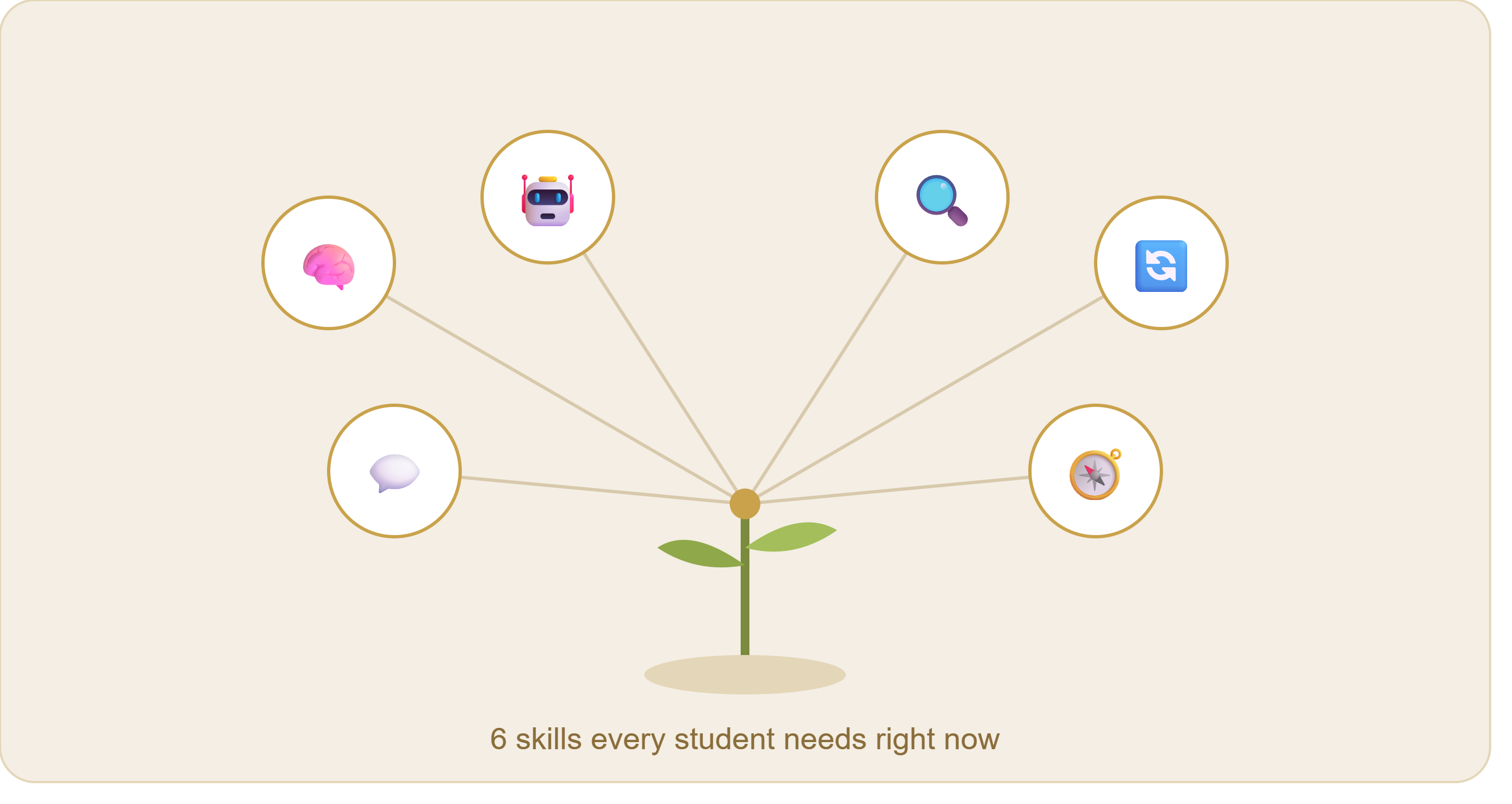
Short answer: the skills students need for the future are the ones employers expect to matter more as AI spreads: analytical thinking, using AI and technology well, creative thinking, resilience and adaptability, communication, and the habit of learning new things on your own. None of them need a special course. You build them through how you study, how you use AI on assignments, and what you do outside class.
Nobody can tell you which jobs will exist in ten years. What we do have is good data on which skills employers say they're looking for and which ones they expect to grow. The most useful source is the World Economic Forum's Future of Jobs Report 2025, which surveyed more than 1,000 large employers worldwide. This guide uses that report to pick six skills, then turns each one into something you can practice this week.
What Employers Say They Need
A few findings from the 2025 report stand out for students:
- Employers expect about 39% of workers' core skills to change by 2030.
- Analytical thinking is the top core skill. About seven in ten companies call it essential.
- Resilience, flexibility and agility come next, followed by leadership and social influence, creative thinking, and motivation and self-awareness.
- The fastest-growing skills are AI and big data, networks and cybersecurity, and technological literacy. Creative thinking, resilience, and curiosity and lifelong learning are expected to grow too.
The pattern is a mix of technical skills and very human ones. That's good news, because most of them can be trained through ordinary schoolwork if you approach it the right way.
The 6 Skills and How to Practice Them
| Skill | Why it matters | One way to practice this week |
|---|---|---|
| Analytical thinking | Top core skill in the WEF report | For one claim in a reading, list the evidence for it and one thing that would weaken it |
| AI and tech literacy | Fastest-growing skill group | Use AI to quiz you on a chapter, then check its answers against the textbook |
| Creative thinking | Expected to keep growing in importance | Solve one homework problem two different ways |
| Resilience and adaptability | Second on the core skills list | Retry a test question you got wrong without looking at the solution |
| Communication | Ties into leadership and social influence | Explain one idea from class in under a minute to someone outside the course |
| Learning how to learn | Curiosity and lifelong learning are rising | Swap rereading for self-testing in one subject |
1. Analytical Thinking
Analytical thinking means breaking a problem into parts, weighing evidence and spotting weak reasoning. School gives you plenty of chances to practice, but only if you go beyond the right answer. When you read an argument, ask three questions: what's the claim, what's the evidence, and what's missing? In math and science, explain why a method works, not just which steps to follow.
2. AI and Technology Literacy
AI literacy isn't avoiding AI or letting it do your homework. It's knowing what these tools are good at, where they make mistakes, and how to check them. A good test: can you tell when an AI answer is wrong? If you can't, you're relying on it more than you're using it.
Practical habits: ask AI to quiz you instead of summarize for you, ask it to explain a concept in a different way when the textbook doesn't click, and always check facts and citations. Our guide on using AI to study without cheating covers this in more detail, and studying with AI without getting dumber covers what happens when you lean on it too hard.
3. Creative Thinking
Creative thinking in school isn't only about art. It's finding a second approach, connecting ideas from different subjects, or asking a better question. Try solving a problem two ways, writing an essay introduction three different ways before picking one, or linking a concept from biology to something in economics. Doing this regularly makes it a habit.
4. Resilience and Adaptability
School often rewards getting it right the first time, which can make being a beginner feel threatening. Adaptability is getting comfortable with that feeling. Take a class outside your comfort zone, retry questions you got wrong instead of just reading the solution, and treat a bad grade as information about what to change, not a verdict on you.
5. Communication
Ideas only matter if you can get them across. The fastest way to practice is to explain things simply. If you can't explain a concept in plain words in a minute, you probably don't understand it well yet. The Feynman technique is built on that idea. Writing helps too. Short, clear writing on a regular basis trains clear thinking.
6. Learning How to Learn
If 39% of skills are expected to change by 2030, the most durable skill is learning new ones quickly. Most students never learn a method. They repeat whatever worked in middle school. The methods with the strongest research behind them are testing yourself instead of rereading and spreading practice over several days instead of cramming. Learn those once and every new subject gets easier.
Self-directed projects build this too. Pick something nobody is grading, such as a small app, a research question or a language, set a goal, and finish it. You'll practice choosing what to learn, finding resources and holding yourself to a deadline.
A Simple Plan for This Month
| Week | Focus | What to do |
|---|---|---|
| 1 | Learning how to learn | Replace rereading with self-testing in your hardest class |
| 2 | AI literacy | Use AI to quiz you, and log every mistake it makes |
| 3 | Communication | Explain one idea per day in a minute, out loud or in writing |
| 4 | Analytical and creative thinking | Pick a reading, find its weakest claim, and propose a better one |
The skills students need are harder to build if basics slip. Our explainer on the U-shaped recovery in U.S. schools covers where recovery has stalled.
Where GoodOff Fits
GoodOff helps with the "learning how to learn" part. Upload a PDF, slides or notes, and it makes flashcards, quizzes and a study guide from them, so self-testing is the default. Flashcards are scheduled with the FSRS algorithm, and Sage, the AI tutor, answers questions using your own material and shows the page it used, which makes it easier to check. It's free to start.
The other five skills come from how you work, not which app you use.
AI literacy is becoming one of those skills. Our look at AI in education trends for 2027 explains what that means for students.
FAQ
What skills will students need in the future?
According to the World Economic Forum's Future of Jobs Report 2025, analytical thinking, resilience and adaptability, creative thinking, technology and AI literacy, and curiosity and lifelong learning are among the most important.
Will AI replace the need to learn skills?
No. Employers expect AI and technology skills to grow, but they also rank analytical thinking, creativity and resilience highly. You need enough knowledge to judge whether an AI answer is right.
How can students prepare for the future?
Learn how to study well, use AI as a tutor rather than a shortcut, practice explaining ideas simply, and take on at least one project that nobody assigns you.
What is the most important skill for the future?
Employers rank analytical thinking highest today. Over the long run, the ability to learn new skills quickly may matter most, because the skills themselves keep changing.
Start With One Skill
Pick one skill from the table and try its practice task this week. Next week, add another. If you'd like your notes turned into quizzes so self-testing is easy to start, you can try GoodOff for free.