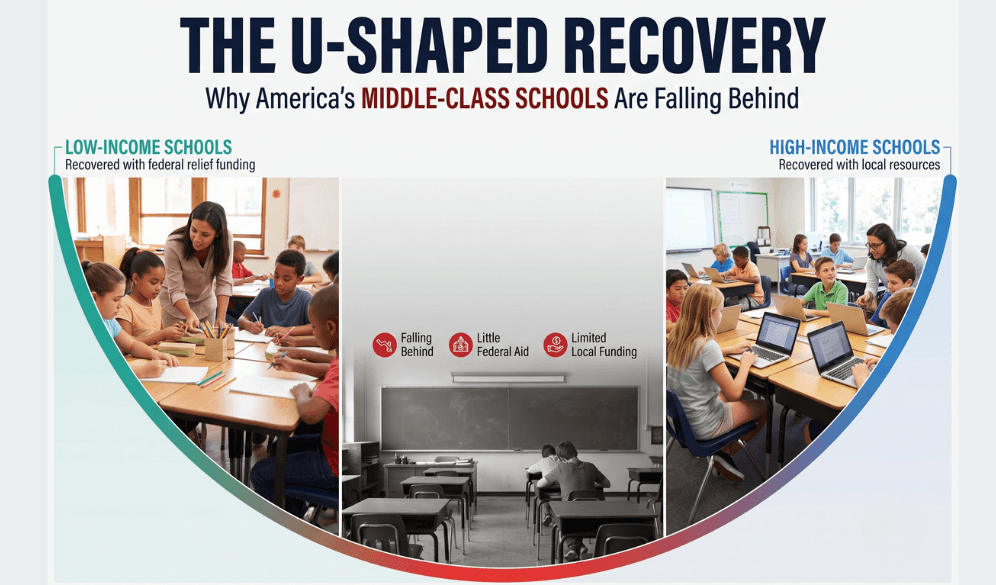
For a while, the story of pandemic learning loss had a simple shape in most people's heads: poor kids got hit hardest, rich kids bounced back fine, and everyone else was somewhere in between, presumably fine too. New research says that picture is wrong. Not a little wrong. Backwards, in an important way.
Researchers at Harvard, Stanford, and Dartmouth have been tracking academic recovery through the Education Scorecard, a project that links state test results for roughly 35 million students in grades 3 through 8 onto one comparable national scale. Their latest findings, released in May 2026, describe something they call a U-shaped recovery. The highest-income districts and the lowest-income districts have both made real progress since 2022. It's the districts in the middle, the ones serving working- and middle-class communities, that are stuck.
What "U-Shaped" Actually Means Here
Picture achievement recovery plotted as a curve, from lowest-income districts on the left to highest-income districts on the right. If the pandemic had hit everyone the same way and recovery had happened evenly, you'd expect something close to a flat line. Instead, the researchers found a curve that dips in the middle: districts on both ends of the income spectrum have recovered the most since 2022, while districts in the 30 to 70 percent range for federally subsidized school lunches, essentially America's middle-income communities, have seen the weakest gains.
That middle band covers a huge number of students. These aren't the wealthiest suburban districts with deep local tax bases, and they aren't the highest-poverty districts that qualified for the largest shares of federal pandemic relief. They're the ordinary, in-between communities that most people probably picture when they think of "public school in America."
Why the Middle Got Squeezed
The explanation researchers point to isn't mysterious once you see it laid out. It comes down to where the money went.
During the pandemic, high-poverty districts received a disproportionately large share of federal relief funding, and by most accounts it worked. Researchers estimate that without those emergency funds, the average high-poverty district would have seen essentially no academic improvement since 2022 at all. The money paid for tutoring, extra staff, and extended learning time, and it moved the needle.
On the other end, the wealthiest districts didn't need federal help the same way. They had local tax revenue, engaged parent communities, and often the flexibility to respond quickly with their own resources.
Middle-income districts fell into a gap between those two supports. They didn't qualify for the same scale of targeted federal aid that poorer districts received, and they don't have the tax base or philanthropic capital that wealthier districts can lean on. Sean Reardon, who directs Stanford's Educational Opportunity Project, has pointed out that this masks a real inequality: scores actually declined more in America's middle- and low-income communities than in wealthy ones, even though the federal investment during the pandemic did limit the damage in the highest-poverty districts. Read plainly, that means the communities without a strong safety net on either side are the ones still waiting for a real recovery plan.
This Didn't Start With COVID
Here's the part of the research that might be even more unsettling than the U-shape itself. The researchers behind the Scorecard actually dropped the word "Recovery" from this year's report title. Their reasoning: American student achievement started declining back in 2013, years before anyone had heard of COVID-19, reversing two decades of prior improvement. The rate of learning loss in reading, it turns out, was similar before the pandemic, during it, and after it.
That reframes the entire conversation. If achievement had been sliding for a decade already, then the pandemic didn't create the problem in middle-income districts. It just made an existing, slower-moving decline much harder to ignore, and much harder to fix with a temporary infusion of relief money.
What's Actually Working, and What Still Isn't
The 2026 findings aren't entirely bleak. There's a real post-pandemic math rebound showing up in the data, and early signs that literacy reforms are starting to pay off. As of March 2026, 42 states plus Washington, D.C. have passed laws tied to evidence-based reading instruction, commonly known as the "science of reading," and researchers are seeing the first real signals of a reading turnaround tied to those policies.
But two problems keep dragging on the middle. First, the federal relief money that helped high-poverty districts is gone as of 2025, which raises an open question about whether those districts can hold onto their gains without it, let alone whether middle-income districts will ever get a comparable boost. Second, chronic absenteeism remains a serious drag on progress everywhere. Students who are chronically absent are effectively losing the equivalent of one to two weeks of learning every year, and the interventions researchers have tested so far only produce small effects.
There's also an emerging piece of the puzzle worth watching: researchers suspect the pre-pandemic decline was partly driven by rising social media use among kids, and early data on school cell phone bans shows small positive effects on achievement, alongside an unfortunate side effect of increased disciplinary actions, especially for minority students. That's a trend researchers plan to keep studying closely over the next year.
Where This Leaves Middle-Income Communities
The practical message from the research is pointed and specific. States and districts need to double down on the catch-up strategies that were working, like tutoring and summer learning, using their own dollars now that federal relief has dried up. Researchers are also calling on states to pair "Districts on the Rise," meaning the roughly one hundred districts that have already returned to or exceeded pre-pandemic achievement in both math and reading, with peer districts that haven't, so that working strategies actually spread instead of staying isolated success stories.
None of that solves the underlying funding gap on its own. Middle-income districts are still stuck without the targeted aid that helped high-poverty schools and without the local resources that carry wealthy ones. If the U-shape is going to flatten out, it will take a deliberate choice, at the state or federal level, to stop treating the middle of the income distribution as the group that's presumably fine.
Because right now, the data says they're not.
Try goodoff