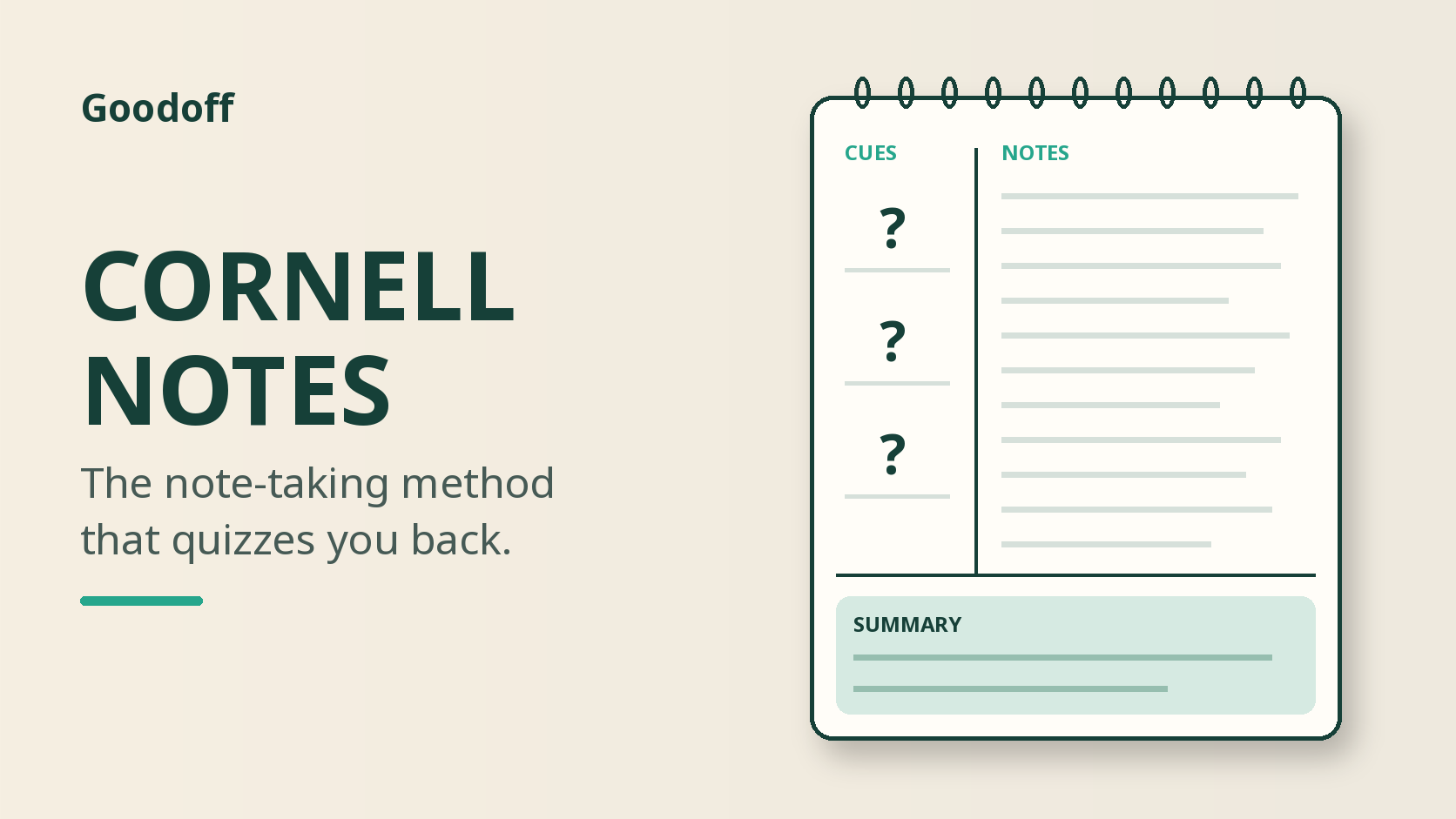
Cornell notes is a note-taking method that splits each page into three parts: a wide column for notes, a narrow column for cue questions, and a short summary at the bottom. You take notes during class, add questions afterward, then cover the notes and answer those questions from memory. That last step is what makes the method work. Your notes stop being something you reread and become something that tests you.
This guide explains what the Cornell note-taking method is, why it helps you remember more, how to set up a page, a worked example, mistakes to avoid, and how to turn your cue questions into a review routine that lasts until exam day.
What Is the Cornell Note-Taking Method?
The Cornell method was developed by Walter Pauk, an education professor at Cornell University, and made popular in his book How to Study in College. It is still one of the most widely taught note-taking systems in high schools and universities because it is simple, needs nothing more than paper, and works for almost any subject.
A Cornell page has three sections:
Notes column (right, about two thirds of the page). What you write during the lecture or while reading: key ideas, definitions, examples, formulas, and diagrams, in short phrases rather than full sentences.
Cue column (left, about one third). Left empty during class. Soon after, you fill it with questions and keywords that the notes on the right answer.
Summary (bottom, five to seven lines). Two to four sentences in your own words that capture the main point of the page.
Pauk's advice was to keep the cue column empty while you take notes, then write questions in it when you review. Writing those questions is what pushes you from copying to thinking.
Why Cornell Notes Help You Remember More
Plain linear notes encourage a passive habit: write everything down, then reread it later and hope it sticks. Cornell notes build three stronger learning habits into the page itself.
Self-questioning. Turning notes into questions forces you to decide what matters and how ideas connect. Research on student-generated questions, such as Alison King's work in the early 1990s, found that students who wrote and answered their own questions understood and recalled lectures better than those who only reviewed.
Retrieval practice. When you cover the notes column and answer the cues from memory, you are practicing recall, one of the most reliable ways to strengthen memory. It works the same way as the blurting method: pull information out of your head first, then check.
Summarizing. Compressing a page into a few sentences of your own makes gaps obvious. If you cannot summarize it, you do not understand it yet.
A 2025 paper on note-taking methods in Frontiers in Psychology describes the Cornell format's main advantage as making it easy to question yourself and review, and points to earlier studies linking it to better exam performance and retention. The format itself is not magic. The benefit comes from actually using the cue column to quiz yourself.
How to Take Cornell Notes, Step by Step
1. Set up the page
Draw a vertical line about 6 to 7 cm (roughly 2.5 inches) from the left edge. Leave about 5 cm (2 inches) at the bottom for the summary. Write the course, date, and topic at the top. You can use a printed Cornell notes template, but a ruled page and a pen are enough. Digital works too: a two-column table in any notes app does the job.
2. Record notes in the right column during class
Capture main ideas, not every word. Use abbreviations, bullet points, and quick sketches. Skip a line between ideas so you have room to add details later. If the lecturer repeats something, writes it on the board, or says it will be on the exam, mark it.
3. Write cue questions within 24 hours
As soon as you can, read your notes and write questions in the left column that each block of notes answers. Good cues ask why and how, not only what. "What are the three stages of cellular respiration?" is fine. "Why does the electron transport chain stop without oxygen?" is better, because it tests understanding. Asking why is the core of elaborative interrogation, and it pairs naturally with the cue column.
4. Summarize at the bottom
Write two to four sentences that explain the whole page to someone who missed class. Use your own words. Do not copy a heading.
5. Recite: cover the notes and answer the cues
Fold the page or cover the right column with a sheet of paper. Read each cue and answer it out loud or on scrap paper. Then uncover and check. Put a small mark next to any cue you missed so you know where to focus next time.
6. Review on a schedule
Repeat the cover-and-recall step a day later, a few days later, and a week or two later. Each round should take only a few minutes per page because you are working from the cues, not rereading everything.
Cornell Notes Example
Here is what a single page might look like for a biology lecture on photosynthesis.
| Cue column | Notes column |
|---|---|
| Where does photosynthesis happen? | Chloroplasts. Light reactions in the thylakoid membranes. Calvin cycle in the stroma. |
| What do the light reactions produce? | ATP and NADPH. Water is split and oxygen is released. |
| Why does the Calvin cycle depend on the light reactions? | It uses the ATP and NADPH from the light reactions to fix CO2 into sugar. |
| What limits the rate of photosynthesis? | Light intensity, CO2 concentration, temperature. The scarcest one sets the limit. |
Summary: Photosynthesis runs in two linked stages inside the chloroplast. The light reactions capture energy as ATP and NADPH and release oxygen, and the Calvin cycle spends that energy to build sugar from CO2. The rate is capped by whichever factor is in shortest supply.
Notice how the third cue asks why. You cannot answer it by spotting a keyword. You have to explain the link between the two stages. If a diagram helps, sketch the chloroplast in the notes column, which adds dual coding to the page.
Common Cornell Notes Mistakes
Leaving the cue column blank. This is the most common mistake. Without cues, Cornell notes are just regular notes with a wide margin.
Writing cues as labels, not questions. "Calvin cycle" is a label. "What does the Calvin cycle need from the light reactions?" is a question you can be tested on.
Copying the slides word for word. Transcribing keeps your brain passive. Paraphrase and leave gaps you fill in later.
Skipping the summary. The summary is short, but it is where you find out whether you understood the page.
Reviewing by rereading. If you uncover the notes before trying to answer, you are recognizing, not recalling. Always attempt the answer first.
Reviewing only the night before. One cram session fades quickly. Spread short reviews over days and weeks.
Cornell Notes for Different Subjects
Math and physics: Put worked examples in the notes column and write cues like "When do I use this formula?" or "What is the first step for this type of problem?" Then solve a fresh problem from the cue.
History: Use cues for causes, consequences, and significance. "Why did this treaty fail?" beats "Date of treaty?"
Languages: Put grammar rules and example sentences on the right, and translation prompts on the left.
Reading assignments: Take notes per section of the chapter, then write one summary per section rather than one per page.
Turning Cornell Cues Into Spaced Review
Your cue column is already a list of flashcard fronts. The notes beside each cue are the backs. That makes Cornell notes a natural starting point for spaced repetition, where each question comes back just before you are likely to forget it. Questions you answer easily return less often, and ones you miss return sooner. For how modern schedulers decide those intervals, see FSRS spaced repetition.
A simple routine: after each lecture, take Cornell notes and write cues the same day. At the end of the week, move your best cues into flashcards. Review those cards on a schedule, and keep your Cornell pages for the big picture and summaries.
Using GoodOff With Cornell Notes
Writing cues by hand is valuable, and you should keep doing it. GoodOff can help with the review side. Upload a photo or PDF of your notes, your lecture slides, or the reading, and GoodOff can turn it into editable flashcards, quizzes, and a study guide with key concepts, definitions, and likely exam questions. Compare its questions with your own cue column to spot ideas you missed. Flashcards are scheduled with FSRS, so each card returns based on how well you knew it. If a cue stumps you, Sage, GoodOff's tutor, answers from your uploaded material and cites the passages it used.
You still do the thinking: taking notes, writing questions, and summarizing in your own words. GoodOff helps you keep reviewing those questions until the exam.
Key Takeaways
Cornell notes divide a page into notes, cue questions, and a summary.
The method works because it builds self-questioning, retrieval practice, and summarizing into every page.
Write cues within 24 hours, and make them why and how questions where you can.
Review by covering the notes and answering the cues from memory, not by rereading.
Spread reviews over days and weeks, and turn your best cues into flashcards.
Frequently Asked Questions
What are the three sections of Cornell notes?
A wide notes column on the right for what you learn in class, a narrow cue column on the left for questions and keywords, and a summary section across the bottom of the page.
Are Cornell notes actually effective?
They are effective when you use the cue column to test yourself. The research benefit comes from self-questioning, recall, and summarizing. If you only fill the notes column and reread it, you lose most of the advantage.
When should I fill in the cue column?
Soon after class, ideally within 24 hours, while the lecture is still fresh. Leave it empty while you are taking notes so you can focus on listening.
Can I use Cornell notes digitally?
Yes. A two-column table with a summary row works in any notes app or document editor. The structure matters more than the medium.
Do Cornell notes work for math?
Yes. Put worked examples and steps in the notes column, and write cues about when and why to use each method. Then practice by solving a new problem from each cue.
How are Cornell notes different from regular notes?
Regular notes are a record. Cornell notes are a record plus a built-in self-test. The cue questions and summary turn each page into review material you can quiz yourself with.