Artificial intelligence is changing how students learn, how teachers teach, and how educational institutions operate. But as AI tools become more common in education, an important question is emerging: Are these tools actually helping students learn better?
In 2027, the conversation around AI in education is expected to focus increasingly on practical results, responsible use, and meaningful improvements in learning.
The 2027 EDUCAUSE Top 10 identifies determining where AI adds real value as the leading technology issue for higher education. This signals a growing emphasis on evaluating AI tools based on their educational impact rather than adopting them simply because they are new.
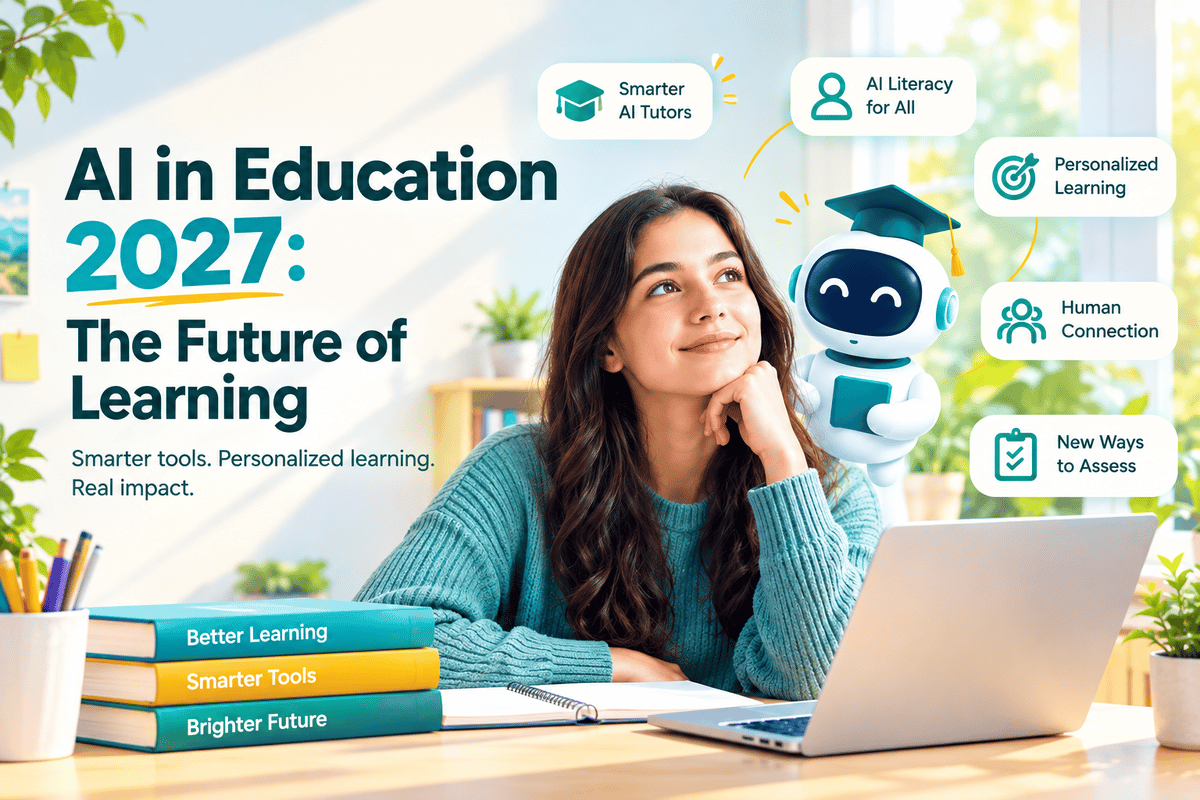
From more guided AI tutors to personalized learning experiences, several developments could shape the future of education.
Here are five AI in education trends to watch in 2027 and what they could mean for students and educators.
1. AI Tutors May Become More Guided and Learning-Focused
AI chatbots can explain difficult concepts, answer questions, and help students complete assignments. However, there is an important difference between an AI tool that provides an answer and one that helps a student understand how to reach that answer independently.
In 2027, educators may increasingly explore AI tutors that guide students through the learning process rather than simply giving them solutions.
These tools can be designed to:
Provide hints and explanations instead of immediately revealing the answer.
Ask students questions to check their understanding.
Break complicated concepts into smaller, manageable steps.
Identify misconceptions and offer additional explanations.
Encourage students to attempt problems before reviewing solutions.
This approach is often associated with scaffolded learning, where learners receive support that helps them gradually develop independence.
For example, imagine a student struggling with a JavaScript problem. Instead of generating the entire solution, an AI tutor could explain the relevant concept, ask the student to predict what the code will do, and offer hints when they get stuck.
The goal is not to make learning more difficult. It is to help students develop the reasoning skills they need to solve similar problems independently.
However, guided AI tutoring will not automatically replace open-ended chatbots. Its effectiveness will depend on how the tools are designed and how educators incorporate them into their teaching.
What this means for students: The most useful AI study tools may be those that help you understand the answer, not just obtain it.
2. AI Literacy Will Become an Increasing Priority
Knowing how to use AI is becoming an important skill, but effective AI use requires more than knowing which questions to ask.
Students also need to understand when AI can be helpful, when its answers may be unreliable, and how to evaluate the information it provides.
As AI becomes more integrated into education, schools and universities are likely to place greater emphasis on AI literacy and responsible use.
This includes teaching students how to:
Evaluate AI-generated information instead of accepting every answer as correct.
Recognize inaccurate information and unsupported claims.
Protect personal information when using AI tools.
Understand academic integrity and appropriate AI use.
Use AI to support critical thinking rather than replace it.
Consider a student researching a topic for an assignment. An AI tool might provide a convincing explanation that contains an error. Without checking the information against reliable sources, the student could unknowingly learn something incorrect.
AI literacy helps students recognize this possibility and develop better research habits.
Educational institutions will also need clear guidelines explaining when AI assistance is appropriate and how students should acknowledge its use. The pace of adoption will vary, but helping students use AI responsibly is becoming an increasingly important educational goal.
What this means for students: Learning how to question, verify, and evaluate AI-generated information will be just as important as learning how to use AI itself.
3. Personalized Learning Could Become More Adaptive
Every student learns differently.
Some understand a concept after reading an explanation. Others need examples, diagrams, practice questions, or repeated revision before the information makes sense.
Traditional classroom instruction can make it difficult to accommodate every student's needs at the same time. AI-powered learning tools offer one possible way to provide more personalized support.
In 2027, adaptive learning experiences are likely to remain an important area of development.
Depending on how they are designed, AI-powered learning tools can:
Adjust explanations to suit a student's level of understanding.
Generate practice questions based on a specific topic.
Explain the same concept using different examples.
Help students identify gaps in their knowledge.
Support revision by focusing attention on difficult concepts.
Imagine two students studying the same biology chapter.
The first student understands the basic concepts but struggles to remember important terminology. The second understands the terminology but finds it difficult to apply the concepts to real-world examples.
A personalized study experience could give the first student more recall practice while helping the second work through application-based questions.
Multimodal AI, which can work with different types of information such as text, images, and voice, may also create new opportunities for interactive learning.
However, personalization alone does not guarantee better results. Educational tools must still provide accurate information, useful feedback, and learning activities that help students build lasting understanding.
What this means for students: AI could make studying more responsive to your individual needs, helping you spend more time on the concepts you find difficult.
4. Human Connection Will Remain Central to Education
As AI takes on more educational tasks, the role of teachers will continue to matter.
Teachers do much more than explain academic concepts. They motivate students, recognize emotional challenges, provide encouragement, and help learners develop communication and collaboration skills.
AI can assist with some routine responsibilities, but it cannot fully replace the relationships and human judgment that support effective education.
Educators may increasingly use AI to assist with tasks such as:
Preparing lesson plans and learning materials.
Drafting feedback on student work.
Creating practice questions and revision activities.
Organizing educational resources.
Adapting explanations for different learning levels.
When used appropriately, these applications may help teachers spend less time on repetitive tasks and more time supporting their students.
For students, the important distinction is between using AI as a learning resource and treating it as a replacement for teachers, classmates, and meaningful discussion.
A student might use AI to understand a difficult mathematical concept before attending class. They can then ask their teacher more focused questions, discuss alternative approaches with classmates, and apply what they have learned to practical problems.
This combination allows AI to support learning while preserving the human interactions that make education valuable.
What this means for students: Use AI to prepare, practise, and clarify concepts, but continue asking questions, participating in discussions, and learning from other people.
5. Schools May Rethink How They Assess Student Learning
Generative AI can produce essays, summaries, explanations, and solutions to many common academic questions. This has encouraged educators to reconsider how they evaluate student understanding.
In 2027, some schools and universities may place greater emphasis on assessments that reveal how students think, explain their reasoning, and apply what they have learned.
Possible approaches include:
Oral examinations and discussions.
In-class writing and problem-solving activities.
Projects based on real-world situations.
Presentations in which students explain their decisions.
Drafts, revisions, and reflections that demonstrate the learning process.
Assignments that require students to apply concepts to specific situations.
For example, rather than assessing a student only on a written explanation of a scientific concept, a teacher might ask the student to explain the concept orally, interpret an experiment, or apply the principle to a new problem.
These methods can provide additional insight into whether a student understands the material.
This does not mean traditional homework and essays will disappear. Written assignments remain valuable for developing research, communication, and analytical skills. Instead, educators may increasingly consider how AI can be used appropriately within an assessment and how to distinguish genuine understanding from work that simply presents a correct answer.
What this means for students: Understanding a topic will matter more than simply producing a polished answer. Practising explanations, applying concepts, and testing your own knowledge can help prepare you for different forms of assessment.
How Will Students Entering College in 2027 Be Different?
Students entering higher education in 2027 will include many who have already encountered generative AI during their school years.
One question people ask most is whether AI tutors will replace teachers.
However, their experiences will vary. Some students will have used AI regularly for research, revision, and problem-solving. Others may have limited access to these tools or little formal guidance on using them effectively.
This creates an important challenge for universities: They cannot assume that every student has the same level of AI knowledge or the same study habits.
Understanding how students use AI, where they struggle, and which skills they need to develop can help educators provide more appropriate support.
Students will also need to develop a clear understanding of when AI assistance is useful and when independent practice is essential.
For example, using AI to generate practice questions can help a student prepare for an examination. But if the student reads the answers without attempting the questions, they may develop a false sense of confidence about their understanding.
The challenge is not simply learning to use AI. It is learning to use it in ways that support independent thinking, deeper understanding, and long-term knowledge retention.
The Biggest Challenges Facing AI in Education in 2027
Despite its potential, integrating AI into education comes with significant challenges.
1. Proving That AI Improves Learning
A tool may save time or attract student interest without necessarily improving understanding.
Educational institutions need to evaluate whether AI applications help students retain information, develop skills, and achieve meaningful learning outcomes.
2. Protecting Student Privacy
AI-powered learning platforms may process personal information, conversations, assignments, and educational records.
Schools and universities must consider how this information is collected, stored, protected, and used.
Students should also understand the privacy implications of the tools they use.
3. Reducing the Digital Divide
Not every student has access to reliable internet, suitable devices, or advanced AI tools.
If educational institutions rely too heavily on technologies that some students cannot access, existing inequalities could become more pronounced.
Making AI-supported education accessible and affordable will remain an important consideration.
4. Preventing Over-Reliance on AI
AI can make learning tasks faster, but convenience can sometimes come at the expense of independent practice.
Personalized learning is the promise that gets the most hype. We looked at how AI personalization holds up in practice in a separate post.
If students consistently depend on AI to generate answers, solve problems, or summarize every reading, they may miss opportunities to develop essential skills.
The solution is not necessarily to avoid AI altogether. Instead, students need to use it strategically, combining AI assistance with independent thinking, active practice, and self-assessment.
5. Maintaining Accuracy and Accountability
AI systems can generate incorrect information, misunderstand questions, or provide explanations that sound convincing but contain errors.
Students and educators need ways to verify important information and identify when an answer requires further investigation.
Educational institutions must also establish clear expectations for responsible AI use.
How Students Can Prepare for the Future of AI-Powered Learning
Students do not need to wait until 2027 to improve the way they use AI.
A few practical habits can help make AI a more effective study companion.
Try answering questions before asking AI.
When you encounter a difficult topic, first write down what you already know. Then use AI to identify gaps in your understanding and clarify confusing concepts.
Ask for explanations, not just answers.
Instead of requesting a solution immediately, ask AI to explain the underlying concept, provide a similar example, or guide you through the reasoning step by step.
Test yourself regularly.
After studying a topic, close your notes and try to recall the important information. Use practice questions or flashcards to identify what you remember and what needs further revision.
Verify important information.
Check important facts against your textbooks, course materials, and reliable sources. Never assume an AI-generated explanation is correct simply because it sounds confident.
Review your mistakes.
When you answer a question incorrectly, identify why the mistake happened. Understanding the reason behind an error can help you avoid repeating it.
Keep independent thinking at the center of your study routine.
Use AI to support your learning, but make time to solve problems, explain concepts, and complete practice exercises without assistance.
These habits can help students benefit from AI while continuing to develop the knowledge and skills they need independently.
How GoodOff Fits Into the Future of AI-Powered Studying
As AI becomes more integrated into education, students need study tools that help them engage with information in practical ways.
GoodOff is an AI study platform designed to support students as they work through their learning materials and prepare for exams.
Rather than approaching studying as a single activity, students can use different learning formats to review information and practise what they have learned.
For example, students can use study resources such as flashcards, quizzes, and other revision materials to revisit important concepts and check their understanding.
The goal is to make studying more interactive and help students find practical ways to work with their learning materials.
However, the value of any AI study tool depends on how students use it. Reading an explanation is only one part of learning. Revisiting information, answering questions, and checking what you can recall are also important parts of an effective study routine.
As AI-powered education evolves, tools that fit naturally into students' study habits may help them organize their learning and practise more effectively.
The most useful approach is to treat AI as a study companion, not a substitute for learning.
AI in Education 2027
AI is likely to play an increasingly important role in education, but its success will depend on more than technological progress.
The direction of change points toward greater attention to educational value, guided AI tutoring, personalized learning, AI literacy, and responsible use.
For teachers and institutions, the challenge will be to identify which applications genuinely support learning while protecting student privacy, maintaining accessibility, and preserving human relationships.
For students, the opportunity is to use AI more thoughtfully.
That means asking better questions, checking information, practising independently, and using technology to strengthen understanding rather than simply complete assignments faster.
The future of education is not about using AI for everything. It is about using AI where it genuinely helps students learn, with human judgment and independent thinking remaining essential.
As 2027 approaches, one principle will remain important: The real value of an AI study tool is not how much work it can do for you, but how effectively it helps you learn to do more for yourself.
Try GoodOff for free!