
If you have used Anki, a medical deck, or any app that asks “again / hard / good / easy,” you have met spaced repetition. FSRS is a newer way to decide when that next review should happen.
So, what is FSRS for students? It is the Free Spaced Repetition Scheduler: an open algorithm that estimates how long you will still remember a specific card, then places the next review near the moment you would otherwise forget it.
You do not need to implement the math. You do need to know why it is different from “review this in 1 day, then 3, then 7,” and how to use it without fighting the queue.
Spaced repetition in one paragraph
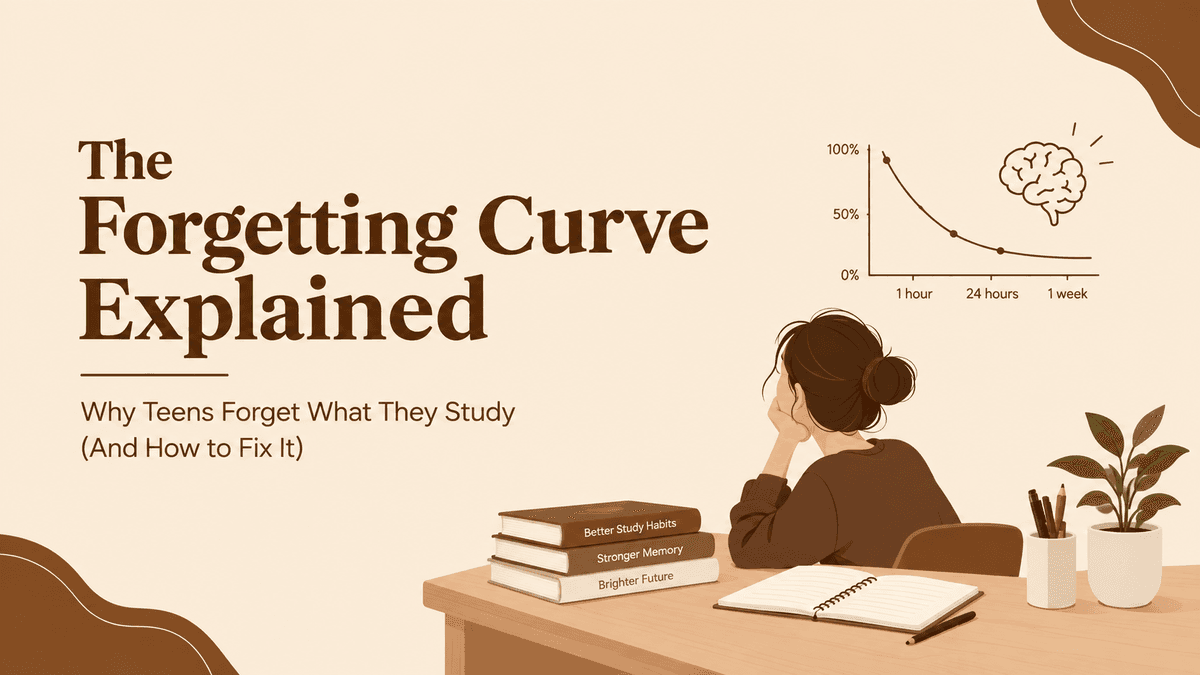
Your brain dumps unused information on a schedule. Hermann Ebbinghaus mapped that drop as the forgetting curve: a lot disappears in the first day, then more slowly after that. If you restudy at the right time, the curve resets higher. If you restudy too early, you waste time. If you wait too long, you relearn from zero.
Spaced repetition is just: practice retrieval, then wait longer each time you succeed. The argument is about the scheduler. Old defaults used a simple formula. FSRS uses a model of your memory on each card.
What FSRS actually tracks
FSRS treats each card as having a small memory state, not a fixed box in a 1-3-7 ladder. In the common explanation used by the FSRS / Anki community, three ideas matter:
Difficulty. How stubborn this card is for you. A messy formula and a friend’s name should not share one interval forever.
Stability. How long the memory is expected to last before it decays to a chosen chance of recall.
Retrievability. The estimated chance you can recall it right now. Reviews are scheduled when that chance is about to dip below your target.
Every rating you give (wrong, hard, good, easy) updates those estimates. After enough reviews, the schedule is less “average student” and more “your history on this card.”
How that differs from SM-2
SM-2, the SuperMemo-era algorithm behind classic Anki, is the reason millions of people learned to space reviews at all. It is also blunt. It leans on an ease factor and fairly rigid steps. A card you barely squeezed out and a card you answered instantly can still march on similar rails.
FSRS was built later, against large review logs, to predict retention more tightly. In practice students notice:
Young cards do not always jump on the same 1-3-7 pattern.
Hard material stays closer. Easy material gets out of your way.
A wrong answer is not just “reset to one day” as a ritual. The model updates difficulty and stability and tries again.
It is not magic and it is not a personality test. It is a better guess about this card, after these reviews.
What students should set (and what to leave alone)
You will see a retention or “desired retention” control in apps that ship FSRS. That number is the chance of recall the scheduler aims for when it shows the card.
Higher retention means more reviews and a safer feeling. Useful before a high-stakes exam if the deck is small.
Slightly lower retention means a thinner daily queue. Useful for huge decks you must live with for a year.
Do not crank it to 99% “just to be safe” on 8,000 cards. You will drown and then stop. Pick a target you can finish on a weekday.
Leave the internal parameters alone unless you know why you are changing them. The useful student levers are: honest ratings, a deck you will actually open, and a daily cap you respect.
How to grade cards so FSRS is not lying to itself
The algorithm only sees your button. If you press Easy on cards you half-recognized, it will hide them. If you press Again because you wanted a prettier wording, it will treat a known idea as fragile.
A working standard:
Again if you could not produce the answer, or you needed the back to remember what the question even meant.
Hard if you got there slowly, with a hint in your head, or you almost mixed it up.
Good if you retrieved it cleanly in a few seconds.
Easy if it was automatic and you are sure you will still have it in a long interval. Use this rarely.
No peeking, then Good. That is how queues become fiction.
Where GoodOff fits
FSRS is the review engine. You still need cards worth reviewing. The usual student failure is not “wrong algorithm.” It is 600 cards copied from slides, rated on a couch at 1 a.m., then abandoned.
GoodOff is built so you can turn a source into a deck and then review with spaced repetition instead of rebuilding a schedule in a spreadsheet. Start from the material — slides, notes, a lecture file — on app.goodoff.co, keep the cards that ask real questions, and let the scheduler place the next review.
A sane first two weeks
Make or import a deck you will finish in under 20 minutes a day.
Review every day you can. Missing a day is normal; missing ten days trains you to dread the pile.
Do not add three new chapters on the same evening you are still learning last week’s cards.
After a couple of weeks, look at which cards keep coming back. Those are either badly written or actually hard. Split or rewrite the bad ones. Keep reviewing the hard ones.
That is FSRS for students: not a brand name to drop, a scheduler that gets out of your way if you give it honest work.