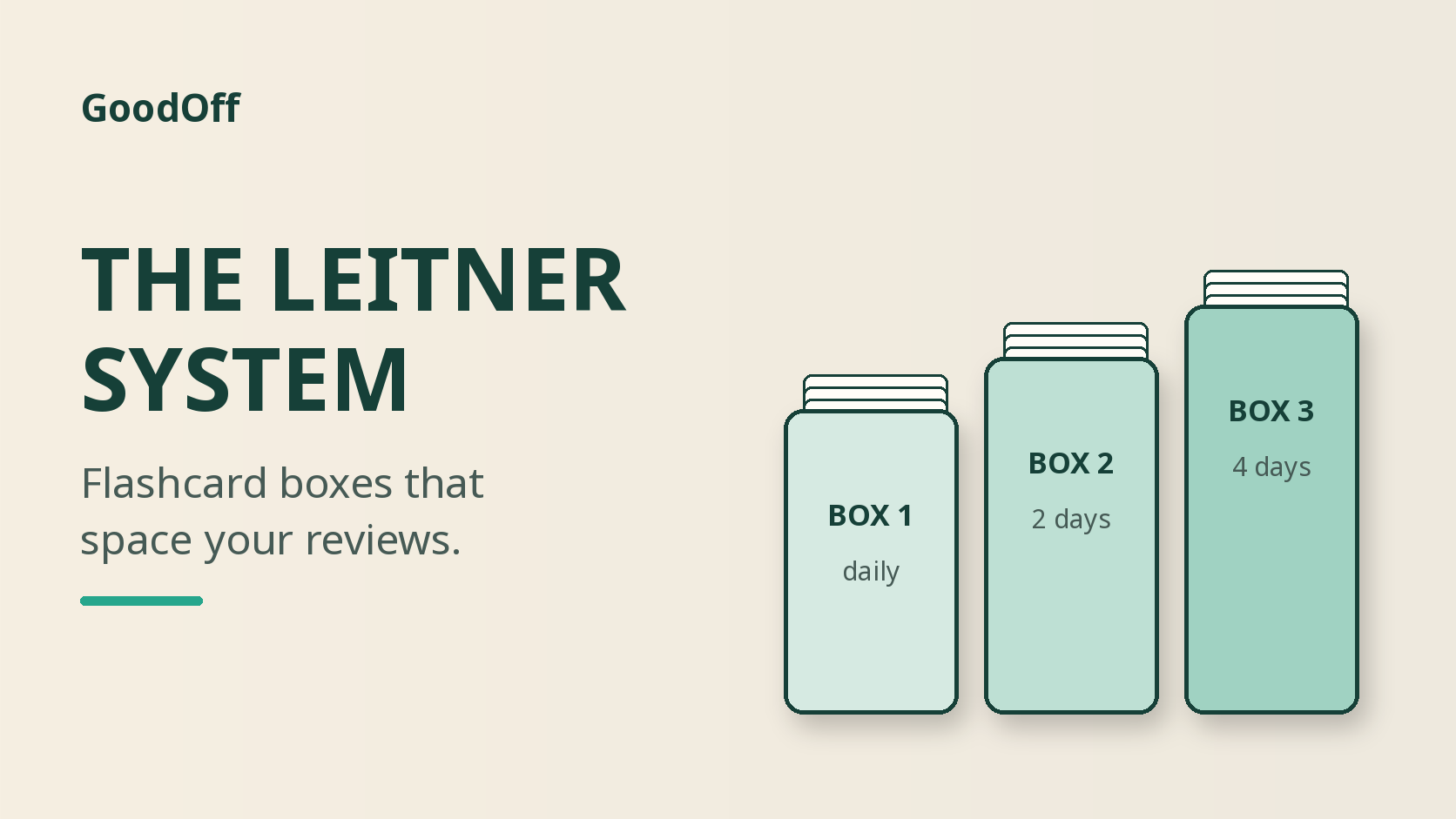
The Leitner system is a way to study flashcards using a few numbered boxes. Every card starts in Box 1. When you get a card right, it moves up one box, and higher boxes get reviewed less often. When you get a card wrong, it goes back to Box 1. The result is simple: you spend most of your time on the cards you don't know yet and very little on the ones you've already mastered.
This guide covers how the Leitner method works, a review schedule you can copy, how to set it up on paper or in an app, the mistakes that make it fail, and how it compares with modern spaced repetition.
What Is the Leitner System?
The Leitner system is a simple form of spaced repetition. German science journalist Sebastian Leitner described it in the 1970s in his book So lernt man lernen ("How to learn to learn"). His version used a single card box with partitions of different sizes. Most students today use three to five boxes, envelopes, or labeled piles instead.
Here's the full method in one paragraph. You sort flashcards into boxes by how well you know them. Box 1 holds new and difficult cards, and you review it every study day. Each later box is reviewed less often. A correct answer promotes a card to the next box. A wrong answer sends it back to Box 1, no matter where it was. Cards that pass the last box are considered learned.
That's the whole thing. There's no software to configure and no algorithm to understand, which is a big part of why it's still popular more than 50 years later.
Why the Leitner Method Works
The Leitner system combines two of the best-supported study techniques in learning research.
It forces active recall
Every flashcard asks you to pull an answer out of memory before you check it. That act of retrieval strengthens the memory far more than rereading does. In a well-known 2006 study, Roediger and Karpicke found that students who practiced recalling a passage remembered much more a week later than students who reread it. If you want to go deeper on this, our guide to quizzing yourself while studying covers the research.
It spaces your reviews
Memories fade fastest soon after you learn something, a pattern Hermann Ebbinghaus described as the forgetting curve. Reviewing just as a memory starts to slip makes it last longer each time. A large 2006 review of spacing studies by Cepeda and colleagues found that spreading practice out over time beats massing it into one session for long-term retention.
The boxes handle the spacing for you. Easy cards drift toward the back and come up rarely. Hard cards stay in Box 1 and come up every day until they stick.
How to Use the Leitner System, Step by Step
Make your cards. Write one question per card, with the answer on the back. Keep each card to a single fact or idea. "What are the three stages of cellular respiration?" is fine. "Explain cellular respiration" is too big for one card.
Label your boxes. Use three to five boxes, envelopes, or rubber-banded piles, numbered Box 1, Box 2, and so on.
Put every new card in Box 1.
Review the boxes that are due today. Always start with Box 1, then any other boxes on today's schedule.
Answer before you flip. Say or write the answer first. Then check it honestly.
Move each card. Right answer: move it up one box. Wrong answer, or a lucky guess: back to Box 1.
Add new cards in small batches. Five to ten new cards a day keeps Box 1 manageable.
A Leitner System Schedule You Can Copy
There's no single official schedule. A common choice is to double the gap between reviews at each box. These are the two most popular setups:
| Box | 3-box schedule | 5-box schedule |
|---|---|---|
| Box 1 | Every day | Every day |
| Box 2 | Every 2 days | Every 2 days |
| Box 3 | Every 4 days | Every 4 days |
| Box 4 | None | Every 8 days |
| Box 5 | None | Every 16 days |
Three boxes work well for a single exam a few weeks away. Five boxes suit bigger goals, like a language or a course that builds all semester. If Box 1 is taking you more than 20 minutes a day, slow down on new cards. If you keep forgetting cards in your top box, shorten its interval.
A Quick Example
Say you're learning 40 biology terms for a quiz in three weeks, using three boxes.
On Monday, all 40 cards are in Box 1. You review them and get 25 right, so those move to Box 2. On Tuesday, you review only Box 1, the 15 you missed. On Wednesday, Box 1 and Box 2 are both due. Most of the Box 2 cards move up to Box 3, and a few slide back to Box 1. By the end of the first week, the terms you know are coming up every few days, and your daily sessions shrink to the handful of terms that keep tripping you up.
That shrinking pile is the point. Instead of reviewing all 40 terms every night, you're reviewing the ten that actually need the work.
Common Mistakes That Break the System
Being generous with yourself. If you hesitated, half-remembered, or guessed, count it as wrong. Passing cards you don't really know just pushes them to boxes you won't see for days.
Adding too many new cards. Dumping 200 cards into Box 1 on day one creates a review pile you can't finish, and that's usually when people quit.
Skipping days. The schedule only works if Box 1 gets reviewed regularly. A short daily session beats a long weekly one.
Writing cards that are too big. A card with five facts on it is hard to mark right or wrong. Split it into five cards.
Retiring cards forever. Cards that pass the last box still fade over months. Before a final exam, shuffle your "learned" cards back in for one more pass.
Leitner System vs. Modern Spaced Repetition
The Leitner system is spaced repetition with fixed rules. Modern flashcard apps use algorithms that set a separate interval for every card, based on your history with it.
| Leitner boxes | Algorithm-based apps | |
|---|---|---|
| Intervals | Fixed per box | Calculated per card |
| After a mistake | Back to Box 1 | Interval shrinks, based on your rating |
| Rating options | Right or wrong | Often several, such as Again, Hard, Good, Easy |
| Setup | Cards and boxes | An app |
| Best for | Small decks, paper lovers, short goals | Large decks and long-term retention |
Algorithms like FSRS (Free Spaced Repetition Scheduler) take the Leitner idea further. Instead of five fixed boxes, each card effectively gets its own schedule, and a card you almost got right doesn't have to start over from the beginning. If that sounds useful, our explainer on what FSRS is and how it works for students breaks it down.
Paper boxes still have real advantages. Writing cards by hand helps you process the material, and there's no phone nearby to distract you. If you're torn, our comparison of digital and paper flashcards can help you choose.
Using GoodOff Alongside the Leitner Method
GoodOff doesn't use Leitner boxes. Its flashcards are scheduled with FSRS, so you get the same promote-what-you-know idea without sorting cards by hand. After each card, you rate it Again, Hard, Good, or Easy, and GoodOff sets when you'll see it next.
The bigger time saver is making the cards. Upload a PDF, your notes, lecture slides, or a photo, and GoodOff turns it into editable question-and-answer flashcards. You can fix or delete any card before you study. If you already have an Anki deck, you can import it. When a card confuses you, Sage, GoodOff's tutor, answers from your uploaded material and cites the passages it used.
Plenty of students mix both: paper Leitner boxes for a small set of tricky facts, and an app for the full course.
Key Takeaways
The Leitner system sorts flashcards into boxes, and each box is reviewed less often than the last.
Right answers move a card up one box. Wrong answers send it back to Box 1.
It works because it combines active recall with spaced reviews.
A 3-box schedule of daily, every 2 days, and every 4 days is an easy place to start.
Be strict when you grade yourself, add new cards slowly, and review Box 1 every study day.
Frequently Asked Questions
How many boxes should I use for the Leitner system?
Three boxes are enough for most single exams. Use five if you're studying something long-term, like a language or a full-year course. More than seven is rarely worth the extra tracking.
How often should I review each Leitner box?
A common schedule is Box 1 daily, Box 2 every 2 days, Box 3 every 4 days, Box 4 every 8 days, and Box 5 every 16 days. Adjust it if your daily reviews get too long or if you keep forgetting cards in the top box.
What happens when I get a card wrong?
In the classic Leitner system, a wrong card goes all the way back to Box 1. Some students use a gentler rule and move it back one box. The classic rule is stricter but keeps weak cards in front of you.
Is the Leitner system the same as spaced repetition?
It's one type of spaced repetition. The Leitner system uses fixed intervals per box, while apps with algorithms like FSRS calculate a separate interval for each card.
Can I use the Leitner system in an app?
Yes. Some apps have a Leitner mode with virtual boxes. Most modern flashcard apps use a scheduling algorithm instead, which follows the same principle with more precise timing.
How many new cards should I add each day?
Five to ten is a good range for most students. Adding more can make Box 1 so large that daily reviews take too long to keep up with.
Start Your First Box Today
You don't need a perfect setup. Grab some index cards, write ten questions from today's class, and put them in Box 1. Review them tomorrow. If you'd rather skip the card writing, upload your notes to GoodOff and start reviewing FSRS-scheduled flashcards made from your own material.