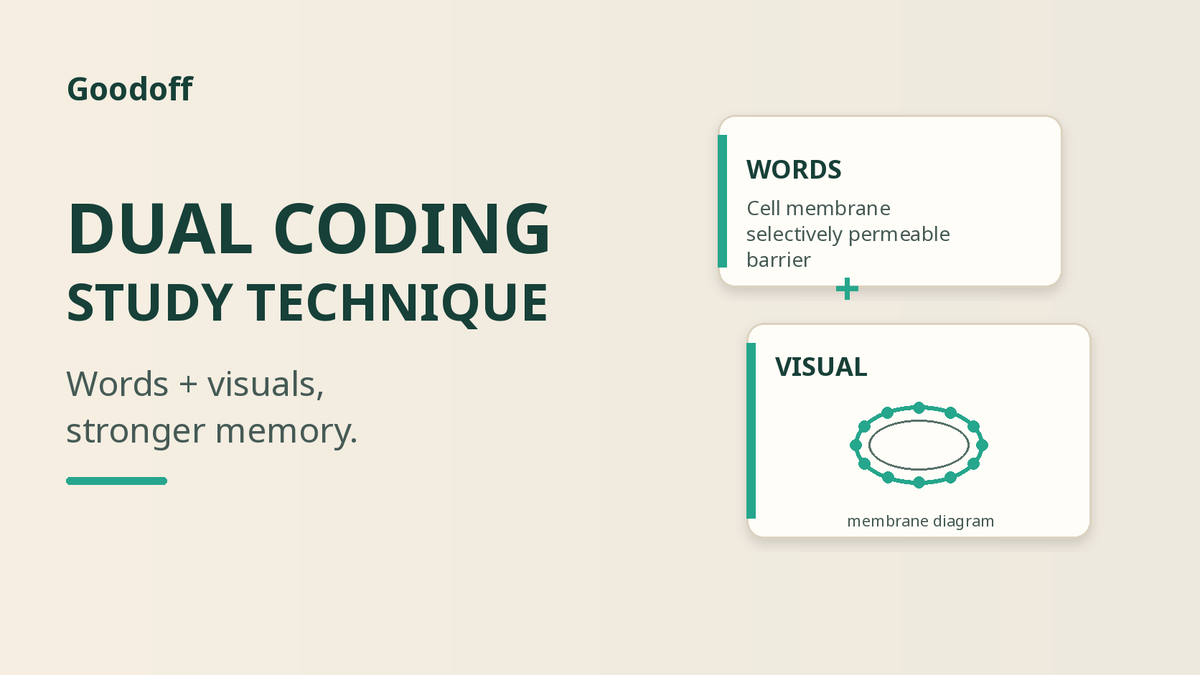
Dual coding is a study technique where you learn the same idea with both words and visuals, such as a short explanation plus a diagram, sketch, or timeline. Because your brain can store verbal and visual information in partly separate channels, pairing them gives you two paths back to the same memory. Students who combine text with meaningful images tend to recall more than those who rely on words alone.
If you have ever drawn a quick sketch next to a definition and suddenly understood it, you have already used dual coding. This guide explains what it is, why it works, how to do it step by step, examples by subject, common mistakes, and how to pair it with retrieval practice and spaced review.
What Is Dual Coding?
Dual coding comes from Allan Paivio's dual coding theory. The idea is that people process information through two mental systems: one for language (words you read or hear) and one for imagery (pictures, diagrams, maps, and mental images). When both systems encode the same idea, memory is stronger and easier to retrieve later.
In practice, dual coding means you do not just read a paragraph about the water cycle. You also sketch the cycle, label the stages, and explain each stage in a sentence. The words and the picture reinforce each other. You are not decorating your notes. You are building a second representation of the same concept.
Dual coding is different from simply adding clip art. A cute icon that does not carry meaning adds little. A diagram that shows relationships, sequence, structure, or comparison is what helps.
Why Dual Coding Works
Learning scientists have studied multimedia learning for decades. Richard Mayer's work on multimedia learning builds on dual coding and shows that people usually learn better from words and pictures together than from words alone, when the design is careful.
Three reasons explain the benefit:
Two retrieval paths. If you forget the wording, the image can cue the idea. If the image is fuzzy, the words can fill it in.
Deeper processing. Turning text into a diagram forces you to decide what matters, how pieces connect, and what to leave out. That selection work is real learning.
Less overload when done well. A clear visual can replace a long verbal description of structure or process, so your working memory has room to think.
Dual coding is not magic. Poorly designed slides that dump text and decorative images can hurt more than they help. The win comes from meaningful visuals that match the words.
How to Use Dual Coding: Step by Step
You can apply dual coding to textbooks, lecture notes, slides, or a study guide. Here is a simple routine for one concept or section.
Pick one idea. Choose a process, structure, comparison, or timeline. Dual coding shines when relationships matter.
Write a short verbal summary. In two to four sentences, explain the idea in your own words. Keep it plain.
Choose a visual form. Use a flowchart for processes, a labeled diagram for structures, a table for comparisons, a timeline for events, or a simple sketch for spatial ideas.
Draw or rebuild it yourself. Copying a perfect textbook figure is weaker than reconstructing it from memory, then checking. Your own sketch does not need to be pretty.
Link words to parts of the visual. Add short labels. Point arrows at causes and effects. Number steps in order.
Explain the visual out loud. Cover the text and teach from the diagram alone. Then cover the diagram and rebuild the explanation from words. Gaps show what to review.
Turn it into a review card. Front: a blank diagram or a prompt like "Draw and label the nephron." Back: the completed visual plus a one-sentence explanation.
Examples Across Subjects
Biology: Read about cell membrane transport, then draw the membrane with arrows for diffusion, facilitated diffusion, and active transport. Label energy use on active transport only.
History: After reading about a revolution, build a timeline with causes above the line and effects below it. Add one short phrase per event.
Chemistry: For stoichiometry, sketch a mole map that shows the paths between grams, moles, and particles. Practice walking a problem along the map.
Psychology: For classical conditioning, draw a simple before-during-after diagram with CS, US, and CR labels instead of memorizing the terms in isolation.
Math: For a word problem, sketch the situation (rates, areas, or overlapping sets) before choosing a formula. The picture constrains which equation makes sense.
Notice the pattern: the visual shows structure or flow, and the words name and explain it. That pairing is dual coding.
Common Mistakes to Avoid
Decorative images. Stock photos that do not encode the concept waste space and attention.
Text overload on the visual. If your diagram is a wall of sentences, you have not dual-coded. You have made tiny paragraphs. Keep labels short.
Passive copying. Tracing a perfect figure without reconstructing meaning does little. Redraw from memory, then correct.
Using it for every fact. Isolated vocabulary or a single date may not need a diagram. Save dual coding for ideas with structure, process, or comparison.
Never testing yourself. Looking at a finished diagram feels fluent. Cover it and redraw or explain from scratch.
Dual Coding vs. Mind Maps and the Feynman Technique
A mind map is one way to dual-code when branches and layout carry meaning. It is less useful when the map is only circled words with no spatial logic. The Feynman Technique focuses on explaining a concept in simple language. You can combine both: draw the structure, then explain it in plain words as if teaching someone new to the topic.
Elaborative interrogation asks why each fact is true. Dual coding asks how to represent the idea in words and visuals. Use elaborative interrogation to deepen reasons, then dual-code the resulting structure so you can see and say it.
How to Combine Dual Coding With Retrieval and Spacing
Dual coding helps you encode information well. To keep it, you still need to pull it back out over time.
Day 1: Build a word-plus-visual summary for each key concept and turn blanks into flashcards (for example, empty diagrams to label).
Following days: Practice retrieving the visual from a verbal cue and the verbal explanation from the visual. Mix topics instead of blocking one chapter at a time.
Over weeks: Review those cards on a spaced schedule so each one returns near the point of forgetting. For how modern schedulers set those intervals, see FSRS spaced repetition.
Before exams: Redraw core diagrams from memory under timed conditions, then check. Pair with better long-term study habits so you are not relying on one late night.
Using GoodOff With Dual Coding
Dual coding takes time when you have to invent every diagram and review schedule by hand. GoodOff can speed up the setup. Upload a PDF, notes, slides, or a URL and GoodOff can generate flashcards, quizzes, a study guide, and visual explanations or infographics you can edit. Those visuals give you a starting diagram to rebuild and label yourself. Flashcards with diagram prompts fit dual coding well, and FSRS-style scheduling brings those cards back before you forget them. Sage can quiz you with citations from your materials when you want to check an explanation.
You still do the important work: redrawing, labeling, and explaining in your own words. GoodOff handles generation and review timing so the dual-coded notes you build today still show up when you need them.
Key Takeaways
Dual coding means learning with both words and meaningful visuals for the same idea.
It works because verbal and visual codes give you two routes to recall and force deeper processing when you build the visual yourself.
Use diagrams, timelines, tables, and sketches that show structure, not decorative images.
Always test yourself by redrawing or explaining from memory.
Combine dual coding with retrieval practice and spaced repetition for lasting results.