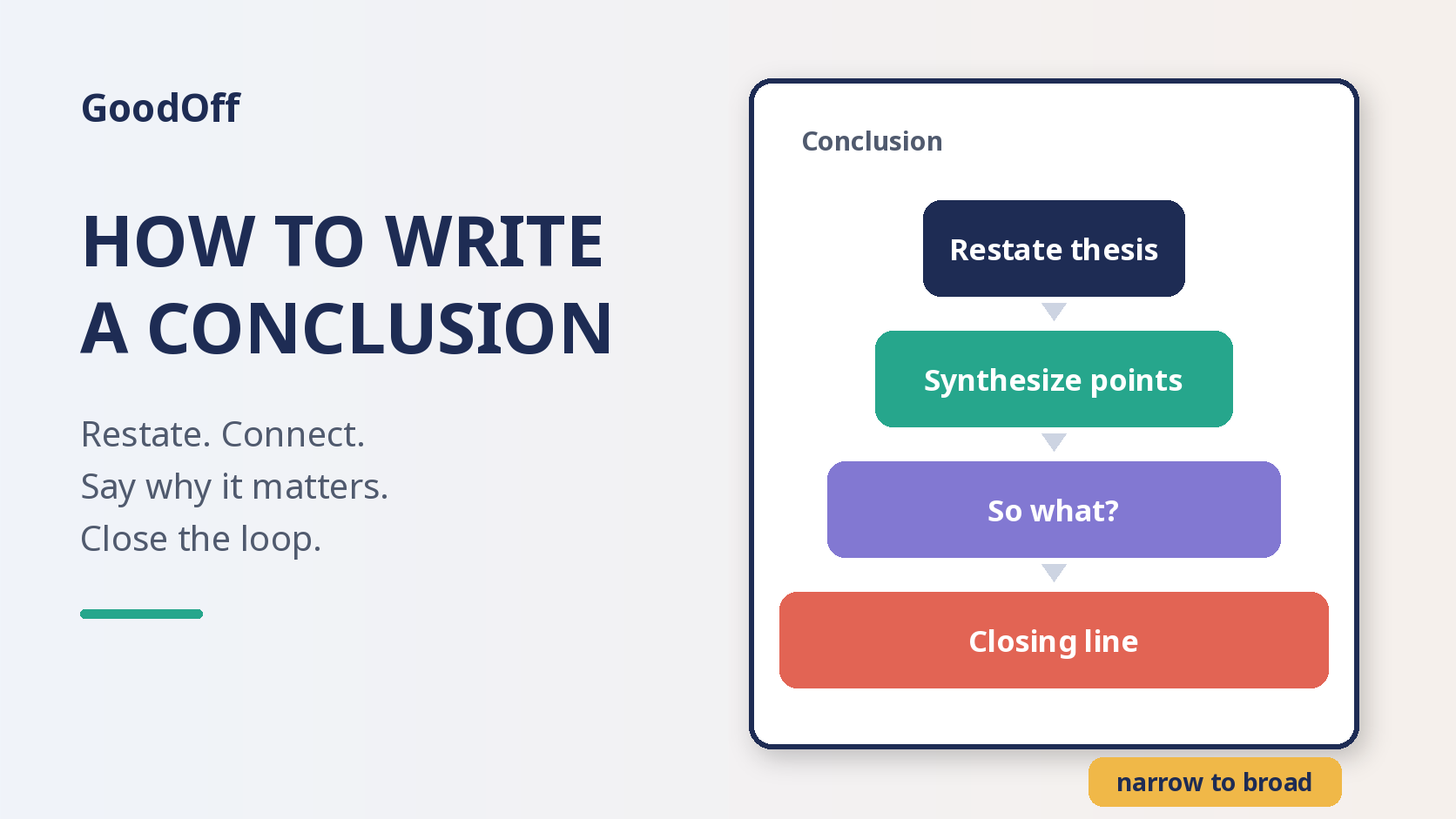
Short answer: To write a conclusion, restate your thesis in new words, show how your main points fit together (don't just list them), explain why the argument matters, and end on a final sentence that closes the loop. Add no new evidence. For most essays, one paragraph of four to six sentences is enough.
That's the whole job. The hard part is doing it without sounding like a copy of your introduction. Below you'll find a four-move formula, a worked example built from a real draft, a weak-to-strong rewrite, and notes on how the conclusion changes for argumentative essays, research papers and lab reports.
What a conclusion is for
Your introduction moves the reader from the world into your argument. The conclusion moves them back out. The UNC Writing Center describes it as a bridge that helps readers see why your analysis should matter after they put the paper down.
So a conclusion answers two questions the reader has by the last page:
- What did you prove? The thesis, now backed by everything in the body.
- So what? Why it matters, who it affects, or what it changes.
Harvard's writing center frames it the same way: after the "what" and the "so what," leave the reader with a final thought. If your conclusion only answers the first question, it'll read like a summary. If it only answers the second, it can drift into a speech.
How to write a conclusion in 4 moves
Think of it as a funnel turned upside down. The University of Waterloo's writing centre suggests starting with the narrowest ideas tied to your thesis and widening toward the broader discussion by the end. Here's that shape as four moves.
Move 1: Restate the thesis, changed by the evidence
Don't paste your thesis back in. Rewrite it so it reflects what the body paragraphs showed. Purdue Global's writing center makes this point: restate the thesis in a way that shows how the body supports it, not word for word.
A quick test: could this sentence have been written before the essay existed? If yes, it hasn't absorbed your evidence yet.
Move 2: Synthesize your main points
Summary repeats. Synthesis connects. Instead of "First I showed A, then B, then C," say how A, B and C work together. Waterloo puts it plainly: synthesis keeps only the most important pieces and shows how they combine into a new understanding.
One or two sentences usually covers this. In a short paper you don't need a full recap. Harvard notes that even a short research paper doesn't need an exhaustive summary.
Move 3: Answer "so what?"
This is where most conclusions fall flat. UNC's "So What" game helps: read a sentence from your conclusion and ask "So what?" or "Why should anybody care?" Answer it. Then ask again about your answer. Two rounds usually gets you to something worth saying.
Your "so what" can take a few forms:
- Implication: what follows if your argument is right.
- Application: where else the idea applies.
- Action: what someone should do about it.
- Open question: what your argument lets us ask now that we couldn't before.
Move 4: End with a closing sentence
The last sentence is the one readers carry away. Waterloo advises taking extra care with it. Good options: return to an image or example from your introduction, state the stakes in one plain line, or point forward. Avoid a quote dropped in with no comment, and skip "In conclusion." UNC calls those stock phrases wooden in writing.
A worked example
Say your thesis was: "City libraries should extend their hours during final exam weeks, because many students lack a quiet place to study at home, campus libraries fill up, and the added cost is small." Your three body paragraphs covered home study space, crowded campus libraries, and staffing costs.
| Move | Example sentence |
|---|---|
| 1. Restate, changed | Longer library hours during finals aren't a perk. They fill a gap that students without quiet space at home already fall into. |
| 2. Synthesize | When home is noisy and campus seats run out, the same students get squeezed twice, and a few extra staffed hours reach exactly that group. |
| 3. So what | That makes exam-week hours less a question of convenience and more a question of who gets a fair shot at studying. |
| 4. Closing line | A library that closes at 6 p.m. in finals week is open for everyone except the people who need it most. |
Put together, that's a four-sentence conclusion. Notice what's missing: no new statistics, no new fourth reason, no "In conclusion, I have shown."
Weak to strong: one conclusion, rewritten
| Weak version | Problem | Stronger version |
|---|---|---|
| In conclusion, libraries should be open longer during finals. | Restates the thesis with nothing added. | Longer library hours during finals fill a gap students without quiet space at home already fall into. |
| First, home is noisy. Second, campuses are crowded. Third, it's cheap. | A list, not a synthesis. | Noisy homes and full campus libraries squeeze the same students twice. |
| Also, a survey I found last night shows most students study late. | New evidence in the conclusion. | Move the survey into a body paragraph with a proper citation, or cut it. |
| Libraries are the heart of every community and a beacon of hope. | Emotional appeal that doesn't fit an analytical essay. | A library that closes at 6 p.m. in finals week is open for everyone except the people who need it most. |
The last row matches one of UNC's four ineffective conclusion types: the sentimental ending that's out of character with the rest of the paper. The others are the bare thesis restatement, the "Sherlock Holmes" conclusion that reveals the thesis for the first time at the end, and the "grab bag" of leftover facts.
How conclusions differ by assignment
| Assignment | What the conclusion should do | Typical length |
|---|---|---|
| Argumentative essay | Restate the claim, show the reasons together, state the stakes or a call to action | One paragraph |
| Literary or rhetorical analysis | Say what your reading reveals about the text and why that reading matters | One paragraph |
| Research paper | Answer the research question, connect to the literature, note limitations, suggest future research | One to several paragraphs |
| Lab report | State whether the results supported the hypothesis, give the main finding, note sources of error and next steps | A short paragraph, often after the discussion |
For research papers, the University of Toronto's OISE skills hub lists three moves: summarize the main takeaways tied to your research question, connect them to the literature, then zoom out to limitations, implications or recommendations. James Madison University's writing center adds that in empirical papers the conclusion often follows the discussion and ends with recommendations for future research.
Make those recommendations specific. Editage's guide is blunt about it: "More research is needed" isn't a direction. A useful one says what to study, with whom, and how. If you're writing up an experiment, our guide on how to write a lab report covers where the conclusion sits in that format.
How long should a conclusion be?
For a standard essay, one paragraph. Waterloo's rule of thumb is about 10 to 15 percent of the paper, so roughly 100 to 150 words for a 1,000-word essay. Longer theses and dissertations may need a full chapter. If your conclusion runs longer than a body paragraph in a short essay, you're probably re-arguing instead of concluding.
Check your instructor's expectations
Not every class wants the same ending. The University of Michigan's Sweetland Center notes that some instructors want you to restate your main points, while others want you to skip the recap and explain the significance instead. Read the rubric. If it's silent, look at the model essays your instructor shared, or ask. Waterloo suggests reading conclusions from the same genre and discipline to learn the conventions.
Conclusion checklist
- The thesis is restated in new words and reflects the evidence.
- Main points are connected, not listed.
- It answers "so what?" in at least one sentence.
- No new evidence, quotes or arguments appear for the first time.
- No apology for what the paper didn't cover.
- It doesn't open with "In conclusion" or "In summary."
- The last sentence would make sense as the paper's final word.
- Length is about one paragraph for a short essay.
Common mistakes
- Copying the introduction. Sweetland warns that the introduction and conclusion shouldn't be the same.
- Adding a new argument. Harvard says a big counterargument belongs before the conclusion, where you have room to answer it.
- Apologizing. If your scope is limited, say so earlier. Don't end on what you didn't do.
- Overreaching. VCU's writing center reminds students they don't have to settle an age-old debate. Communicating an idea is enough.
- Writing it first. Most people find the conclusion easier once the body exists, because then you know what you proved.
A strong conclusion starts with a strong thesis. If yours feels vague, fix it upstream with our guide on how to write a thesis statement. And if you're writing under a clock, how to study for an essay exam walks through timed practice so you finish whole answers, closing paragraph included.
Where GoodOff fits
GoodOff doesn't write conclusions for you, and it isn't an essay grader. It can help with the reading behind your argument. Upload a PDF, your notes or slides, and make an AI study guide, quiz or flashcards from them. The Free plan includes AI decks, quizzes, study guides and FAQs with daily, weekly and monthly limits. On Pro, the Sage tutor answers questions from the source you uploaded and cites the passages it used, which helps when you want to check that your conclusion matches what a source actually says. AI answers can still be wrong, so confirm them against the source.
Frequently asked questions
What are the 4 parts of a conclusion?
A restated thesis, a synthesis of your main points, the "so what" (why it matters), and a closing sentence. Some assignments add limitations or a call to action.
How do you start a conclusion without saying "in conclusion"?
Start with your restated thesis. The reader can see it's the last paragraph. You can also open by returning to an example or question from your introduction.
Can you add new information in a conclusion?
Not new evidence or arguments. You can add new perspective, like an implication or a question for further study, as long as it grows out of what you already proved.
How many sentences should a conclusion have?
For a short essay, about four to six. Match the length to the paper: roughly 10 to 15 percent of the total is a common guideline.
Should a conclusion summarize the essay?
Briefly, at most. It's better to synthesize: show how the points connect rather than repeating each one. Some instructors do want a recap, so check the rubric.
How is a research paper conclusion different?
It answers the research question directly, links findings to earlier studies, names limitations and suggests specific future research. In some papers it's a separate section after the discussion.
The bottom line
Restate what you proved, show how your points fit together, say why it matters, and close with one deliberate sentence. Keep new evidence out, skip "In conclusion," and keep it to about a paragraph. If you can answer "so what?" in plain words, you've got a conclusion.
Need to get through the readings behind your essay first? Try GoodOff free and turn a PDF into a study guide or quiz in your library.
Sources
- The Writing Center, University of North Carolina at Chapel Hill, "Conclusions."
- Harvard College Writing Center, "Conclusions."
- University of Waterloo Writing and Communication Centre, "Conclusions."
- Purdue University Global Academic Success Center, "Writing the Conclusion Paragraph" (2026).
- University of Michigan LSA Sweetland Center for Writing, "How Do I Write an Intro, Conclusion, & Body Paragraph?"
- Virginia Commonwealth University Writing Center, "Conclusions and Why They Matter."
- University of Toronto OISE Academic Skills Hub, "How to Write Conclusions."
- James Madison University Writing Center, "Discussion and Conclusion Sections for Empirical Research Papers."
- Editage, "How to Write the Conclusion of a Research Paper."