You knew this. Last night, you knew it cold.
You could recite the definition, work the formula, list all six causes in order. Then you sat down, the clock started, you read question one, and your brain returned a single flat error message: nothing.
You stared. You panicked a little. You scraped together an answer you weren't sure about. And then, the moment you walked out of the room, it all came flooding back. Every answer. Instantly. Almost cruelly.
If that's you, read this carefully, because here's the part nobody tells you: that is not a knowledge problem. It's a retrieval-under-pressure problem. And it's very fixable once you understand what's actually happening.
Why Your Mind Goes Blank (It's Not What You Think)
The information didn't disappear. It was in there the whole time. So why couldn't you reach it?
The answer is working memory, the small mental workspace your brain uses to hold and manipulate information in the moment. Think of it as your brain's RAM: a tiny desk where the actual thinking happens. It's powerful, but it's cramped.
Here's the problem. When you're anxious, your worries don't wait politely outside. Thoughts like "I'm going to fail," "everyone's writing faster than me," and "why can't I remember this" barge onto that desk and take up space.
So the very workspace you need for retrieving answers is now clogged with panic. There's no room left to think. That's the blank.
Test anxiety doesn't erase what you know. It occupies the mental space you need to reach it.
This is why the smartest-sounding advice, "just relax," almost never works. You can't simply command a crowded desk to clear. But you can train your recall to be so strong and so automatic that it barely needs the desk at all. That's where the real fix lives.
How to Overcome Test Anxiety: Build Recall That Survives Pressure
The counterintuitive truth: the best cure for blanking isn't a breathing exercise. It's how you study in the weeks before.
If your recall is fragile, pressure shatters it. If your recall is automatic, pressure barely touches it. Here's how to build the automatic kind.
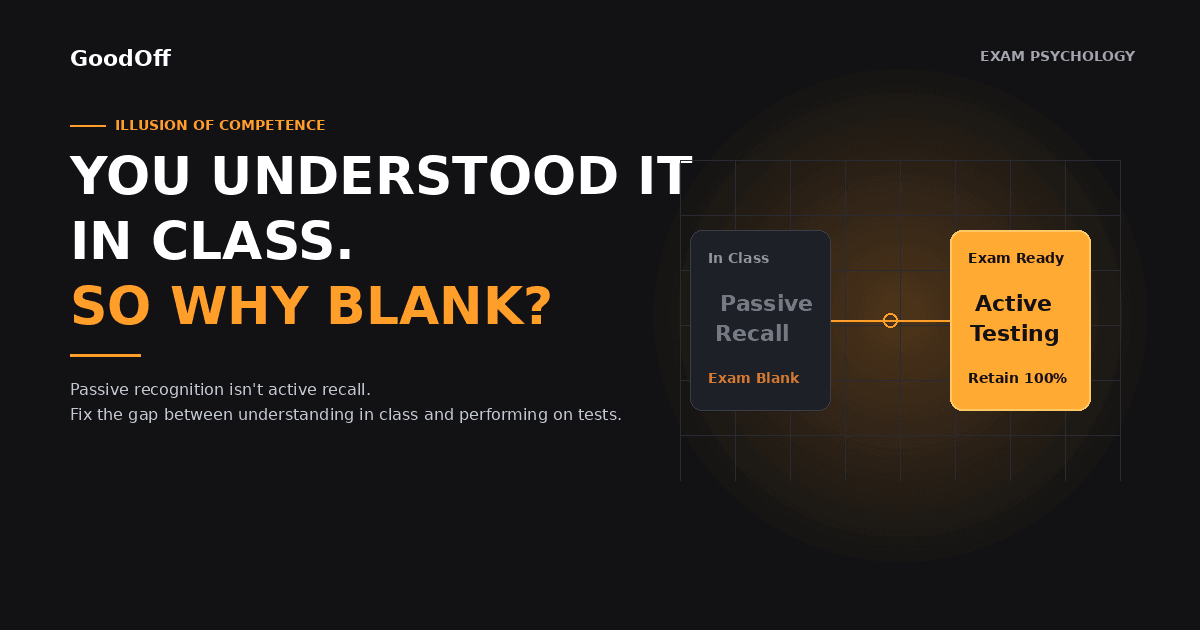
Practice retrieving, not rereading. Rereading your notes builds recognition ("that looks familiar"), which collapses under stress. Retrieval practice, actively pulling answers out of your memory without looking, builds the exact skill an exam tests. Close the book and quiz yourself. Every time you struggle to recall and then succeed, that memory gets stronger and easier to reach.
Practice the way you'll perform. Recall is context-sensitive. If you only ever "study" by highlighting on your comfy bed, exam conditions feel alien. So rehearse retrieval under conditions closer to the real thing:
Do timed practice questions, not open-book review.
Sit at a desk, phone away, no notes.
Take full practice tests so the format stops being a threat.
The goal is to make the exam feel like a rerun, not an ambush. Familiarity is the quiet antidote to panic.
Overlearn with spaced repetition. Reviewing material across days and weeks (rather than one frantic night) pushes knowledge past "I sort of know this" into "I know this automatically." Automatic recall needs almost no working memory, so anxiety has far less to disrupt.
Do this, and you walk in with retrieval that holds even when your heart is pounding.
On the Day: 4 Moves That Clear the Desk
Prepared recall does most of the work. These tactics handle the rest by freeing up working memory in the moment.
Do a brain dump. In the first two minutes, write down formulas, dates, or key facts in the margin before anxiety can crowd them out. Getting them onto paper gets them out of your head, where they were taking up space.
Write your worries down first. Spending a few minutes writing out your anxious thoughts before the exam has been shown to actually improve scores. It's like closing background apps: you offload the worry so your mind has room to work.
Reframe the nerves. That racing heart is not a sign you're failing. It's your body getting ready. Telling yourself "I'm excited and ready" instead of "I'm terrified" measurably improves performance, because the physical feeling is the same, only the label changes.
Breathe slow, then start easy. A few slow exhales calm your body's alarm response. Then answer the easiest question first to bank a quick win and build momentum before tackling the hard ones.
One honest note: if test anxiety is severe, keeps you up at night, or shows up in daily life beyond exams, that's worth talking to a school counselor or doctor about. There's no shame in it, and real support exists.
How GoodOff Helps You Stop Blanking
Everything above points to one root fix: build recall strong enough to survive pressure. That means practicing retrieval, again and again, under realistic conditions. Doing that by hand is slow, which is why most students fall back on rereading and stay stuck.
GoodOff closes that gap.
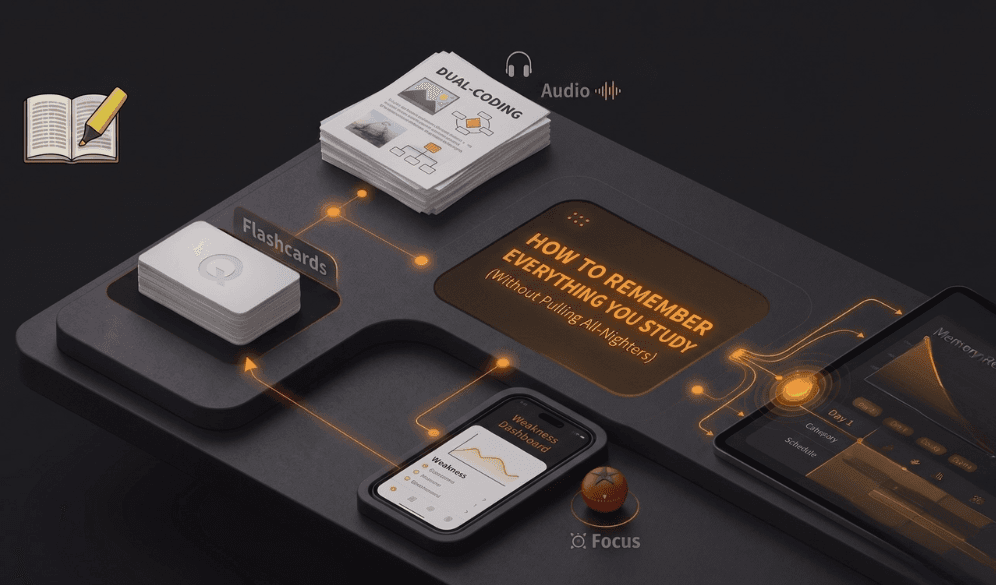
Instant practice tests. Drop in your notes, a PDF, or a slide deck, and GoodOff turns them into quizzes and flashcards in seconds. You get retrieval practice, the thing that actually beats blanking, without building a single card yourself.
Realistic, repeatable reps. Quiz yourself as many times as you want, under timed, no-notes conditions, so exam day feels like a format you've already survived a dozen times.
Spaced repetition built in. GoodOff resurfaces shaky material at the right intervals, pushing it toward automatic recall that pressure can't easily shake.
Ask Sage when you blank in practice. When a question stumps you, Sage, GoodOff's AI tutor, re-explains the concept on the spot, so a weak spot gets fixed now instead of ambushing you later.
You keep the understanding. GoodOff handles the relentless retrieval practice that turns "I knew it yesterday" into "I know it right now, even here."
The Bottom Line: Train Recall, Not Just Knowledge
If you take one thing from this, make it this:
Blanking isn't proof that you didn't study. It's proof that you studied the wrong way. Recognition folds under pressure. Retrieval holds.
You don't need to magically feel calm on exam day. You need recall so well-practiced that it shows up even when you're nervous. Quiz yourself instead of rereading, rehearse under real conditions, and clear your mental desk when the clock starts.
What you know is already in there. Let's make sure it shows up when it counts.
Ready to stop blanking and start recalling? Try GoodOff free and turn your notes into practice tests that make exam day feel like a rerun.