You've read this page three times now. Your highlighter has touched almost every line; the paragraph practically glows. And if someone asked you to explain what it just said, you'd have nothing.
So you read it a fourth time. Same result. The words go in through your eyes and quietly leave through the back of your head, leaving no trace behind.
Here's what's going on, and it's not that you're a bad reader. You're doing the thing almost everyone does with a textbook, and it's the thing that guarantees you'll forget it. Let's fix how you read.
Why Reading a Textbook Usually Fails
There's a difference between two things that look identical from the outside: passive reading and active reading.
Passive reading is letting your eyes slide across the words while your mind idles. It feels like studying. You're "getting through the chapter." But your brain isn't doing anything with the information, so nothing sticks.
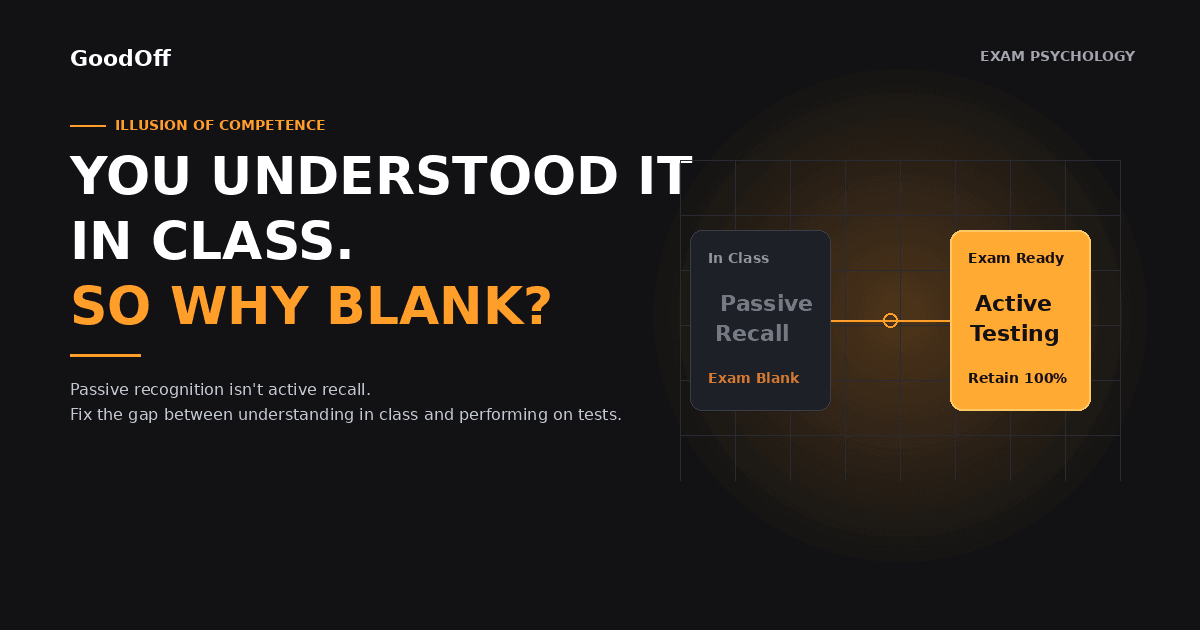
This is the same trap as rereading and highlighting. They feel productive because the page becomes familiar. But familiarity is not memory.
Recognizing words on a page is not the same as being able to recall what they mean. An exam tests the second thing. Passive reading only trains the first.
And highlighting deserves a special callout, because it's the most popular study habit there is and one of the least effective. When you highlight, you're mostly just marking where the important stuff is for "later." You're deferring the actual thinking. Later rarely comes.
The fix isn't reading more. It's reading in a way that forces your brain to work while your eyes move.
How to Read a Textbook the Active Way
Active reading means turning a one-way stream of words into a back-and-forth. You question the text, answer it, and check yourself, all as you go.
There's a classic framework for this called SQ3R: Survey, Question, Read, Recite, Review. It's been around for decades because it works. Here it is in plain language, as five moves.
1. Survey before you dive in. Before reading a word of the body text, skim the whole section. Read the headings, the bold terms, the summary, and any questions at the end. This takes two minutes and builds a mental map, so new information has somewhere to land instead of piling up loose.
2. Turn headings into questions. A heading like "The Causes of Inflation" becomes "What causes inflation?" Now you're not just reading, you're hunting for an answer. That small shift gives your brain a job, and a job keeps it awake.
3. Read in chunks, then look away and recall. Read one section, then glance up from the page and try to say the main idea in your own words, without looking. This is retrieval practice, and that little moment of effort is what actually builds the memory. If you can't recall it, you didn't learn it yet, and now you know to reread that part with attention.
4. Explain it like a person, not a textbook. After a section, explain the idea as if you were telling a friend who knows nothing about it. If you get stuck or reach for jargon you can't unpack, you've found a gap. Plain-language explanation is one of the fastest ways to turn reading into understanding.
5. Review by testing, not rereading. When you finish, don't reread the chapter. Quiz yourself on the questions you made in step two. Then revisit them again days later. Spacing your review out is what moves the material into long-term memory.
Notice what every step has in common: it makes you do something with the text, not just look at it.
Annotate With Purpose (Not a Highlighter Massacre)
If you like marking up your book, do it in a way that requires thought:
Write questions in the margin, not just underlines. A question forces engagement; a highlight doesn't.
Summarize each section in one short sentence in your own words at the end of it.
Star only what you don't already know. If everything is highlighted, nothing is. The point of marking is to separate the new from the familiar.
The test for any annotation: did it make you think, or did it just make the page colorful? Only the first kind helps.
Turn Your Reading Into Recall With GoodOff
Active reading gets the ideas into your head. The last two steps, testing yourself and reviewing on a schedule, are where it sticks, and they're also the steps students skip most because doing them by hand is slow. That's where GoodOff carries the load.
Turn a chapter into a quiz instantly. Drop in your textbook PDF or your notes, and GoodOff builds flashcards and practice questions in seconds. Your reading becomes retrieval practice with no manual work.
Get a clean summary to check against. GoodOff condenses the chapter into the core ideas, so you can compare your own recall against it and catch what you missed.
Review on a smart schedule. Spaced repetition resurfaces the concepts you're shaky on right before you'd forget them, doing the "review days later" step for you.
Ask Sage when a passage won't click. When the textbook explains something badly, Sage, GoodOff's AI tutor, re-explains it in plain language with examples.
You do the active reading. GoodOff makes sure that effort turns into memory instead of evaporating by next week.
The Bottom Line: Read Less Passively, Remember More
If you take one thing from this, make it this:
The goal of reading a textbook isn't to get to the end of the chapter. It's to be able to close the book and explain what was in it.
Stop measuring your reading by how many pages you covered or how much you highlighted. Measure it by what you can recall with the book shut. Survey first, read to answer your own questions, recall as you go, explain it simply, and review by testing. Do that, and the chapter finally stays with you.
Ready to remember what you read? Try GoodOff free and turn your next chapter into a quiz that makes it stick.