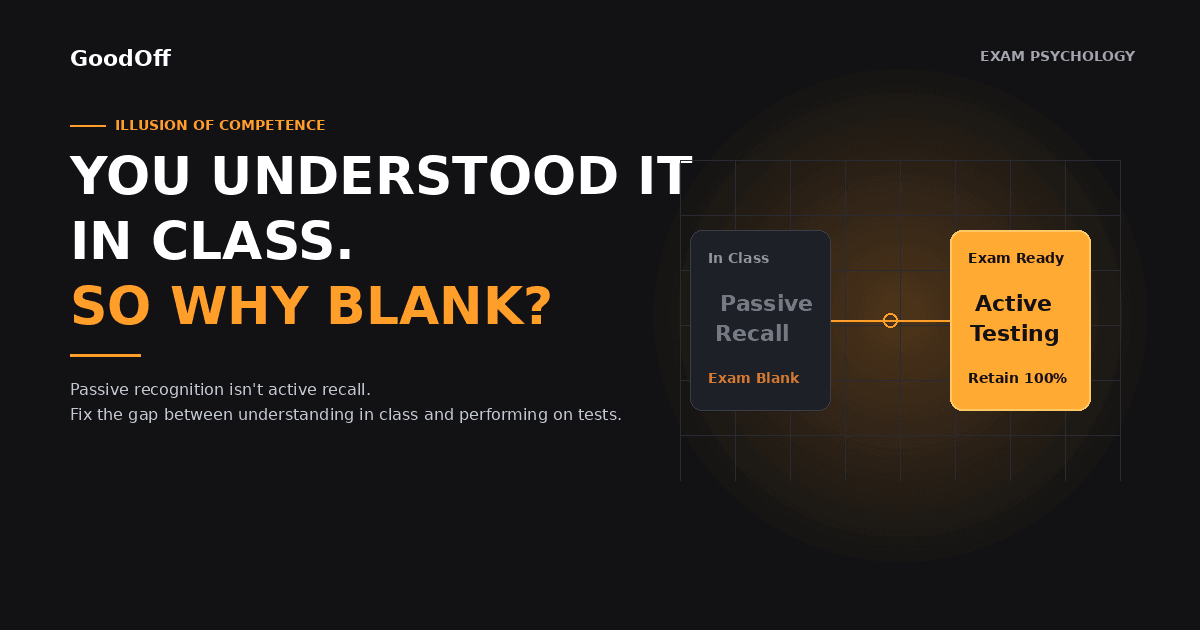
You spend five hours re-reading notes, highlighting entire pages in neon yellow, and going over lecture slides until your eyes hurt. You feel prepared.
Then exam day arrives, you read Question 4, and your mind is completely blank.
You didn’t lack effort. You fell into the Illusion of Competence confusing the comfort of recognizing a page with the ability to retrieve the fact from memory under pressure.
To actually retain information for the long haul, you must swap passive consumption for systematic retrieval.
The Highlighting Trap
When you re-read a textbook chapter, your brain does almost zero cognitive work. It simply recognizes familiar phrasing and whispers: "I know this."
In reality, Hermann Ebbinghaus’s Forgetting Curve demonstrates that without active retrieval, humans forget around 70% of new information within 48 hours.
Passive Re-reading:   Low Effort  ──► Zero Resistance ──► 70% Forgotten by Day 2
Active Recall:        High Effort ──► Strong Synapse  ──► 90% Retained Long-Term
True memory formation requires friction. If studying feels effortless, your brain treats the data as disposable.
The 4-Step Retention Framework
High-performing students don't study longer hours; they run a closed feedback loop.
1. Consume With Intent (Dual-Coding)
Don’t just stare at walls of text. Layer visual frameworks with audio summaries:
Listen to an audio breakdown of your lecture on your walk or commute.
Map high-level structure (diagrams, chapter outlines) before reading detailed sections.
2. Test Immediately (Zero Peeking)
Never close a book and assume you learned it. Convert the core concepts into active questions right away:
Turn key lecture slides or PDF notes directly into flashcard prompts and quick quizzes.
Close your notes and write a 3-sentence summary of the core thesis from scratch.
3. Diagnose the Misses
When you get a practice question wrong, log the root cause:
Concept gap: You never understood the mechanism.
Recall failure: You understood it yesterday, but the cue failed today.
Careless miss: You rushed through the prompt.
4. Space Your Reviews
Do not review everything every day. Schedule recall intervals for flagged cards:
Review 1: 24 hours later
Review 2: Day 4
Review 3: Day 10
Review 4: Day 25
The 45-Minute Daily Focus Routine
Replace chaotic 4-hour cram sessions with a single structured Pomodoro block:
00 – 10 min Priming: Listen to topic audio overview & review structural diagrams; 10 – 25 min Active Testing Run through a 20-card flashcard deck (no hints allowed)25 – 35 min Gap Analysis: Pinpoint missed items & review missing definitions 35 – 45 min Spaced Repetition: Take a 5-question targeted quiz on weak areas
Build Your Study Kit Automatically
Manually creating flashcards and organizing study schedules takes valuable hours away from actual learning.
With GoodOff, turn your PDFs, slides, and study notes into an automated learning system:
AI-generated flashcards and practice quizzes built from your materials
Audio podcasts for studying on the go
Automated spaced repetition and weak-spot tracking