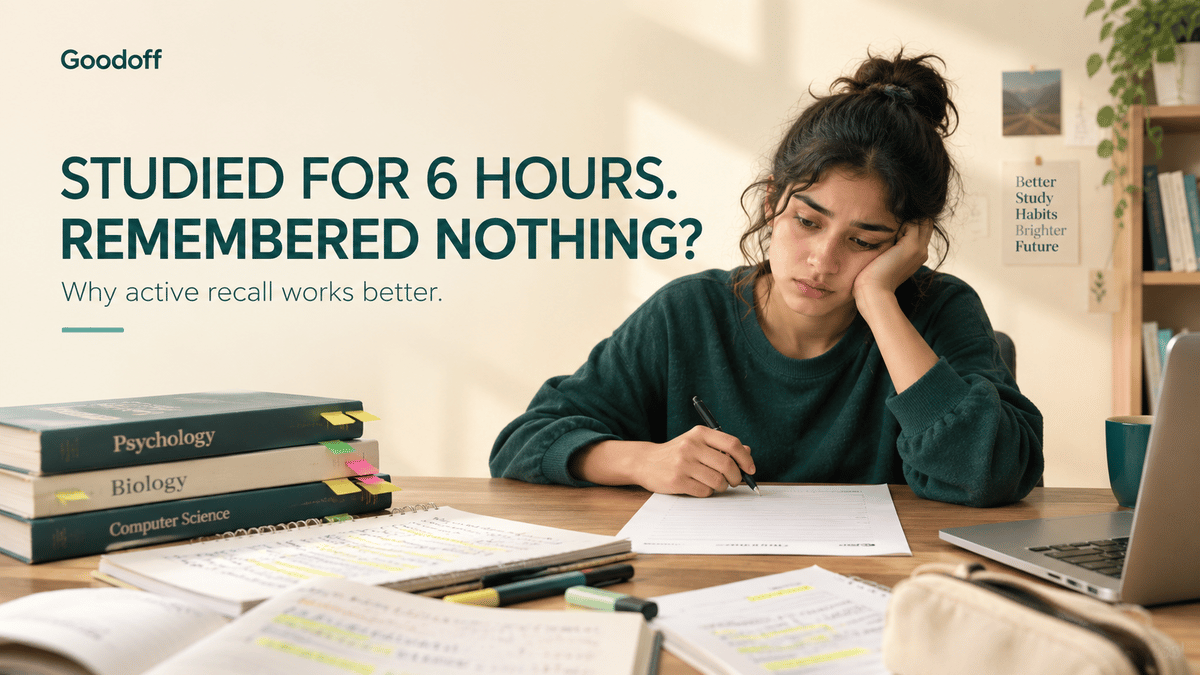
You sat at your desk for six straight hours. Your textbook is covered in highlighter, you went through your notes three times, and your phone stayed out of reach. You walked away feeling like you'd done real work.
Two days later, you open the exam paper and question one feels familiar, but the answer won't come.
Most students blame themselves: "My memory is bad," or "I just get test anxiety." Here's the thing: this isn't your fault, and it isn't a flaw in your brain. Nobody ever teaches us how learning actually works. Most of us were simply handed a textbook and told to "go study."
The Recognition Trap
When you re-read the same page, your brain gets comfortable with its layout, phrasing and headings. Psychologists call this recognition, and it creates a convincing illusion: "I've seen this before, so I know it."
But exams don't test recognition. They test retrieval: pulling facts and ideas out of memory with no source in front of you.
The research on this is consistent. In a well-known 2006 study, Henry Roediger and Jeffrey Karpicke found that students who practiced recalling material remembered more a week later than students who simply re-read it, even though the re-readers felt more confident. A large review by Dunlosky and colleagues (2013) reached a similar conclusion: practice testing ranked among the most effective study techniques, while highlighting and re-reading ranked among the least.
In short, if your study method never forces you to retrieve, hours with the book open can leave you tired but underprepared.
A Simple Loop That Builds Recall
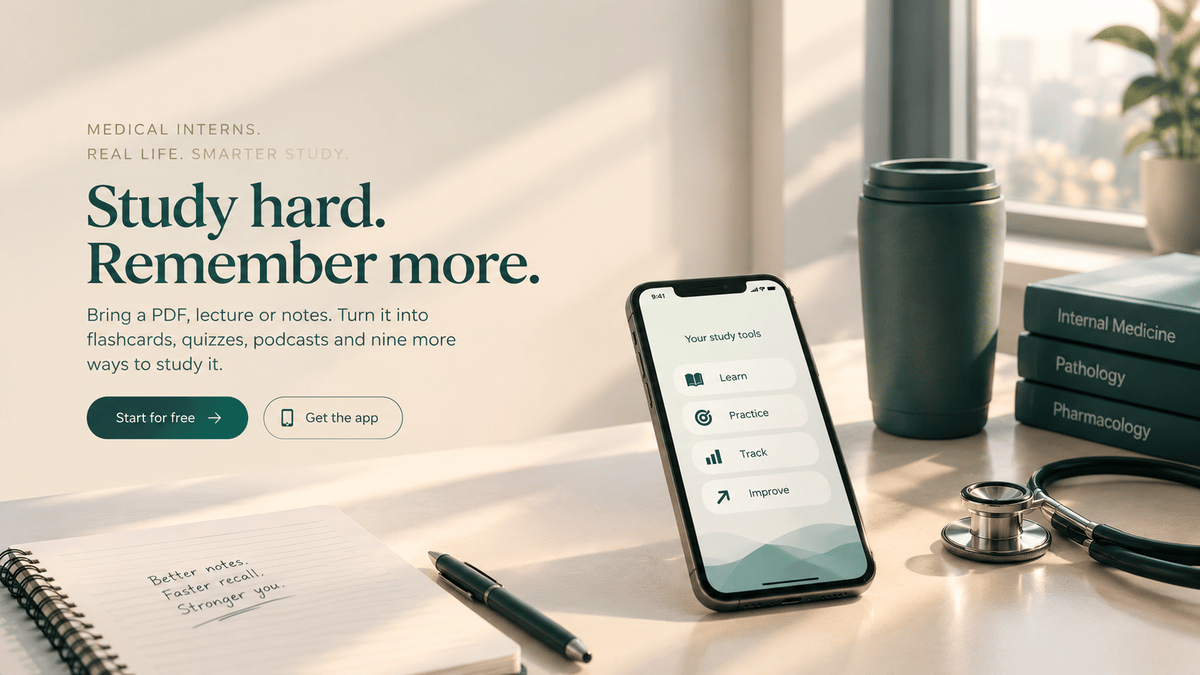
Effective studying works best as a loop where every step gives you feedback:
Learn: Break a topic into small, focused chunks instead of tackling a wall of text.
Practice: Right after each chunk, take a quick quiz (even 60 seconds) without looking at your notes. This exposes gaps while they're easy to fix.
Track: Note what you got right, what you missed, and when you last reviewed each topic, so you know which ideas are still fragile.
Improve: Spend a focused 25-minute block on your weakest topic, with one task and no tab-switching.
This is the approach we built Goodoff around: short modular decks, instant diagnostic quizzes, live accuracy tracking and built-in focus timers. But you don't need any tool to start. You can run this loop with a pen and paper.
Passive vs. Active Study
Passive study
Main method: Re-reading aur highlighting
Self-check: Aksar sirf mock exams mein
Feels like: Smooth aur productive
What you measure: Time spent
Active study
Main method: Recalling aur self-testing
Self-check: Har topic ke baad
Feels like: Harder, kabhi kabhi frustrating
What you measure: Jo recall karne ki koshish ki, usmein accuracy
That "harder" row matters. Retrieval feels more difficult in the moment, and that difficulty is what strengthens memory. If studying feels effortless, it may not be working.
3 Rules for Your Next Session
Close the book and write. After reading a topic, turn the page face down and write three key takeaways from memory. If you can't, you haven't learned it yet, and now you know exactly where to look.
Start with your weak spots. Begin with the topic that gave you the lowest score last time. Re-reading what you already know feels comforting, but it's the least useful way to spend your time.
Run one 25-minute sprint. Set a timer, keep one topic in front of you, and work until it rings.
The Bottom Line
Exam success isn't about logging more hours. It's about spending your hours on the right activity. Swap some of your re-reading for retrieval, and you'll likely remember more, feel more prepared, and walk into the exam hall with a lot more confidence.
References: Roediger, H. L., & Karpicke, J. D. (2006). Test-enhanced learning. Psychological Science. Dunlosky, J., et al. (2013). Improving students' learning with effective learning techniques. Psychological Science in the Public Interest.