Struggling to remember what you study? We break down the science of notes vs flashcards, active recall, and how to maximize your long-term retention.
Then the exam starts. You read question one. And your brain returns a soft, echoing… nothing.
Here's the uncomfortable truth: the hours you spent highlighting probably weren't studying at all. They felt like studying, which is exactly the problem.
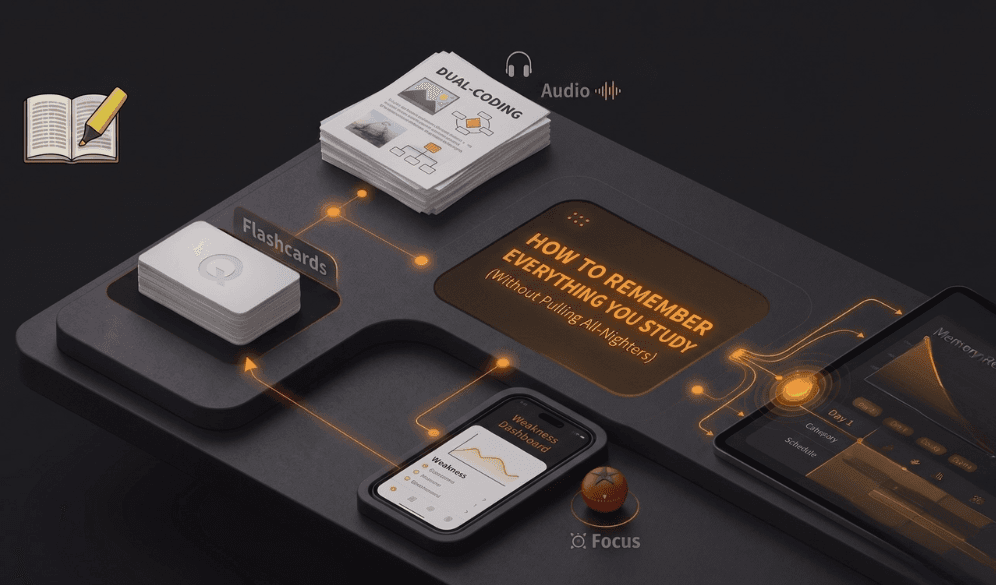
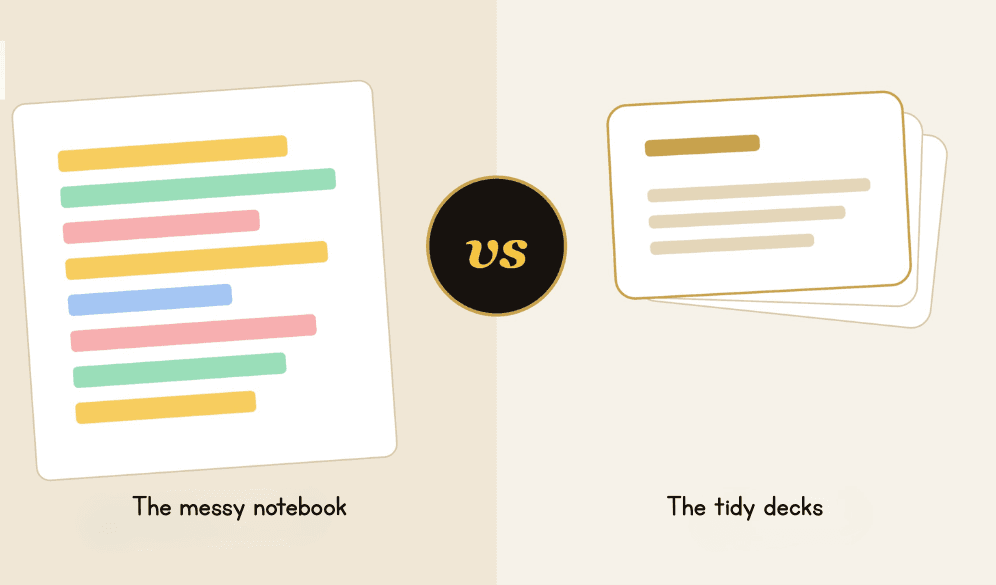
This is the great debate every student eventually runs into notes vs flashcards and the answer has less to do with preference than with how memory actually works. Let's fix your study time for good.
The Illusion of Competence (Why Highlighting Lies to You)
When you reread a page you've already highlighted, the words feel familiar. Your brain goes "yep, I know this," and you feel a warm glow of progress.
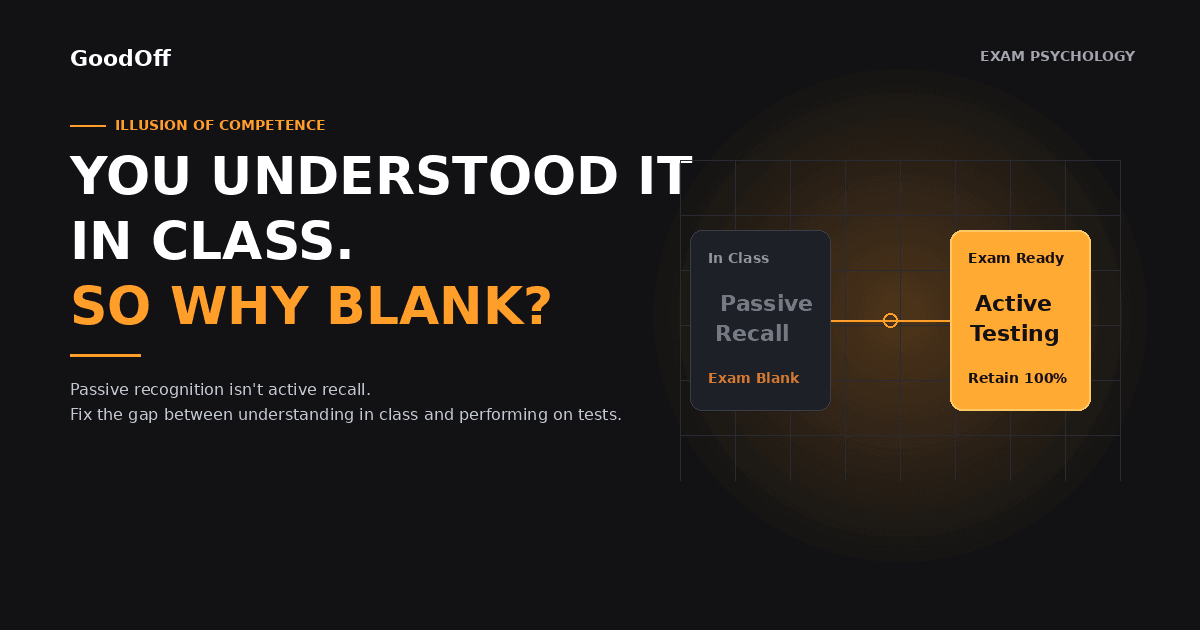
That glow has a name: the fluency illusion (sometimes called the illusion of competence). It's the trap of mistaking recognizing information for remembering it.
Think of it like this:
Recognizing is spotting a friend's face in a crowd. Easy.
Remembering is describing that friend's face to a sketch artist from a blank page. Way harder.
Your exam is the sketch artist. Highlighting only ever trains you for the crowd.
This is the core split behind every study method the difference between passive review (letting information wash over you) and active recall (forcing your brain to pull it back out). Almost everything below comes down to that one distinction.
Section 1: The Case for Notes
Notes get unfairly dragged in these debates, so let's be fair. The problem isn't notes it's how most people use them.
Passive Review vs. Active Synthesis
There are two very different things happening when you "take notes":
Passive review is copying slides word-for-word or re-reading what you wrote. Low effort, low payoff. Your hand moves; your memory doesn't.
Active synthesis is rewriting ideas in your own words, drawing connections, and organizing messy information into a structure that makes sense to you. This is where the magic is.
That act of reorganizing deciding what matters, linking concept A to concept B is called encoding. It's your brain filing information into a shape it can actually retrieve later.
When Writing Notes Genuinely Helps
Learning something for the first time, where you need to build understanding before you can memorize anything.
Complex, interconnected topics (think biology systems, historical cause-and-effect, legal frameworks) where structure is the content.
Summarizing a lecture into your own words, which quietly forces comprehension.
Where Notes Fall Short
They're a comfort blanket. Re-reading them feels productive but is mostly recognition, not retrieval.
Writing a note once doesn't lock it in. Encoding gets information into memory; it doesn't strengthen your ability to get it back out.
Beautiful, color-coded notes can become a form of productive procrastination. Pretty ≠ permanent.
Notes are how you understand. But understanding and remembering are two separate jobs and that's where flashcards walk in.
Section 2: The Case for Flashcards
Flashcards win the long game for one reason: they're built on the two most powerful ideas in memory science.
Active Recall: Making Your Brain Sweat
Active recall is the practice of retrieving information from a blank slate no notes, no hints, just you and the question. Every time you flip a card and struggle to remember the answer, something important happens.
Here's the counterintuitive part: the struggle is the point.
Memory works like a muscle. You don't get stronger by watching someone lift weights (rereading) you get stronger by lifting them yourself (retrieval). Researchers call this a desirable difficulty: the effortful, slightly uncomfortable act of pulling information out is exactly what carves it deeper into long-term memory.
This is why active recall vs passive review isn't a close contest. In landmark research on the "testing effect," students who practised retrieving material dramatically outperformed those who simply reread it often nearly doubling how much they remembered on a delayed test. Same material, same time. Radically different results.
Spaced Repetition: Outsmarting the Forgetting Curve
Your brain forgets on a predictable schedule. Learn something today, and without review, most of it quietly leaks out over the following days. That drop-off is the forgetting curve.
Spaced repetition fights back by showing you a card right before you're about to forget it then stretching the interval longer each time you get it right. Today, then three days, then a week, then a month.
Each well-timed review flattens the forgetting curve a little more, until the fact is basically permanent. Good flashcard apps automate this timing so you never have to think about it.
Where Flashcards Shine
Vocabulary, definitions, formulas, dates, and facts.
Any high-volume material you need to recall fast and cold (medical terms, languages, anatomy).
Cumulative subjects where old material keeps showing up and can't be allowed to fade.
The catch: flashcards are weaker at teaching you why things connect. Drilling isolated facts without understanding is like memorizing puzzle pieces without ever seeing the picture. Which is your first clue that this was never really an either/or question.
Section 3: Head-to-Head Notes vs Flashcards
📝 Notes🃏 Flashcards Cognitive Effort Moderate (high if you synthesize, low if you just copy) High forces retrieval every single time Ideal Use Cases Understanding new topics, organizing complex ideas, seeing the big picture Facts, vocab, formulas, high-volume memorization, cumulative subjects Study Time Required High upfront to create; often re-read inefficiently Low, focused sessions; spacing means you review less over time, not more Long-Term Retention Low–Moderate on their own (encoding without retrieval fades)High active recall + spaced repetition are the gold standard for durable memory Biggest Risk The fluency illusion (feeling ready when you're not)Memorizing facts you don't actually understand
The pattern is clear: notes are for building understanding. Flashcards are for making it stick. So stop choosing.
Section 4: The Hybrid Approach (The Learning Loop)
The best students figured out the secret years ago — they don't pick a side. They chain the two methods into a loop where each one covers the other's weakness.
Here's the loop:
Read & synthesize → take structural notes. Turn the messy source material into your own organized understanding. This is the encoding step where you build the picture.
Convert your notes into flashcards. Every key concept, definition, or cause-and-effect becomes a question. This is where active recall enters.
Review with spaced repetition. Let the intervals do the heavy lifting so the material moves into long-term retention on autopilot.
Return to your notes when a card exposes a gap. Blanked on a card? That's not failure — that's your notes telling you where to look. Patch the understanding, and the loop tightens.
Notes give you the why. Flashcards give you forever. Together, they turn passive reading into durable, exam-proof memory.
There's just one problem, and it's the reason most people never actually do this: turning a page of notes into a good deck of flashcards is tedious, slow work. By the time you've hand-typed 40 cards, you're too burned out to study them.
That's the exact bottleneck we built GoodOff to remove.
Section 5: Close the Loop with GoodOff
The whole hybrid method lives or dies on one boring step, making the cards. When that step is painful, the loop breaks, and people fall back to highlighting.
GoodOff is built to erase that friction so you spend your energy learning, not formatting.
Write (or drop in) your structural notes. Bring your lecture summaries, textbook chapters, or your own synthesized notes.
Instantly generate a practice deck. GoodOff reads your material and turns it into active-recall flashcards in seconds no manual typing, no burnout.
Study on a smart spaced-repetition schedule. The system times your reviews to hit right before you'd forget, so retention happens without you managing intervals.
Move seamlessly between the two. Understand something in your notes, then immediately test whether it stuck the encode-and-retrieve loop, all in one place.
It's the difference between knowing the hybrid method works and actually running it every day. GoodOff turns "I should make flashcards from this" into "the deck is already done, start studying."
Stop Studying Harder. Start Remembering.
Here's what all the science quietly agrees on: the goal was never to spend more hours at your desk. It was to make the hours you do spend actually stick.
Notes help you understand. Flashcards make you remember. And the moment you connect them, studying stops feeling like shovelling sand and starts feeling like building something that lasts.
Your next exam doesn't need more highlighter. It needs a better loop.
👉 Turn your notes into a smart flashcard deck with GoodOff and find out what it feels like to walk into an exam already sure you know it.