You left lecture feeling fine. The examples made sense. Your notes looked clean. You even nodded along when the professor said “this will be on the exam.”
Then the test dropped. Same topic. Different wording. And your brain offered… nothing.
That whiplash is not proof you are bad at school. It is usually a mismatch between what class trains and what exams demand.
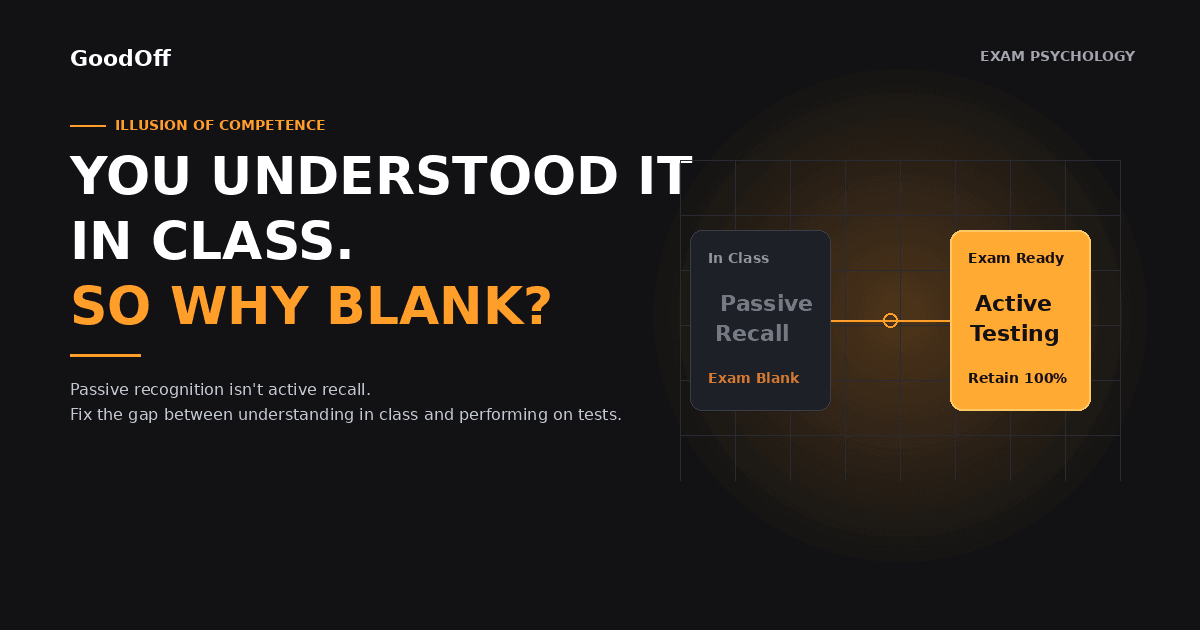
Class rewards recognition. Exams reward recall.
Recognition vs recall (the gap that wrecks exam scores)
Recognition is “I’ve seen this before.” Your notes look familiar. The textbook page feels known. The lecture example rings a bell. Familiarity feels like understanding, so your brain files it under “done.”
Recall is “I can pull this out cold.” No hints. No bolded heading. No professor voice guiding you. Just a blank page and a question that expects you to reconstruct the idea yourself.
Exams are mostly recall. Studying is often mostly recognition. That is the trap.
Learning research has a name for part of this: the familiarity illusion. You mistake “I recognize this” for “I can explain and use this.” The two feel similar in the moment. They are not the same skill.
Why class + rereading feels like mastery (and isn’t)
Lecture is a guided tour. Someone else chooses the path, points at the landmarks, and fills in the gaps. Your job is to follow along. That is useful for first exposure. It is a weak test of whether you can navigate alone.
Then comes the classic study loop: reread notes, highlight again, skim the slides, maybe watch a recap video. Each pass makes the material feel smoother. Your brain goes, “Yep, I know this.” What you mostly practiced is recognizing content while it sits in front of you.
Passive review is comfortable. Active retrieval is awkward. Guess which one predicts exam performance better?
Learning research on the testing effect is pretty clear on the direction: trying to retrieve information strengthens memory more than restudying it. Spacing those retrieval attempts over time helps even more. Neither idea requires a lab coat. You have lived the opposite version: cramming until everything feels familiar, then watching it fade under pressure.
So if your study plan is “understand once, then reread until calm,” you are polishing recognition. The exam is asking for recall.
How to close the gap
You do not need a perfect system. You need to practice the same skill the exam will ask for: getting answers out of your head without looking.
1. Close the notes and retrieve
After a class or a reading session, put the material away. Write down everything you can remember about the key idea: definition, why it matters, one example, one common mistake. Check after. The blanks are the curriculum.
If you cannot explain it without peeking, you do not own it yet. That is useful information, not a personal failure.
2. Turn headings into questions
Open your notes. Cover the body text. Convert each heading into a question, then answer out loud or on paper.
“Photosynthesis” becomes “What are the inputs and outputs of photosynthesis, and where do they happen?”
“Supply and demand” becomes “What happens to equilibrium price when demand rises and supply stays the same?”
If your answer is vague, dig until it gets concrete. Vague recall fails under exam wording.
3. Do practice questions before you feel ready
Waiting until you “fully understand” before testing yourself is a common delay tactic. Practice questions are not the final boss. They are the workout.
Use past papers, textbook problems, or quiz yourself from your notes. Struggle is part of the point. Every wrong answer is a map of what still needs work.
4. Teach it in two minutes
Explain the concept to a friend, a rubber duck, or your phone’s voice memo. Use plain language. If you stall, wave your hands, or say “you know what I mean,” you found a soft spot. Go fix that spot, then teach it again.
Teaching forces structure. Exams love structure.
5. Space the reviews
One heroic night of recall helps less than several shorter sessions across the week. Come back tomorrow. Come back in three days. Come back next week. Each time, try to retrieve first, then check.
Spaced repetition is just a fancy label for “don’t wait until everything has evaporated.” Small, repeated retrieval beats one long, panicked reread.
A simple “tonight” plan (and a weekly habit)
Tonight, pick one lecture or chapter you think you already understand. Set a 25-minute timer.
Close everything. Write a messy brain dump of the main ideas for five minutes.
Open your notes. Mark what you missed or mangled.
Create five practice questions from the weak spots (or use existing ones).
Answer them without looking. Check. Correct.
Schedule a five-minute redo for tomorrow and another for three days later.
That is it. No aesthetic notes required. No color-coding ceremony.
For the week, keep the same rhythm: after each class, one short retrieval session the same day, then light spaced reviews later. Protect at least two short practice blocks before any big exam. Use those blocks for questions under mild time pressure, not for rereading until you feel soothed.
The goal is not to feel ready. The goal is to prove readiness with recall.
When you want less friction
If building quizzes and flashcards by hand is the part that always slips, tools can help. GoodOff (https://goodoff.co) turns one uploaded source (notes, slides, a chapter) into flashcards, quizzes, study guides, and other study formats, plus spaced review with FSRS. There is also a source-grounded tutor, Sage, if you want to poke at a concept without drifting into random internet explanations.
Use whatever keeps you retrieving, not just rereading. The method matters more than the brand.
The reframe that actually helps
Blanking on an exam after a “clear” lecture does not mean you lied to yourself about understanding. It means understanding and exam-ready recall are different jobs.
Class introduces the map. Studying has to make you draw the map from memory.
Start tonight with one closed-book brain dump. Tomorrow, ask yourself the questions before you open the answers. Keep spacing those checks. The familiarity illusion loses power once you stop mistaking recognition for recall.
Ready to practice the way exams actually test you? Try turning your next set of notes into retrieval practice at https://goodoff.co.