Stop the "study-forget-repeat" cycle. Understand the science of the Forgetting Curve and learn how to remember what you study using Active Recall and Spaced Repetition.
The "Leaky Bucket" Problem
You spend six hours cramming for a midterm. You highlight the entire textbook until it looks like
a neon coloring book. You feel prepared. Then, you sit down for the exam, look at the first
question, and your mind is a total vacuum. The information hasn't just "slipped your mind" it has
effectively vanished.
If this sounds familiar, you aren't "bad at memorizing." You are simply fighting against a
biological law called the Ebbinghaus Forgetting Curve. This curve shows that humans lose
roughly 50% to 70% of new information within 24 hours unless they actively work to keep it.
Traditional studying is like trying to fill a leaky bucket with water; no matter how fast you pour
(cram), the water is constantly draining out the bottom.
To stop forgetting, you have to patch the bucket. Here is the science-based framework to ensure
that what you learn on Monday is still there for the final exam in May.
1. Why Traditional Studying Fails
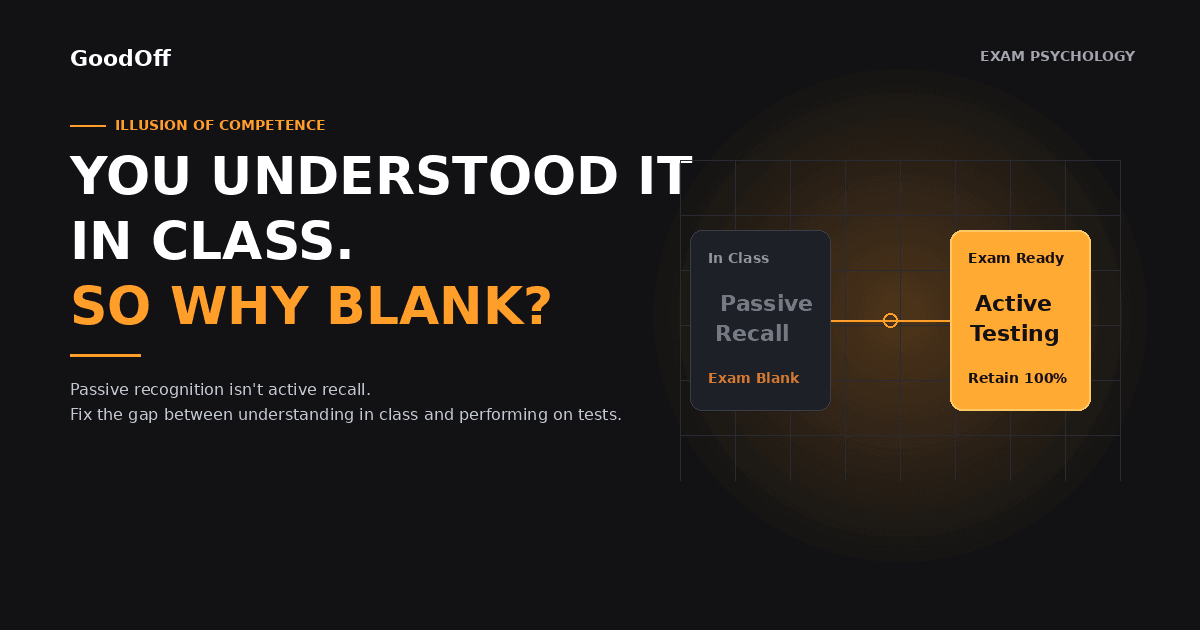
The reason you forget is that most "study" methods are passive. Re-reading your notes,
highlighting text, and watching lectures are low-effort activities. They create an "illusion of
competence" you feel like you know the material because you recognize it on the page. But
recognition is not the same as retrieval.
Cramming is the ultimate enemy of long-term retention. While it might get you through a quiz
tomorrow, it doesn't build the neural pathways required for long-term memory. When you cram,
you are loading information into your short-term "working memory," which has a very limited
capacity. As soon as you sleep, your brain performs a "trash sweep" and deletes most of that
data to make room for the next day.
2. The Solution: Active Recall + FSRS
If you want to remember what you study, you must shift from "putting information in" to "pulling
information out." This is known as Active Recall. Instead of looking at your notes, you close
the book and force your brain to retrieve the answer from scratch. This "desirable difficulty"
signals to your brain that this information is important and needs to be stored permanently.
To maximize this, you combine Active Recall with Spaced Repetition. Instead of reviewing a
concept ten times in one day, you review it at increasing intervals (1 day, 3 days, 10 days, 30
days). The most advanced way to do this in 2026 is through the FSRS (Free Spaced
Repetition Scheduler) algorithm. Unlike older models, FSRS uses your personal performance
data to predict exactly when you are about to forget something and forces you to review it right
before that happens. This "memory hack" flattens the forgetting curve.
3. How to Implement the System
You don't need to be a genius; you just need a better workflow.
● Step 1: Atomic Notes. Don't write paragraphs. Turn your notes into questions and
answers. Every piece of information should be a prompt.
● Step 2: The Blurting Method. After a study session, take a blank piece of paper and
"blurt" out everything you remember about the topic. Then, go back and see what you
missed. The gaps you find are your high-priority study areas.
● Step 3: Daily Review. Spend 15 minutes every morning reviewing your "due" material.
Consistency beats intensity every single time.
4. GoodOff: The Practical Retention Tool
Building this system manually is exhausting. This is why high-performing students use GoodOff
to automate the process.
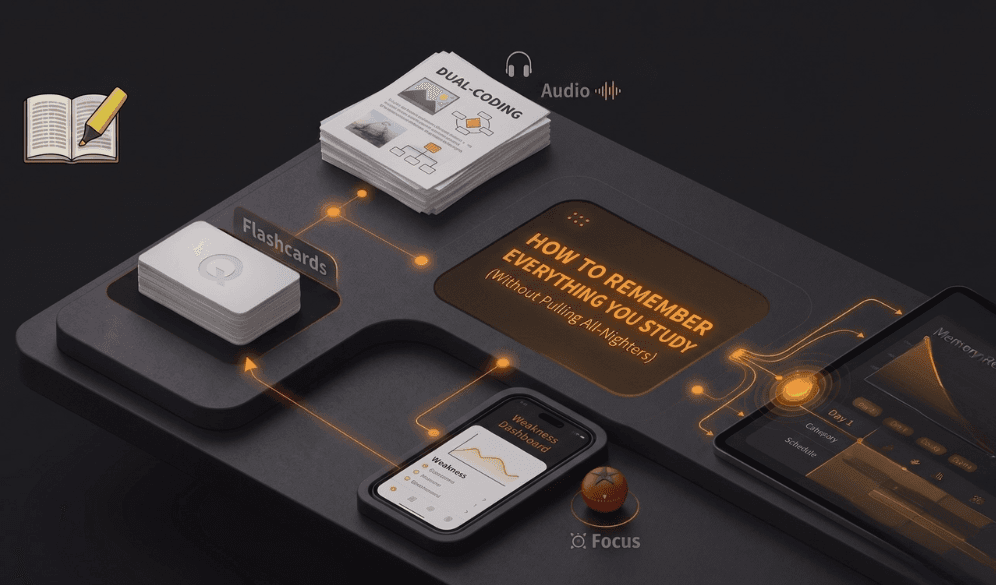
● Instant Conversion: You can upload your lecture PDFs or notes, and the AI instantly
converts them into smart flashcard decks.
● FSRS-Powered Scheduling: You don't have to decide what to study today; the platform
uses the FSRS algorithm to present exactly what you are at risk of forgetting.
● Multi-Modal Learning: Use the AI Audio Learning feature to review your cards while
you’re at the gym or commuting, turning "dead time" into retention time.
● Progress Tracking: GoodOff provides real-time analytics so you can see your mastery
scores. You no longer have to "hope" you remember; you can see the data that proves
you do.
5. Common Mistakes to Avoid
● Studying "Easy" Cards: Don't waste time reviewing things you already know. Focus
your energy on the "Hard" and "Again" cards.
● Skipping Days: Spaced repetition relies on the interval. If you skip a week, the
"forgetting curve" resets, and you’ll have to do double the work to catch up.
● Over-Highlighting: If your book is yellow, you aren't studying; you're decorating. Switch
to active testing immediately.
The Bottom Line
Forgetting is a choice. You can continue the cycle of cramming and panicking, or you can use
the science of your brain to your advantage. Shift to Active Recall, trust the Spaced Repetition
intervals, and use a tool like GoodOff to handle the logistics.
Stop filling a leaky bucket. Patch the holes, build the system, and start remembering more while
actually studying less.