Let's be honest about how studying actually goes right now.
You read your lecture notes in Notion or Obsidian. Then you switch to Quizlet or Anki to build flashcards. Then you open your phone for a timer, so you'll actually focus. Three apps, three logins, three places your progress lives.
By the time you've set everything up, you've burned twenty minutes and half your motivation. And here's the part nobody tells you: that fractured workflow isn't just annoying. It's quietly wrecking your memory.
Let's talk about why, and what to do instead.
The App Scatter Crisis (Why Your Setup Is Working Against You)
Learning isn't supposed to be a relay race between apps. But that's exactly what most students have built for themselves.
Here's the typical scatter:
Notes live in one place (Notion, Obsidian, or a paper notebook).
Flashcards live in another (Quizlet, Anki, or Revisely).
Focus lives on your phone (a timer app that also happens to serve you notifications).
Every switch between them is a tiny tax on your attention. Research on task-switching is pretty blunt about this: every time you jump contexts, your brain pays a "switch cost" and needs time to fully re-engage. Do that dozens of times a session and you're studying at a fraction of your real capacity.
But the deeper problem is the broken feedback loop.
When your notes, practice, and progress all live in separate silos, nothing talks to each other. You can't see whether the note you wrote on Tuesday actually turned into a fact you remember on Friday. The workflow is fractured, so the memory is too.
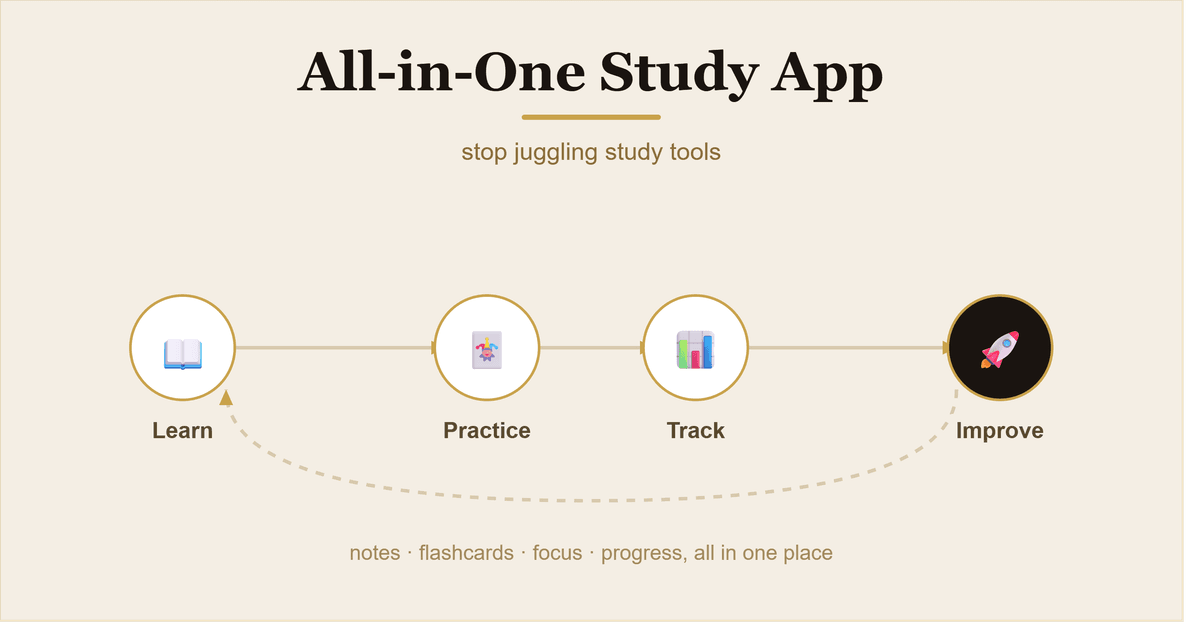
Learning is supposed to be a loop: Learn → Practice → Track → Improve. Scattered tools snap that loop into disconnected pieces.
Why Students Outgrow the Usual Tools
Every major study app does one thing well and leaves a gap somewhere else. That's why so many students end up stacking three or four of them.
Here's the honest breakdown:
Quizlet is great for grabbing pre-made decks and quick review. But the review itself is fairly basic, and it isn't built to schedule your learning for genuine long-term retention. It helps you cram; it doesn't help you keep.
Revisely shines at AI-powered flashcard generation and turning notes into cards fast. Where it thins out is the long game. Strong creation, weaker spaced repetition scheduling to make those cards stick over weeks and months.
RemNote and Anki are the power tools. Their FSRS (Free Spaced Repetition Scheduler) engine is genuinely excellent for durable memory. The catch is the wall you hit getting there. Steep learning curves, dense interfaces, and setup that feels more like configuring software than studying. Powerful, but overwhelming, especially when you just want to learn.
Notion and Obsidian are beautiful for notes and knowledge management. But they're passive by design. They store what you know; they don't actively test whether you remember it.
See the pattern? Each tool owns one stage of the loop. So, students bolt them together, and the seams are exactly where memory leaks out.
The GoodOff Loop (One App, One Continuous Loop)
GoodOff was built around a simple conviction: the entire learning lifecycle should live in one place, running as a single real-time loop instead of four disconnected apps.
Learn → Practice → Track → Improve. No exporting, no re-importing, no bouncing between tabs. Here's how it works.
Learn & Practice: Where Notes Become Memory
This is where the loop actually closes, because in GoodOff your notes and your practice live side by side.
Seamless note integration. Write your structural notes right where you study, then turn them into practice without ever leaving the app.
AI-powered flashcard generator. Drop in your notes and let GoodOff draft an active-recall deck in seconds. No more hand-typing 40 cards until you're too burned out to review them.
Smart Assist helps you refine and expand your material, so your decks get sharper instead of staying shallow.
And when it comes to how you practice, GoodOff goes well past basic front-and-back cards. It's built for genuine active recall, the single most effective thing you can do for memory:
Cloze deletion for filling in the blanks and testing recall in context.
Image occlusion for hiding parts of a diagram, which is a gamechanger for anatomy, geography, and anything visual.
Diagram sets for mastering labelled, spatial material.
Review modes for every mood: Learn mode to build fluency, Test mode to simulate the real thing, plus Practice All and In Order for when you want control over exactly what you drill.
Gamified activities like Match and live game modes that make heavy review sessions feel less like a grind.
The point isn't the feature count. It's that all of it runs on real active learning principles, in a UX clean enough that you actually use it.
Track & Improve: Progress You Can Actually Feel
This is the half of the loop most apps forget. And it's the half that keeps you going.
GoodOff pairs its practice engine with spaced repetition so your reviews land right before you'd forget, building long-term retention on autopilot instead of leaving you to cram.
But the magic is in how you see it:
Real-time dashboard updates. Finish a session and watch your progress move immediately. No reloads, no waiting, no wondering.
Human-friendly analytics. Not a wall of intimidating charts, but clear signals of what's sticking, what's slipping, and what to review next.
Motivation you can watch build. Seeing your retention climb is the difference between a study habit that lasts and one that fizzles by Friday.
When you can see the loop working, you keep showing up. That's the whole game.
Stay Sharp: Focus Is Built In
Here's the small thing that quietly makes a big difference: you never have to reach for your phone to focus.
GoodOff has a built-in Pomodoro timer, so your focus tool lives right next to your study material. Work in focused sprints, take structured breaks, and keep your mind fresh through long sessions without ever opening the app that's most likely to distract you.
No phone in hand means no "quick check" that turns into twenty lost minutes. Focus and study, finally in the same window.
Bring the Whole Loop Home
Here's the takeaway. The problem was never that you weren't studying hard enough. It's that your tools were fighting each other, and your memory was paying the price.
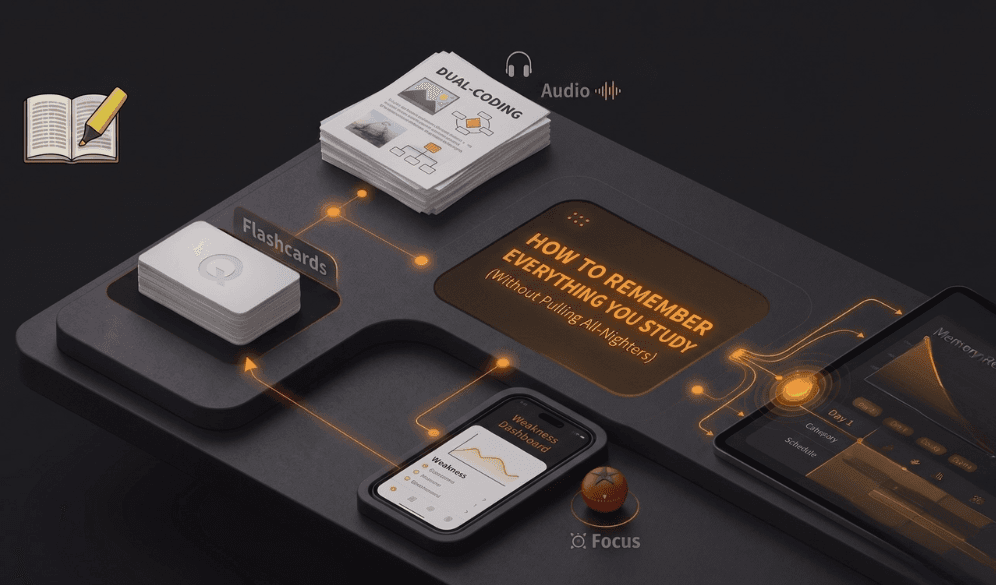
GoodOff closes the loop. Notes, AI-generated flashcards, active-recall practice, spaced repetition, real-time progress, and focus tools, all in one clean, modern app built to make knowledge actually stick.
Stop paying the switch-cost tax. Stop watching your progress scatter across four apps. Start studying in one place that's built for how memory really works.
Try GoodOff free at goodoff.co and feel what it's like when your entire study workflow finally runs as one loop.