Discover the neuroscience behind the FSRS algorithm predicts your forgetting curve and why GoodOff’s real-time analytics are the secret to long-thind the spacing effect. Learn erm memory.
The Efficiency Formula
If you have ever spent a weekend cramming 200 pages into your brain only to forget 90% of it by the following Friday, you have fallen victim to the Spacing Effect. Most students treat their brain like a hard drive as if you can just drag and drop files until the storage is full. In reality, your brain is more like a muscle: it needs rest and specific intervals of stress to grow stronger.
High-performing mentors don't tell you to study more; they tell you to study at the mathematically optimal moment. If you study too soon, you waste time on information you already know. If you study too late, you’ve already forgotten the material and have to re-learn it from scratch. Spaced Repetition is the science of hitting that "sweet spot" exactly.
1. The Biological "Hard-Drive": Memory Consolidation
When you learn something new, the connections between your neurons (synapses) are weak. To make them permanent, your brain must go through a process called Long-Term Potentiation (LTP). This doesn't happen during the study session; it happens during sleep and, crucially, during the struggle of trying to remember something.
The "Spacing Effect" works because it forces your brain to work harder to retrieve information right when it’s about to slip away. This "desirable difficulty" signals to your hippocampus that the information is high-priority. Every time you successfully recall a fact just before forgetting it, you double or triple the time it will stay in your memory.
2. Enter FSRS: The Future of Memory 2026
For years, the gold standard for spaced repetition was the SM-2 algorithm (used by older apps). But SM-2 is a blunt instrument; it treats every student and every subject the same. In 2026, the elite standard is the FSRS (Free Spaced Repetition Scheduler).
FSRS is a high-performance algorithm that adapts to your personal "memory state." It tracks two variables:
Stability: How likely are you to remember this tomorrow?
Difficulty: How much cognitive effort did it take to get the right answer?
By using FSRS, platforms like GoodOff can predict your personal forgetting curve with surgical precision. You aren't following a generic schedule; you are following a roadmap generated by your own performance data.
3. The Learn-Practice-Track Loop
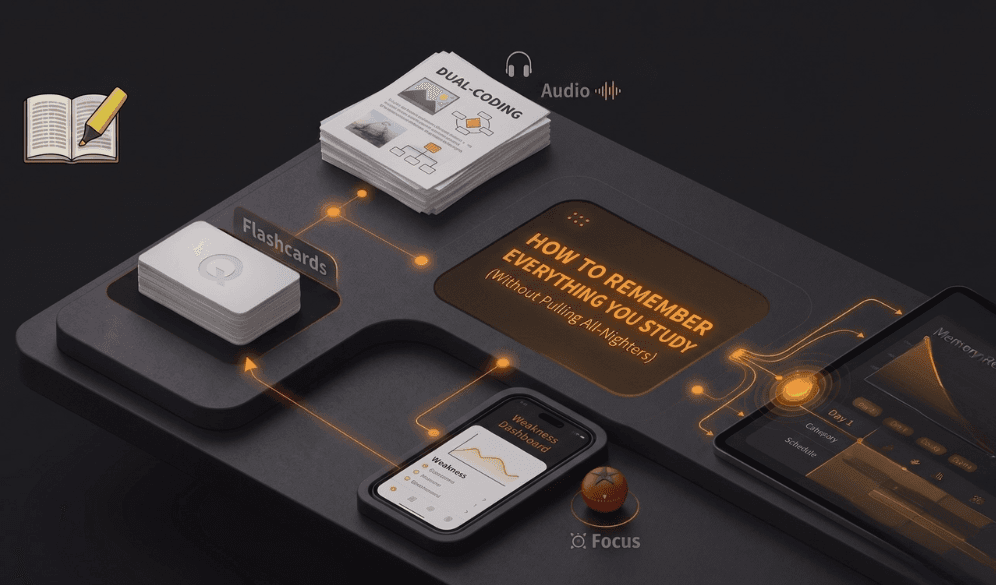
To make the science work, you need a system that supports it. GoodOff follows a specific mechanical loop designed to maximize the spacing effect:
Learn: AI-driven tools convert your notes into active learning prompts.
Practice: You engage in Active Recall through smart decks.
Track: Real-time analytics show you exactly where you are on the mastery scale.
Improve: The FSRS algorithm adjusts your schedule so you focus only on your weakest points.
This loop ensures that no effort is wasted. You stop studying "chapters" and start studying "gaps."
4. Real-Time Updates vs. Static Planning
Traditional planners are dead. A paper planner can't tell you that you've forgotten the concepts from Tuesday's lecture. GoodOff prioritizes real-time updates. If you miss a study session or struggle with a specific quiz, the platform re-calculates your entire schedule instantly.
This removes the "planning friction" that leads to procrastination. When you open the app, you don't ask "What should I do?" You simply execute the tasks that the algorithm has identified as high-risk for forgetting.
5. Human-Friendly Feedback
One of the biggest psychological hurdles in spaced repetition is the feeling of being a "data point." Older apps give you cold, technical stats. GoodOff provides human-friendly feedback, like telling you a deck was updated “5 minutes ago” or celebrating a 5% increase in your overall mastery. This creates a positive feedback loop, turning the "chore" of studying into the "satisfaction" of progress.
The Bottom Line
Studying hard is a brute-force method that leads to burnout. Studying smart is a technical process that leads to mastery. By leveraging the science of Spaced Repetition and the power of the FSRS algorithm, you can learn more in two hours than most students learn in ten.
Stop guessing when you’re ready for the exam. Use the data. Trust the system.