Stop letting cortisol ruin your GPA. Learn the mechanical ways to lower
exam anxiety naturally by focusing on nervous system regulation and data-backed preparation.
Anxiety is a Technical Glitch
Let’s get one thing straight: Exam anxiety isn't a personality trait, and it isn't a sign that you’re
"not cut out" for your major. It is a biological misfire. When you sit down, see a question you
don’t immediately recognize, and feel your heart hammering against your ribs, that is your
Amygdala the lizard brain deciding that a Calculus exam is a predator trying to eat you.
In 2026, the stakes feel higher, and the digital noise is louder. But if you want to perform like a
high-level professional, you have to treat your body like hardware. You don't "wish" a glitch
away; you patch it. Here is how you naturally de-escalate the panic and take your cognitive
power back.
1. Patch the Hardware: The Respiratory Bypass
The fastest way to stop anxiety is not "positive thinking." It is physiological intervention. When
you are anxious, you breathe shallowly. This keeps your carbon dioxide levels off-balance,
which signals to your brain that the emergency is ongoing.
You need to use the Physiological Sigh. This is a pattern of breathing discovered by
researchers to be the fastest way to lower your heart rate in real-time.
● The Method: Take a deep breath in through your nose, and at the very top, sneak in a
second, shorter inhale to fully inflate the alveoli in your lungs. Then, exhale through your
mouth as slowly as possible.
● The Result: This forces your heart rate to slow down by activating the Vagus nerve. Do
this three times before you open your exam paper. It’s not "mindfulness" it’s a
kill-switch for your sympathetic nervous system.
2. Manage the Chemical Load: Caffeine and Cortisol
Most students "prepare" for exams by doubling their caffeine intake. This is a tactical error.
Caffeine increases your baseline heart rate and mimics the physical sensations of a panic
attack. If you are already prone to exam anxiety, high-dose caffeine is like throwing gasoline on
a flickering candle.
Furthermore, cortisol (the stress hormone) peaks in the morning. If you wake up, immediately
check your grades or social media, and chug an energy drink, you are spiking your anxiety
before you even hit the library. Swap the third coffee for L-Theanine or just plain water. You
need a sharp mind, not a vibrating one.
3. The Uncertainty Gap: Preparation as a Shield
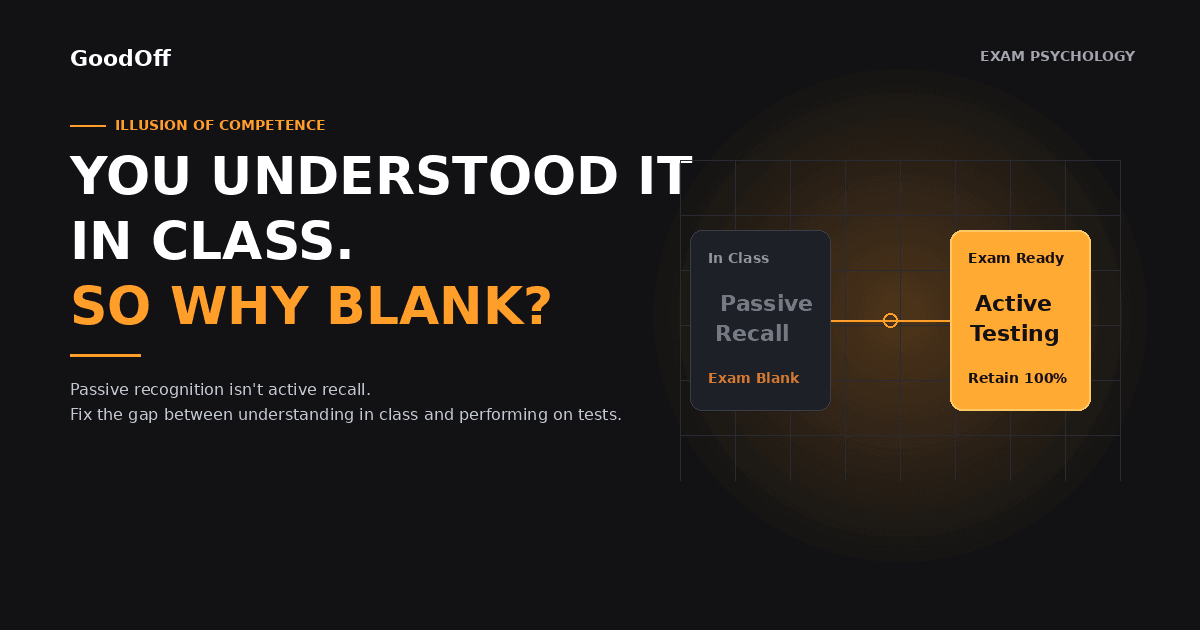
Anxiety lives in the gap between what you think you know and what you actually know. Most
students "study" by re-reading notes. This is passive and useless. It creates an "illusion of
competence" you feel like you know the material because it looks familiar, but when the blank
page of an exam stares back at you, you realize you can’t retrieve it.
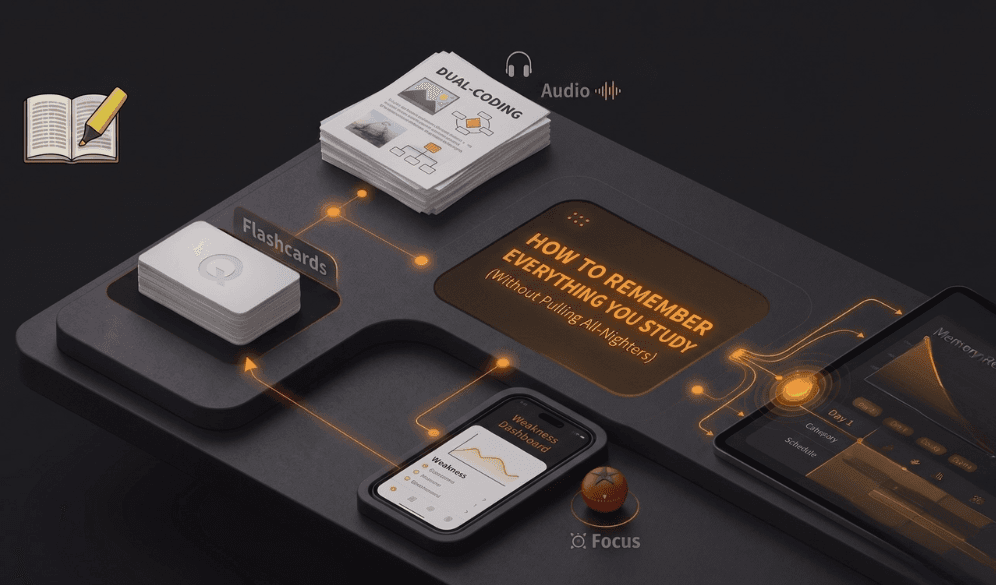
This uncertainty is the root of 90% of exam stress. You overcome this naturally through Active
Recall. Using tools like GoodOff Decks allows you to test yourself in a low-stakes environment
every day. When you can see a data-backed mastery score of 95%, your brain stops viewing
the exam as a threat because the "uncertainty" has been removed. You aren't "hoping" to do
well; you have the data to prove you will.
4. The "Brain Dump" Protocol
The moment the exam starts, your working memory is under siege by anxious thoughts ("What
if I fail?" "I don't remember chapter four"). You need to clear the RAM.
Before you even look at the first question, flip the paper over or use the scratch pad to perform a
"Brain Dump." Write down every formula, key date, or complex concept you’re afraid of
forgetting. By externalizing this information, you free up your cognitive load to actually solve
problems instead of just trying to "hold onto" facts.
5. Environmental Habituation
Natural anxiety relief also comes from familiarity. If you study in a bed with music playing and
then take an exam in a silent, cold hall, the environment itself becomes a stressor.
Train where you fight. If your exam is at 9:00 AM in a quiet room, your peak study sessions
should be at 9:00 AM in a quiet room. This is called State-Dependent Learning. By mimicking
the exam conditions during your prep, you lower the "novelty" of the exam day, making it feel
like just another Tuesday.
The Bottom Line
Stop waiting for the "feeling" of anxiety to go away. It won't. High performers don't lack anxiety;
they have better systems for managing it. Stop the caffeine abuse, fix your breathing, and use
active learning tools to prove to your brain that you are prepared.
Confidence isn't a mood; it’s the result of a repeatable process. Get to work.
For more mechanical study frameworks and real-time focus tools, check out the rest of our
guides at goodoff.co/blog.