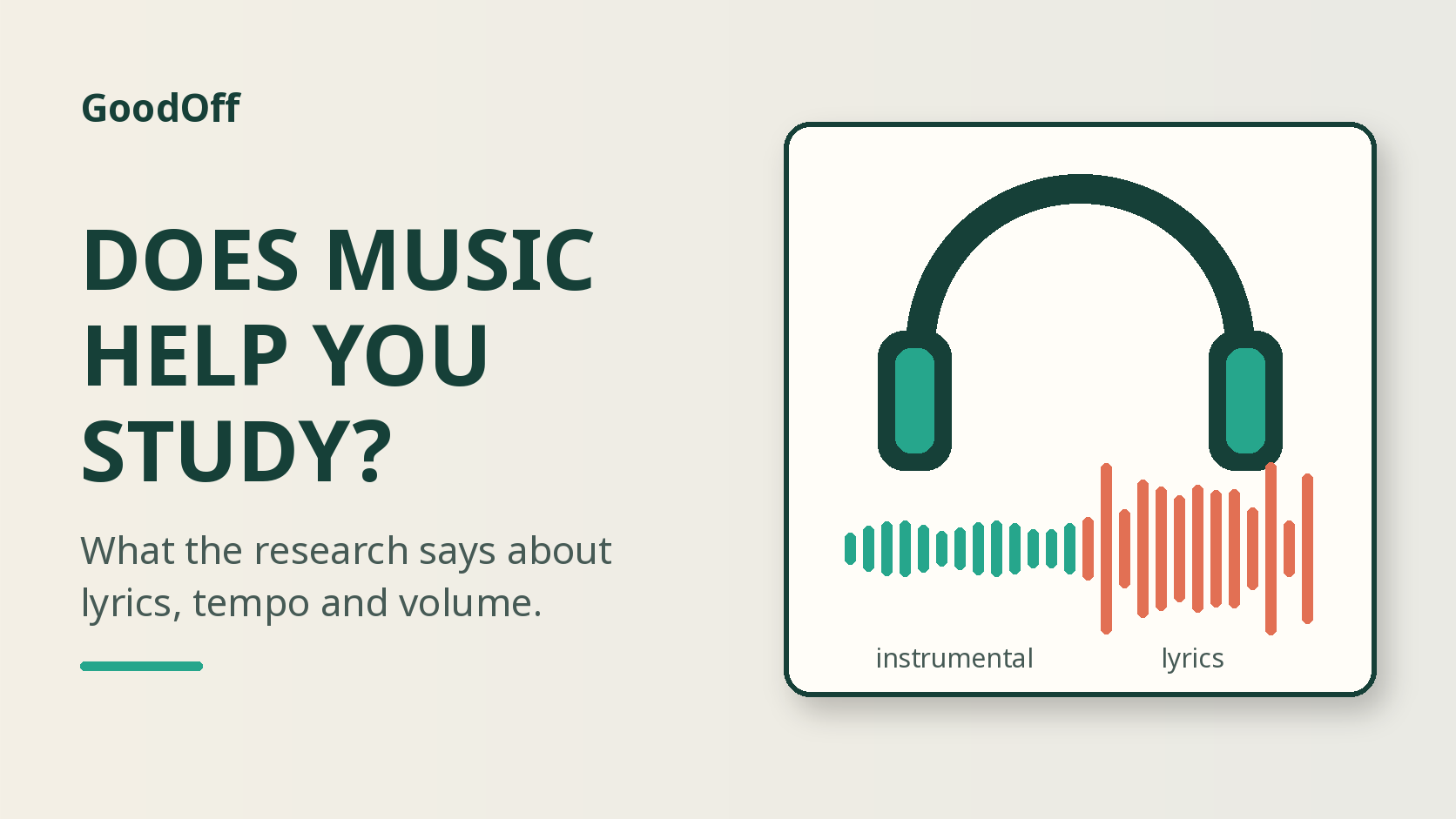
Does music help you study? Sometimes. Music can lift your mood and make routine work like copying formulas, organizing notes, or doing practice problems you already know feel easier. But for hard work like reading new material, memorizing, or writing, research shows music with lyrics usually makes you perform worse, and even instrumental music can hurt when it's fast and loud. Silence or quiet instrumental music is the safer choice when you're learning something new.
Below is what the studies actually found, how to tell whether music is helping you or just making studying feel nicer, and a simple setup you can try tonight.
The Short Answer: It Depends on the Task
Researchers have run more than a hundred experiments on background music, and the results look messy until you sort them by task. A 2022 systematic review in Music & Science pulled together 154 experiments and found background music generally hurt memory and language tasks, hurt difficult tasks more than easy ones, and was most harmful when it had lyrics. In most cases it had no effect at all, and only one experiment showed a clear benefit.
So the useful question isn't "is music good or bad?" It's "what am I about to do, and how much of my brain does it need?"
| Study task | Music with lyrics | Quiet instrumental | Best choice |
|---|---|---|---|
| Reading a new chapter | Usually hurts comprehension | Mixed, often neutral | Silence or very low instrumental |
| Memorizing terms or flashcards | Hurts recall | Can still distract | Silence |
| Writing an essay | Competes with your inner voice | Often fine at low volume | Instrumental or silence |
| Math practice you already know | Smaller effect | Often fine | Your preference |
| Rewriting notes, making a schedule, formatting | Usually fine | Fine | Whatever keeps you going |
Why Lyrics Get in the Way
Reading, memorizing, and writing all lean on your verbal working memory, the "inner voice" you use to hold words in mind. Lyrics are words too, so your brain processes them automatically, even when you're trying to ignore them. Psychologists call this the irrelevant sound effect: sound that keeps changing, especially speech, makes it harder to hold information in order.
The research here is fairly consistent:
- Nick Perham and Harriet Currie (2014) had students read passages in quiet, with instrumental music, with lyrical music they liked, and with lyrical music they disliked. Scores were best in quiet and with instrumental music. Lyrical music hurt comprehension, and it didn't matter whether students liked the songs.
- A 2023 study in the Journal of Cognition tested college students on verbal memory, visual memory, reading comprehension, and arithmetic. Music with lyrics hurt memory and reading. Lo-fi hip-hop without vocals didn't reliably help or hurt.
Lyrics in a language you understand are the biggest problem. Songs in a language you don't speak, or ones you've heard so many times you tune them out, seem to distract less, but they still aren't better than quiet for hard material.
Tempo and Volume Matter Too
Instrumental music isn't automatically safe. William Forde Thompson, Glenn Schellenberg, and Adriana Letnic (2012) played classical pieces at different speeds and volumes while students read. Slow or quiet versions were fine. The fast, loud version dropped reading comprehension below the silent baseline.
If you use music, keep it slow, steady, and low enough that you could hold a quiet conversation over it. Tracks that build, drop, or switch styles every minute pull your attention more than something that just hums along.
So Why Does Music Feel Like It Helps?
Because it often does help with one thing: mood. The arousal and mood idea, tested by Thompson, Schellenberg, and others, says music you enjoy can make you a bit more alert and positive, and that can carry over into your work. That's also why the famous "Mozart effect" faded under scrutiny. The small boost people saw after listening to Mozart came from feeling more awake and in a better mood, not from anything special about classical music.
A 2025 study of 279 university students who regularly study with music found that their own chosen music didn't lower reading comprehension compared with silence, and it kept their mood from dropping during the reading session. So for some students, a familiar playlist is a fair trade.
There's a catch, though. In several studies, students believed instrumental music helped them even when their scores didn't change. How focused you feel isn't a reliable measure of how much you're learning. If you can't focus at all, music might just be covering up a bigger issue, and our guide on what to do when you can't focus while studying is a better place to start.
Who Might Benefit More (or Less)
Not everyone reacts the same way. A few patterns show up in the research:
- Introverts tend to be more disrupted by background music than extraverts, especially on hard tasks.
- Students with lower working memory capacity may lose more when music competes for attention.
- Students who always study with music may be less bothered by it, since it's part of their routine.
- Students with ADHD often report that steady background sound helps them start and stay on task. The research is still small, so treat it as something to test, not a rule. Our ADHD study tips cover other options.
How to Test Whether Music Helps You
You don't have to guess. Run a small experiment over one week:
- Pick one type of task, like reading a chapter and answering the questions at the end.
- Do it twice in each condition: silence, instrumental music, and your usual playlist. Keep the time of day roughly the same.
- Close the book and quiz yourself right after each session. Write down how many answers you got right without looking.
- Compare your scores, not how the session felt. If your playlist scores match silence, keep it. If they drop, save it for easier work.
The quiz step matters most. Rereading can make material feel familiar, but only testing yourself shows whether it stuck. That's also why reading a textbook so you actually remember it involves stopping to recall what you just read.
A Simple Music Setup for Studying
- Hard, new material: silence, earplugs, or steady noise like rain or a fan.
- Familiar practice: low-volume instrumental, lo-fi, ambient, or film scores.
- Busywork: any playlist you like, lyrics included.
- Breaks: your favorite songs as a reward between blocks.
- Keep the phone away: pick a long playlist before you start so you're not skipping tracks every three minutes.
That last point is easy to miss. Constantly picking the next song is a small distraction that adds up, and it often leads to checking messages. If that sounds familiar, read about why focusing on studying feels harder than it used to.
Where GoodOff Fits
GoodOff doesn't play music, so bring your own playlist or enjoy the quiet. Where it helps is the self-testing step that tells you whether your setup works. You can upload a PDF, slides, a lecture recording, or pasted notes, and GoodOff makes flashcards, a quiz, and a study guide from them. You can edit everything it makes.
After a session, take a quick quiz on what you just covered and compare your score across your silence and music sessions. Your flashcards are scheduled with FSRS spaced repetition, and there's a built-in focus timer you can run next to your cards. It's free to start on iOS, Android, and the web.
Frequently Asked Questions
Is it better to study in silence or with music?
For reading, memorizing, and writing, silence usually wins, or at least ties with quiet instrumental music. For routine tasks, music you enjoy can make the work feel easier without lowering your results.
What is the best music to study to?
Slow, steady, instrumental music at a low volume, like lo-fi, ambient, or classical. Avoid songs with lyrics in a language you understand when the task involves words.
Does classical music make you smarter?
No. The "Mozart effect" was a short-term boost on spatial tasks, and later research linked it to better mood and alertness, not to classical music itself.
Is lo-fi good for studying?
Lo-fi without vocals is one of the safer options. In a 2023 study it didn't reliably help or hurt performance, which makes it fine if it helps you stay at your desk.
Can music help with memorizing?
Background music usually doesn't help you memorize, and lyrics tend to hurt. Turning information into a song or rhyme you sing yourself is different. That can work as a memory aid for lists and formulas.
Try It This Week
Pick one subject and run the silence-versus-music test for three or four sessions. End every session with a short quiz, then go with what your scores say. If you want the quizzes ready without making them by hand, upload your notes to GoodOff and start with the free plan.