For decades, society has pushed the narrative that "early birds get the worm" while "night owls" pay a heavy tax on their productivity, focus, and mental well-being. If you've ever struggled to pull yourself out of bed at 7:00 AM, feeling like your brain was encased in concrete while morning larks leaped into their morning routines, you’ve likely felt that evolutionary disadvantage firsthand.
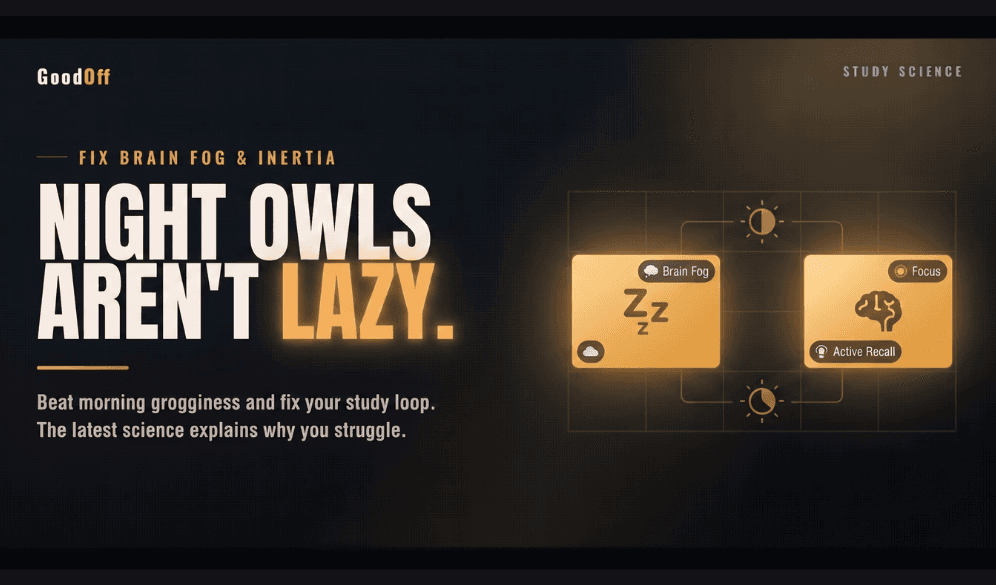
However, groundbreaking neuroscientific and genetic research published in medRxiv (Burns et al., Harvard Medical School & Massachusetts General Hospital) reveals that being a night owl isn't the problem sleep inertia is.
If you are a student, professional, or lifelong learner struggling with morning cognitive grogginess, understanding this distinction changes everything about how you schedule your learning, structure your study sessions, and optimize your mental bandwidth.
The Science: Night Owls Aren't Doomed, They're Misaligned
Historically, epidemiological studies linked an evening chronotype (a natural preference for staying up late and waking up late) to higher rates of anxiety, mood disorders, and lower academic or professional performance. Society assumed that late-night biology itself was fundamentally unhealthy.
The 2024 study analyzed longitudinal data from nearly 500,000 individuals in the UK Biobank. The researchers uncovered a pivotal finding:
Night owls who do NOT experience severe sleep inertia face NO higher risk of mental health struggles or cognitive deficits compared to morning types.
The true culprit is sleep inertia the prolonged, groggy transition period between sleep and full wakefulness, characterized by low arousal, reduced processing speed, and impaired short-term memory.
Why Sleep Inertia Hits Night Owls Hardest
Our 9-to-5 society is built for morning chronotypes. When a night owl is forced to wake up during their biological night, their internal circadian clock remains out of sync with external demands. This circadian misalignment dramatically intensifies sleep inertia, causing morning brain fog that can linger for 30 minutes to over two hours.
How Sleep Inertia Sabotages Learning & Productivity
When sleep inertia strikes, your brain's prefrontal cortex—the command center responsible for focus, problem-solving, active memory retrieval, and decision-making—is effectively running in low-power mode.
If you try to tackle dense, high-friction tasks during a severe bout of sleep inertia, you experience:
Attentional Drift: Inability to focus on reading heavy textbooks or technical documentation.
Low Working Memory: Difficulty holding complex equations or concepts in your head.
Frustration & Burnout: Forcing high cognitive load onto a groggy brain creates fatigue early in the day, leading to procrastination later.
To learn effectively, you don't need to force yourself into a 5:00 AM club. You simply need a study strategy designed around minimizing sleep inertia and capitalizing on your biological peak hours.
4 Science-Backed Ways to Hack Your Brain & Beat Morning Inertia
1. Shift High-Cognitive Work to Your Peak Energy Windows
Stop attempting heavy analytical tasks or dense memorization during your morning waking transition. Reserve your morning hours for low-friction, structured activities (like reviewing summary flashcards or listening to short educational recaps), and save complex problem-solving for when your body temperature and cognitive alertness peak later in the day.
2. Warm Up Your Brain with "Micro-Learning"
When experiencing sleep inertia, pushing through a 2-hour textbook reading session is a recipe for failure. Instead, use active, short-burst learning modes. Engaging with short quizzes or interactive flashcards stimulates neuro-arousal gently without overwhelming your executive functioning.
3. Leverage Audio Learning for Low-Energy Transitions
During the first hour after waking, reading bright screens or dense text can feel repulsive. Listening to audio-based summaries or voice-guided lesson reviews allows your brain to absorb key concepts passively or semi-actively while your body naturally dissipates sleep inertia.
4. Enforce Strict Focus Blocks with Pomodoro Timers
Brain fog breeds distraction. By breaking your study time into defined 25-minute focus intervals followed by 5-minute restorative breaks, you prevent cognitive burnout and give your brain clear boundaries to lock in attention.
How GoodOff Helps Every Chronotype Learn Smarter, Not Harder
At GoodOff, we build tools that honor human biology, not rigid societal clocks. Whether you're an early bird who thrives at dawn or a night owl optimizing evening study hours, GoodOff provides the active learning infrastructure you need to turn cognitive friction into steady momentum.
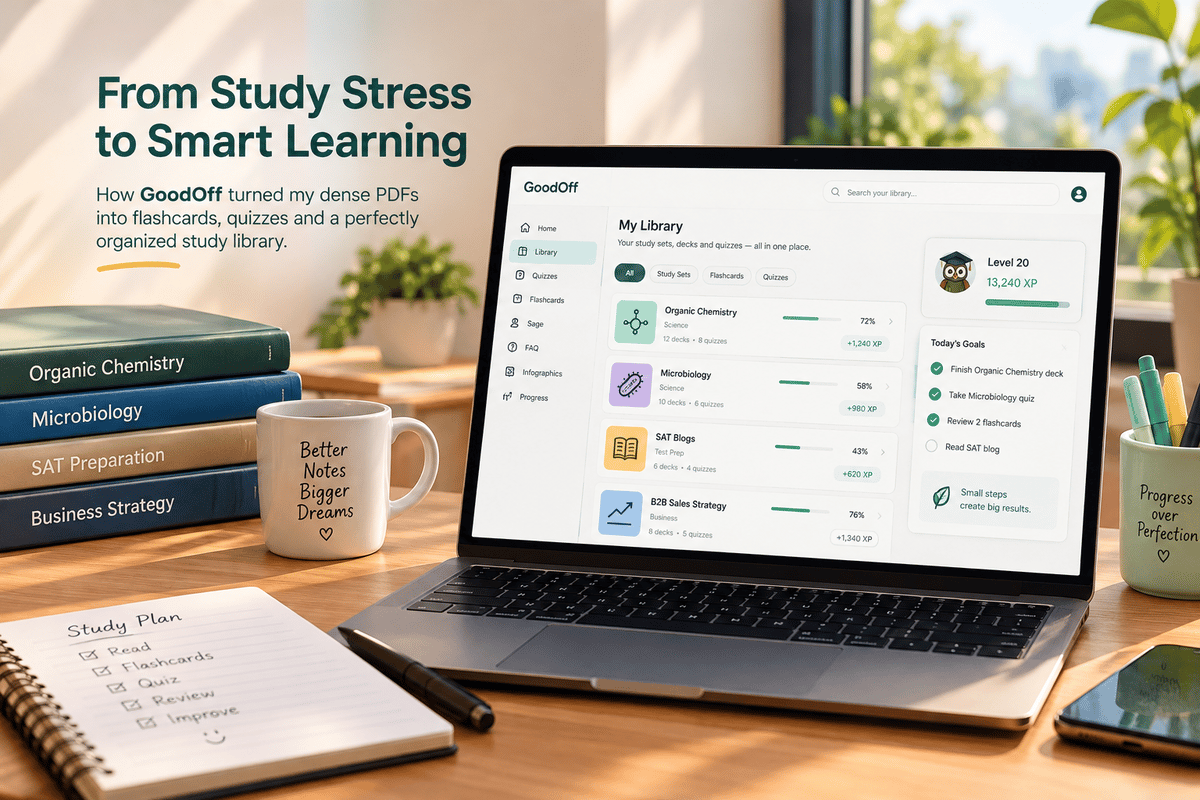
1. Learn (Audio & Decks): Use audio summaries and flashcard decks during gentle, low-friction morning warm-ups to ease your brain into gear.
2. Practice (Quizzes & Recall): Challenge your memory with active recall quizzes and spaced repetition during high-energy intervals.
3. Track (Real-time Analytics): Monitor your focus and progress seamlessly through instant dashboard updates without page reloads.
4. Improve (Targeted Growth): Use clear feedback and study patterns to target lingering gaps and continuous improvement.
Here is how GoodOff transforms your study routine across every phase of your day:
Active Recall Decks for Low-Friction Mornings
When morning grogginess makes reading a textbook daunting, GoodOff’s flashcard decks lower the barrier to entry. Our active recall interface tests your memory in bite-sized pieces, waking up neural pathways without causing cognitive fatigue.
Audio Learning for Hands-Free Wake-Ups
Kickstart your brain during your morning routine. GoodOff’s audio learning features convert key concepts into audio decks, allowing you to review flashcards and summaries while getting ready, walking, or taking a morning stroll to get natural daylight (the best natural cure for sleep inertia!).
Integrated Pomodoro Focus Tools
Stay locked into deep work during your peak biological hours. GoodOff integrates customizable Pomodoro focus sessions right alongside your study decks, helping you maintain high attention density while tracking active study minutes seamlessly.
Real-Time Learning Analytics
Stop guessing when you learn best. GoodOff tracks your quiz performance, retention rates, and study duration in real time without refreshing your page. By analyzing your progress patterns, you can pinpoint your exact cognitive peak hours and tailor your schedule accordingly.
Stop Fighting Your Clock, Start Optimizing Your Loop
Being an evening chronotype is not a flaw, and morning brain fog isn't a permanent sentence. The latest scientific evidence is clear: when you manage sleep inertia and align your habits with your natural circadian rhythm, your potential for focus, retention, and mental clarity is unlimited.
Stop forcing yourself into study schedules that clash with your biology. Embrace a learning ecosystem that meets your brain where it is.
Ready to beat brain fog and master active learning on your own terms?