If you have ever sat in a quantum mechanics lecture feeling like the professor switched to another language halfway through, you are not alone. Ask almost any physics major, and quantum mechanics usually shows up on their list of hardest classes, right alongside electrodynamics and statistical mechanics. But quantum mechanics has a reputation all its own. It is not just hard in the way calculus is hard. It is hard in a way that makes you question how you think about reality itself.
Let us actually break down why this class wrecks so many students, and what you can do about it.
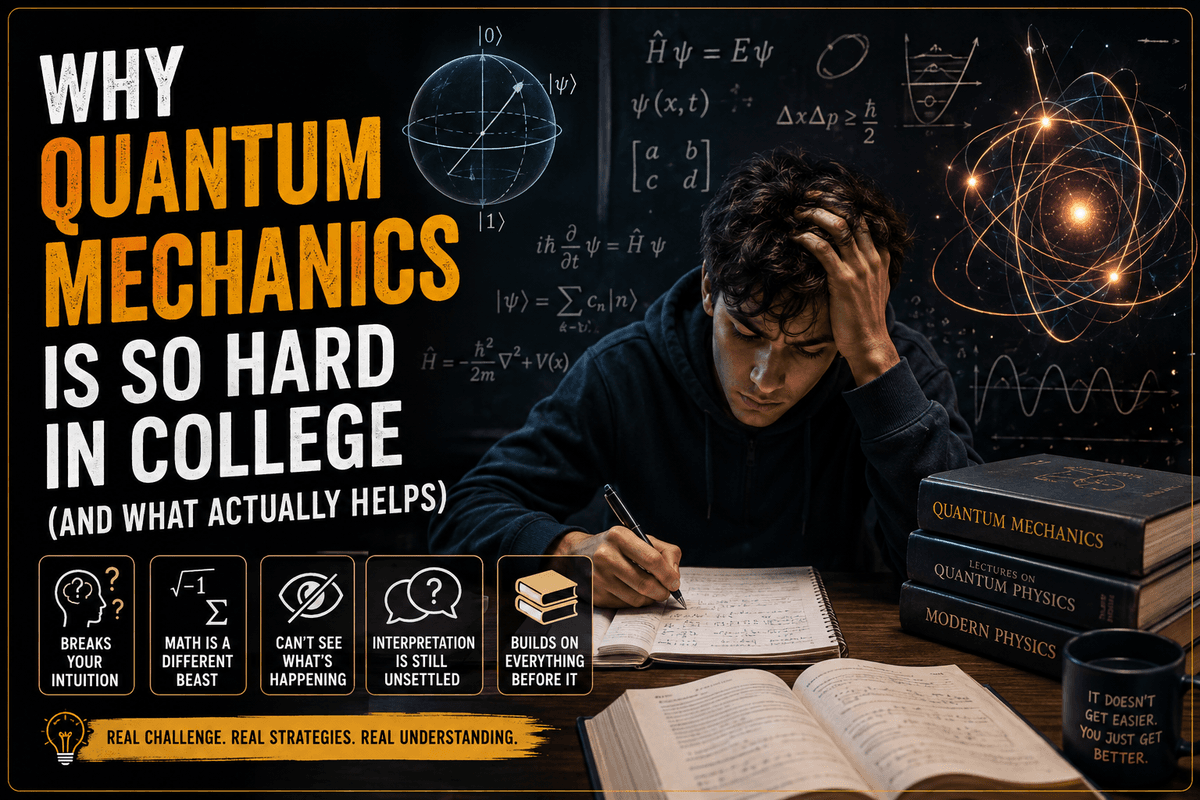
1. It Breaks Your Intuition on Purpose
By the time you reach quantum mechanics, you have spent your whole life building intuition about how the world works. Objects have a definite position. Things do not disappear and reappear somewhere else. A cat is either alive or dead, not both.
Quantum mechanics throws all of that out. Particles behave like waves. A particle can exist in a superposition of multiple states until it is measured. Two particles can be entangled in a way that changing one instantly affects the other, no matter how far apart they are.
Your brain evolved to survive in a world of rocks, trees, and predators, not electrons and photons. So when quantum mechanics describes reality accurately, it often feels wrong, because it contradicts everyday experience. Students do not just have to learn new material, they have to unlearn assumptions they never even knew they had.
2. The Math Is a Different Beast
In earlier physics courses, most of the math is calculus and some linear algebra, usually applied to things you can picture in three dimensional space. Quantum mechanics demands more.
You need complex numbers, not just as a mathematical trick but as something physically meaningful. You need linear algebra at a much deeper level, including eigenvalues, eigenvectors, and vector spaces. You need to understand differential equations well enough to solve the Schrodinger equation for different potentials. And on top of that, you need to get comfortable with abstract notation like bra-ket notation, which looks intimidating the first time you see it.
The tricky part is that the math is not just a tool here. In quantum mechanics, the math often is the physics. A wave function is not just a number, it is a mathematical object that encodes everything you can know about a system. If your math foundation has any cracks, quantum mechanics finds them fast.
3. There Is No Direct Way to "See" What Is Happening
In mechanics, you can watch a ball roll down a ramp. In circuits, you can measure voltage with a multimeter. Quantum mechanics does not offer that kind of direct feedback.
You cannot watch an electron orbit a nucleus like a tiny planet, because that picture is simply wrong. Instead, you work with probability distributions, wave functions, and operators that act on abstract states. Everything is inferred rather than observed directly. This makes it much harder to build a mental model you can trust, because you cannot check your understanding against something you can literally watch happen in front of you.
4. Interpretation Is Genuinely Unsettled
Here is something many students do not realize until they are deep into the course. Physicists themselves do not fully agree on what quantum mechanics means at a fundamental level.
The math works. The predictions are extraordinarily accurate. But the interpretation, what is actually happening when a measurement occurs, whether the wave function represents something real or just our knowledge of a system, is still debated. The Copenhagen interpretation, many-worlds theory, and pilot wave theory all give different pictures of reality using the same equations.
Most intro courses do not spend much time on this debate, which can leave students confused about whether they are missing something or whether the confusion is simply built into the subject. Spoiler: it is largely the second one.
5. It Builds on Everything Before It
Quantum mechanics is rarely a first physics course. By the time you take it, you are expected to already be comfortable with classical mechanics, electricity and magnetism, and often some thermodynamics. If any of those foundations are shaky, quantum mechanics exposes the gap immediately, because it constantly references classical analogies, harmonic oscillators, angular momentum, and energy conservation, while also telling you why those classical pictures eventually break down.
So How Do You Actually Get Through It?
None of this means quantum mechanics is impossible. It means the difficulty is real, and pretending otherwise does not help anyone. A few things genuinely make a difference.
Get comfortable with the math before the course, not during it. Review complex numbers and linear algebra over the summer if you can. Trying to learn eigenvectors and quantum theory at the same time is where a lot of students burn out.
Do not chase intuition too early. Some concepts in quantum mechanics only start to feel natural after you have solved enough problems. Let the math guide you first, and let intuition catch up later.
Work through problems by hand, slowly. Quantum mechanics problems often look short but hide several conceptual steps. Rushing leads to memorizing procedures without understanding why they work.
Accept that confusion is part of the process. Even Richard Feynman famously said that nobody truly understands quantum mechanics in an intuitive sense. That is not an excuse to give up, it is permission to stop expecting instant clarity.
Use multiple resources. If your textbook's explanation is not clicking, try a different one, or a video series that approaches the same topic from another angle. Sometimes a slightly different explanation is all it takes for something to finally make sense.
The Bottom Line
Quantum mechanics is hard because it asks you to think in a completely new way, using unfamiliar math, about a reality that cannot be directly observed, all while resting on every physics course you took before it. That is a lot to ask of any student.
But the difficulty is also what makes it worth learning. Quantum mechanics is not just another course to survive, it is one of the most accurate and successful theories humans have ever built. Struggling with it does not mean you are bad at physics. It usually just means you are doing it right.
Try goodoff