AI tutors aren't replacing traditional education, but they're changing what a good study session looks like. The best evidence so far shows that a well-designed AI tutor can help students learn more in less time than a typical lesson, while a general chatbot used for answers can make students worse at solving problems on their own. Teachers still matter for motivation, feedback on open-ended work, and knowing when a student is struggling for reasons that have nothing to do with the material.
Here's what the research actually says about AI tutors vs teachers, where AI helps, where it backfires, and how to use one without letting it do your thinking for you.
Why People Expect AI Tutors to Change Education
In 1984, educational psychologist Benjamin Bloom reported that students who got one-on-one tutoring performed about two standard deviations better than students taught in a regular class. That's the difference between an average student and one near the top. He called it the "two sigma problem": tutoring works incredibly well, but nobody can afford a personal tutor for every student.
AI tutors are the latest attempt to solve that problem. They're available at 2 a.m., they don't get impatient when you ask the same question three times, and they can cost far less than a human tutor, who can easily cost $50 or more an hour in the US.
What the Research Shows So Far
The early studies are promising, but they come with important details.
- Harvard physics (2025): In a randomized trial published in Scientific Reports, Greg Kestin and colleagues had about 200 undergraduates learn physics topics either from a custom AI tutor or in an active-learning class. Median learning gains in the AI group were more than double, and students spent less time. The key detail: the tutor was built to guide students step by step instead of handing out answers.
- Nigeria (2024): A World Bank pilot in Benin City gave secondary students twelve after-school sessions with a GPT-4 chatbot, guided by teachers. Over six weeks, students scored about 0.3 standard deviations higher on the end-of-program test than those who weren't selected.
- Turkey (2025): A study in PNAS with nearly 1,000 high school math students found that a plain ChatGPT-style tool raised practice scores by 48%, but students scored 17% worse on a later exam without it. A version with guardrails that gave hints instead of answers mostly removed that harm.
Put together, the lesson is clear. AI tutoring helps when it makes you think. It hurts when it thinks for you.
AI Tutors vs Teachers: What Each Does Best
| Job | AI tutor | Human teacher |
|---|---|---|
| Explaining a concept again, a different way | Strong, any time of day | Strong, limited time |
| Practice questions and instant feedback | Strong | Slower at scale |
| Spotting why you're stuck (stress, gaps, confusion) | Weak | Strong |
| Feedback on essays, projects, and lab work | Useful first pass, can be wrong | Strong |
| Motivation and accountability | Limited | Strong |
| Accuracy | Can make confident mistakes | Usually reliable in their subject |
That's why most researchers describe the future as hybrid. AI handles repetition and on-demand explanations. Teachers handle judgment, relationships, and the work that doesn't have one right answer.
The Real Risk: Using AI as a Crutch
The Turkey study found that students with the plain chatbot mostly asked for answers and copied them. Their practice looked great, then their exam scores dropped. Familiar story: getting the right answer with help feels like learning, but your brain didn't do the retrieval work.
Watch for these warning signs:
- You ask for the solution before trying the problem.
- You can follow the AI's explanation but can't redo the problem alone.
- You accept answers without checking them against your notes or textbook.
Our guide on how to study with AI without getting dumber goes deeper on this.
How to Use an AI Tutor the Right Way
- Try first, then ask. Attempt every problem before you open the chat, even if your answer is wrong.
- Ask for hints, not answers. Type something like "Don't solve it. Ask me one question that helps me find the next step."
- Explain it back. After the AI explains something, close the chat and explain it in your own words.
- Check against your sources. AI can be wrong in a confident tone. Confirm key facts in your notes, slides, or textbook.
- Test yourself later. Redo the same type of problem a day later without help. That's the real measure of whether you learned it.
For more practical ideas, see how AI tools can help you study without cheating and our honest look at personalized learning with AI, promise vs reality.
Where GoodOff Fits
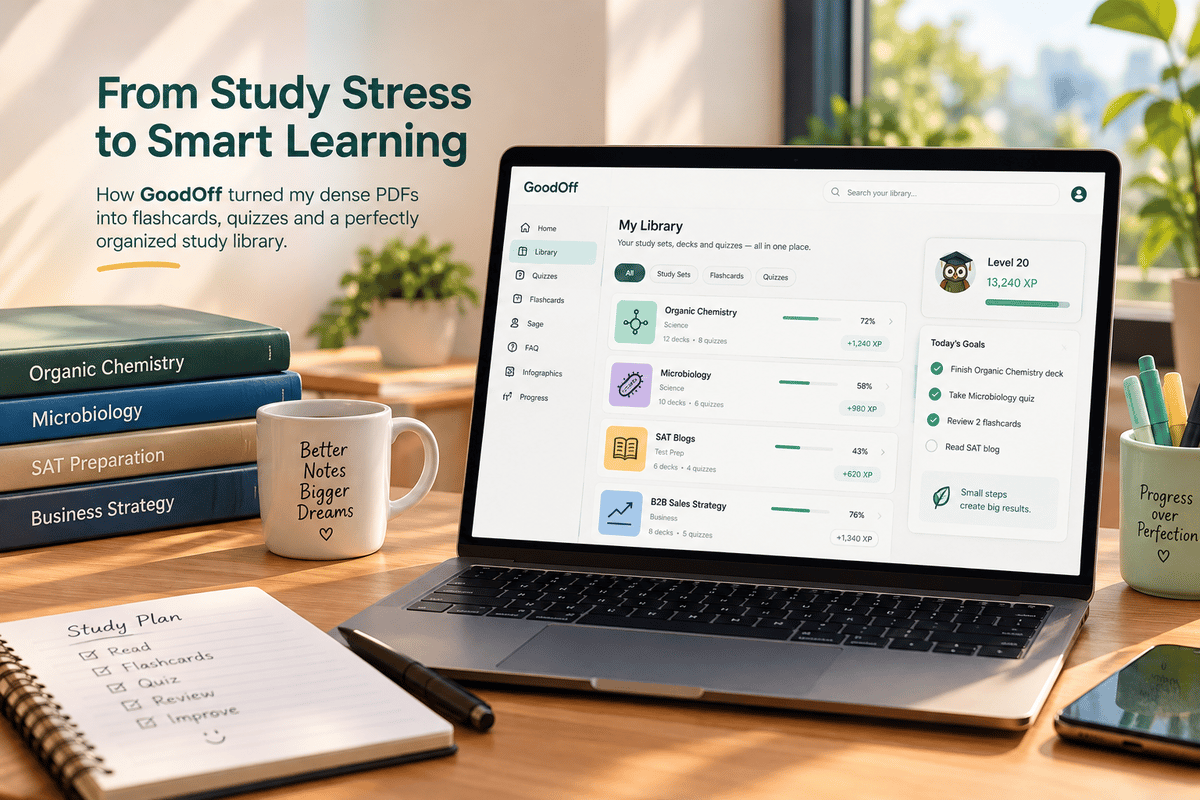
GoodOff is built around your own material instead of the open internet. You upload notes, PDFs, slides, or a lecture recording, and it makes flashcards, quizzes, and a study guide that you can edit. Its tutor, Sage, answers questions using your uploaded material and shows the page it used, so you can check the answer against the source.
Quizzes give instant feedback, and flashcards are scheduled with FSRS spaced repetition so you practice recalling, not just reading. GoodOff won't replace your teacher, and it shouldn't. It's a way to get more practice in between classes.
Frequently Asked Questions
Will AI tutors replace teachers?
Not based on current evidence. AI tutors work best alongside teachers, handling explanations and practice while teachers handle feedback, motivation, and complex work.
Are AI tutors effective?
Well-designed ones can be. Randomized trials at Harvard and in Nigeria found real learning gains, but a study in Turkey showed that answer-giving chatbots can lower exam scores.
Is using an AI tutor cheating?
Using AI to understand material usually isn't. Submitting AI-written work as your own often is. Check your school's policy, since rules differ by class.
Are AI tutors accurate?
Not always. They can state wrong facts confidently. Tools that cite your own sources make it easier to check, but you should still verify anything important.
Start With One Subject
Pick the class where you get stuck most often. Next time you study, try every problem first, use AI only for hints, and quiz yourself the next day. If you want practice built from your own notes, upload them to GoodOff and try the free plan.