The Promise That Sold a Decade of EdTech
For years, the pitch was simple: every student learns differently, and AI would finally let education catch up to that fact. No more one-size-fits-all lesson plans. No more fast learners bored and slow learners lost in the same 45-minute class. Instead, software that watches how a student learns and adjusts in real time, like having a personal tutor for every child, at scale.
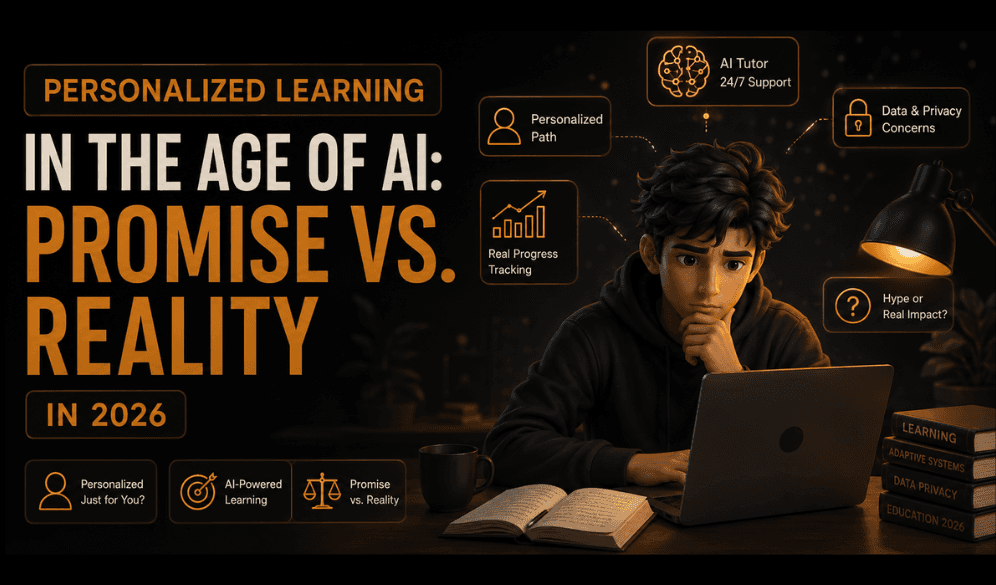
It's 2026. AI is no longer a pilot program in a handful of schools. It's embedded in classrooms, homework platforms, and school administration systems worldwide. So the question worth asking isn't "will AI personalize learning?" anymore. It's: has it?
The honest answer is: partly. And the gap between the promise and the reality tells us more about education than the hype ever did.
What's Actually Working
1. Real-Time Adaptation Is No Longer Theoretical
By 2026, AI systems can genuinely analyze student responses continuously, spot learning gaps, and adjust content difficulty on the fly, without requiring teachers to build multiple versions of the same lesson. This is one of the clearest wins: personalization that used to require an army of tutors can now happen automatically, for an entire classroom at once.
2. Instant Feedback Loops
One of the most consistently reported benefits is speed. Students no longer wait days for a graded quiz to learn they misunderstood a concept; AI tools flag it immediately, often mid-assignment. That immediacy matters more than it sounds; catching a misunderstanding in the moment prevents it from calcifying into a bigger gap.
3. AI Tutoring at Scale, Without Replacing Teachers
The 2026 shift away from "AI replaces teachers" toward "AI supports teachers" has been significant. Rather than substituting instruction, AI is increasingly used for short, focused bursts of guided practice, freeing teachers to spend more time on the harder work: mentorship, discussion, and addressing individual struggles AI still can't fully read.
4. Simulations Are Changing How Abstract Subjects Are Taught
AI-powered simulations now let students manipulate variables and test hypotheses digitally, making subjects like physics and chemistry visual instead of purely textbook-based. This has proven especially useful for students who struggle with abstract, text-heavy instruction, turning invisible concepts into something they can see and adjust.
5. Leveling the Playing Field, Somewhat
In under-resourced regions, real-time AI-driven instruction has helped provide access to quality instruction that previously required in-person specialists who simply weren't available. This is genuine progress, not just marketing language, though, as the next section shows, "access" and "equity" aren't quite the same thing.
Where the Reality Falls Short
1. Personalization Isn't the Same as Understanding
Most AI personalization still means adjusting the difficulty of content, not necessarily adapting to how a specific student thinks, what confuses them conceptually, or why. Current intelligent tutoring systems still excel in structured domains like math and grammar, but struggle with complex, open-ended subjects that require higher-order reasoning, the kind of learning that's arguably hardest to standardize and most in need of a human eye.
2. The Equity Gap Didn't Disappear, It Moved
AI was supposed to level the playing field. In some ways it has. But researchers now point to a different set of barriers: technological, pedagogical, and infrastructural gaps that still limit inclusive deployment of AI-based personalized learning. A school with reliable internet, updated devices, and trained staff can use AI meaningfully. A school without those things gets a diluted version, or none at all. The tool changed; the inequality found a new shape.
3. Cost and Scalability Are Still Real Barriers
Despite the hype, deploying sophisticated AI tutoring systems across diverse educational contexts, especially under-resourced ones, remains genuinely difficult, and development costs are still high enough to limit how widely these tools actually spread. "AI in education" often means AI in well-funded education first.
4. Data Privacy Is the Quiet Cost of Personalization
The more precisely an AI system personalizes learning, the more it needs to know about a student: their pace, mistakes, patterns, even emotional engagement. That data comes with real risk: personal learning records can be inadvertently exposed during model training or fine-tuning, and the ethical questions around bias, transparency, and data protection are becoming more complex, not less, as these systems scale.
5. "Novelty Fatigue" Is Setting In
For a while, simply having AI tools felt innovative. That era is ending. In 2026, schools are being pushed to prioritize tools that measurably improve outcomes, relevance, and student wellbeing, not just tools that are new. This is a healthy correction, but it also reveals how much of the last few years was adoption without evidence of actual impact.
6. Long-Term Effectiveness Is Still Unproven
Most of the evidence for AI-driven personalized learning is short-term: better quiz scores, faster feedback, higher engagement in the moment. What's still missing is rigorous, long-term data on whether these gains hold up over months or years, or whether they fade once the novelty (and the immediate feedback loop) wears off.
Promise vs. Reality: A Quick Comparison
AI personalizes learning for every student. AI adjusts difficulty well; deeper conceptual personalisation is still limited. AI closes equity gaps. AI narrows some gaps while creating new infrastructure-based ones AI replaces the need for large teaching staff. AI supports teachers most effectively when paired with them, not instead of them Personalized data improves learning Personalized data also raises real privacy and consent questions. AI tools are inherently effective. Effectiveness depends heavily on design, oversight, and long-term evidence
What This Means for Students, Parents, and Educators
The honest 2026 picture isn't "AI failed" or "AI solved education." It's more useful, and more actionable, than either extreme:
For students: AI tools can genuinely help you get faster feedback and more tailored practice, especially in structured subjects like math. But for deep understanding of complex or open-ended topics, human instruction and discussion still matter enormously. Treat AI as a supplement, not a substitute.
For parents: Access to an AI tool doesn't automatically mean access to quality personalized learning. It's worth asking how a platform personalizes: is it adjusting difficulty, or actually addressing your child's specific confusion?
For educators: The most effective use of AI in 2026 classrooms isn't replacing your judgment. It's freeing up time previously spent on repetitive grading or content variation, so you can focus on the parts of teaching AI still can't do well: mentorship, motivation, and reading a room.
Takeaway
Personalized learning through AI was never going to be a light switch, turned on, problem solved. In 2026, it looks more like what most real educational progress looks like: uneven, promising in specific areas, genuinely limited in others, and deeply dependent on the resources and oversight behind it.
The technology got smarter. The question of who benefits from it, and who gets left with a thinner version of the promise, is still being answered.