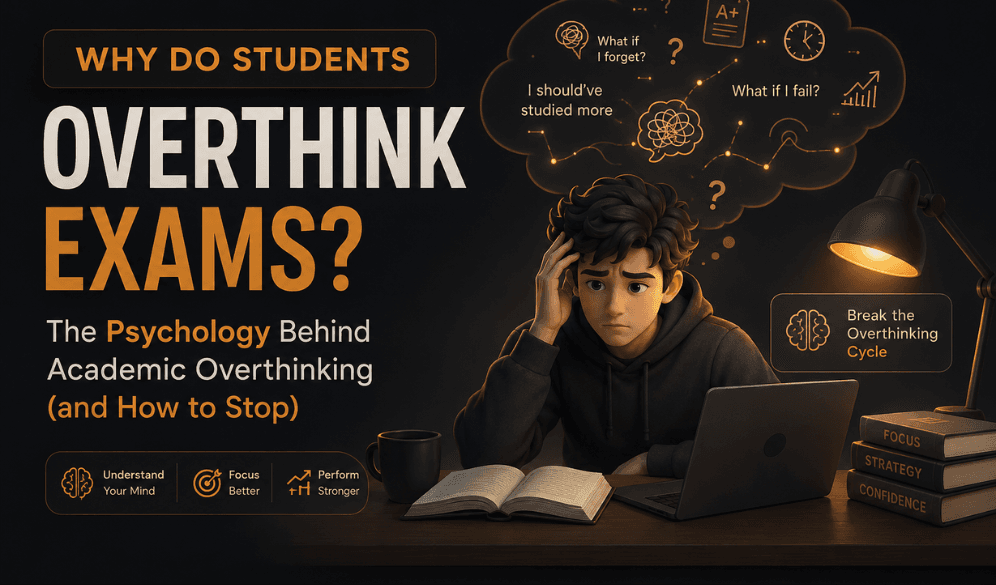
Your Brain Isn't Always Studying. Sometimes, It's Just Spiraling.
It's midnight before the exam. You've read the same paragraph four times. Instead of finishing your notes, you're replaying last week's quiz score, imagining the worst-case exam scenario, or wondering if you picked the right college, major, or career path.
This is overthinking, and for senior students, it shows up everywhere: exam prep, application essays, grade anxiety, and the pressure of "what comes next." It feels like work. It isn't. And it's quietly draining the energy you actually need to study.
What Overthinking Looks Like for Senior Students
Overthinking isn't the same as carefully reviewing material. Careful review moves you toward mastery. Overthinking loops it circles the same worry without ever resolving it.
For students, this usually shows up as two patterns:
Rumination: replaying a past test, a wrong answer, or a comment from a teacher ("Why did I mess that up?")
Anticipatory worry: spiraling about a future exam, application, or decision ("What if I fail?" "What if I chose the wrong path?")
Both feel urgent. Neither actually helps you prepare, write, or decide.
Why Senior Year Triggers So Much Overthinking
Senior year, whether it's the final year of high school, university, or any "what's next" stage, is uniquely loaded with overthinking triggers:
1. High-Stakes Decisions, All at Once
College choices, majors, career paths, thesis topics seniors face several irreversible-feeling decisions simultaneously. The brain treats this pile-up as a threat, not a to-do list.
2. Performance Pressure Peaks
Final exams and grades often feel like they carry more weight than earlier years, real or perceived. That pressure activates the brain's threat-detection system, the same one built for physical danger, not test scores.
3. Comparison to Peers
Watching classmates get acceptance letters, internships, or high grades can trigger a specific kind of overthinking: constantly measuring your own progress against others instead of your own plan.
4. Fear of Wasting Time
Every hour feels valuable during exam season, which paradoxically makes students more likely to overthink instead of study because overthinking masquerades as productivity.
5. It Becomes a Habit Loop
The more a student rehearses worst-case scenarios before a test, the more automatic that mental pathway becomes similar to how any habit strengthens with repetition, even an unhelpful one.
Why Overthinking Feels Productive (But Isn't)
Moves toward mastery or a decision. Loops without resolution. Focuses on what you can control (today's material). Focuses on what-ifs (the exam, the future). Has a natural stopping point. Repeats indefinitely. Reduces anxiety over time. Increases anxiety over time
If your "studying" isn't moving you closer to understanding the material or finishing the task, it's likely overthinking not preparation.
How to Stop Overthinking During Exams and Big Decisions
1. Name the Loop
Notice when you shift from studying to spiralling: "I'm not reviewing anymore; I'm just worrying." This small shift creates distance between you and the thought, a technique used in cognitive behavioural therapy (CBT).
2. Set a "Worry Window"
Give yourself 10–15 minutes a day to worry on purpose about the exam, the application, the decision. When the thought shows up at 1 a.m. instead, remind yourself: "That has a time slot. Not now."
3. Ask One Grounding Question
"Can I act on this right now?"
If yes → do one small, specific task (review one topic, write one paragraph).
If no → it's rumination, not planning. Let it go for now.
4. Use the Two-Minute Reset
When you notice a spiral, stand up, get water, or step outside for two minutes. Physical movement interrupts the mental loop faster than trying to think your way out of it.
5. Study in Focused Blocks, Not Marathon Sessions
Overthinking thrives in unstructured time. Use short, defined study blocks (25–45 minutes) with clear goals it leaves less room for the brain to drift into spirals.
6. Limit Reassurance-Seeking
Constantly asking friends "Do you think I'll pass?" or "Did I pick the right major?" can reinforce the loop instead of calming it. Practice sitting with uncertainty for short stretches it builds tolerance over time.
7. Write the Worry Down
Externalizing a thought, putting it on paper, often makes it look smaller and more specific than it felt in your head. It also frees up mental space for actual studying.
When It's More Than Just Exam Stress
Some pre-exam nerves are completely normal. But if overthinking is affecting your sleep, appetite, or ability to function day-to-day, it may be connected to anxiety that's worth talking to a counsellor, school psychologist, or trusted adult about. Academic pressure is real, but you don't have to carry it by looping through it alone.
Final Thought
Overthinking isn't a sign you care too little it's often a sign you care a lot, aimed in the wrong direction. The goal isn't to stop thinking about your exams or your future. It's to notice when your mind has stopped preparing and started spiralling, and gently bring it back to the next small, doable step.
You don't have to solve your entire future tonight. You just need to finish today's chapter.