It's 2 a.m. The exam is at 9.
You've got coffee, panic, and forty pages left. So you do what every student has done since the dawn of finals: you decide to power through. Sleep is for after the exam.
Here's the brutal irony, backed by decades of memory research: the all-nighter you're pulling to remember more is the exact thing making you forget.
Sleep isn't the enemy of studying. It's the part of studying most people skip. Let's fix that.
Your Brain Doesn't Save Memories While You Study
This is the piece that changes everything once you understand it.
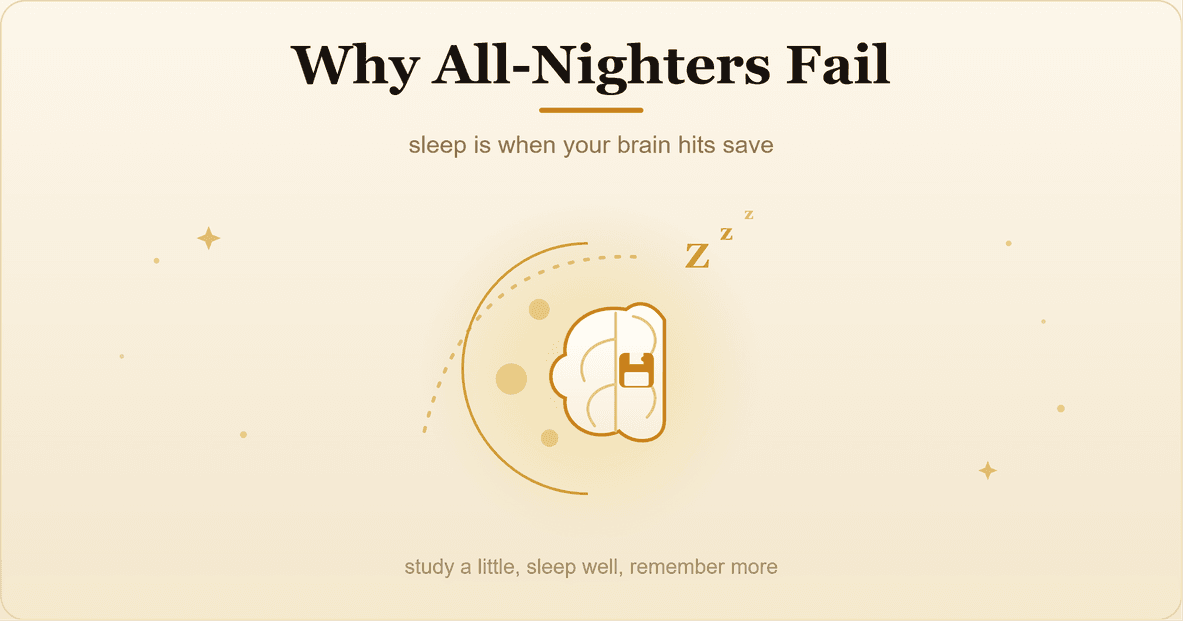
When you study, you don't actually lock the information in. You just load it. Think of it like typing a document without hitting save. It's there, but it's fragile, and one distraction can wipe it.
The saving happens while you sleep.
During deep sleep, your brain replays what you learned that day and moves it from short-term storage into long-term memory. Scientists call this memory consolidation. It's not a metaphor. Researchers can literally watch the brain re-run the day's patterns overnight.
So when you skip sleep to study more, you're loading more and more onto the screen, then walking away without ever hitting save.
What an All-Nighter Actually Does to You
Staying up doesn't just cost you the consolidation. It actively sabotages the exam itself. Here's the damage, in order:
Your memory formation breaks. A sleep-deprived brain is far worse at forming new memories the next day. So even the material you review at 4 a.m. barely sticks.
Your recall slows down. The information you do have gets harder to retrieve under fatigue, which is why you blank on things you swore you knew.
Your focus collapses. One all-nighter impairs attention and reasoning about as much as being mildly drunk. You wouldn't take an exam tipsy.
Your stress spikes. Less sleep means higher cortisol, which makes exam anxiety worse right when you need calm.
You end up trading a few hours of shallow cramming for a brain that can't form, hold, or retrieve memory properly. It's the worst deal in studying.
The Fix: Study With Your Sleep, Not Against It
You don't need more hours. You need to work with the way memory actually gets saved. Here's how.
1. Front-load the hard stuff, then sleep on it.
Study your toughest material in the evening, then go to bed. You're handing your brain the exact thing you want it to consolidate overnight. This is one of the rare "do less, get more" tricks that's actually real.
2. Review right before bed (briefly).
A short, focused review of key facts just before sleep gives that material priority in the overnight replay. Keep it light and low-stress, not a two-hour panic session.
3. Protect the night before an exam.
If you must choose between one more hour of cramming and one more hour of sleep the night before, choose sleep almost every time. A rested brain that knows 80% will out-score an exhausted brain that "covered" 100%.
4. Space it out so you never need the all-nighter.
This is the real solution. All-nighters only exist because studying got crammed into one night. When you review a little across several days, each night's sleep locks in another layer, and you walk in genuinely ready.
Where GoodOff Comes In
That last point is the whole reason spaced repetition works, and it's exactly what GoodOff is built to run for you.
GoodOff schedules your reviews across days using spaced repetition, so your learning is spread out, and every night of sleep gets to consolidate another piece. No cram, no all-nighter.
Its active recall practice means the small reviews you do before bed are the high-impact kind that stick, not passive re-reading that evaporates.
And because it turns your notes and PDFs into decks in seconds, an evening review session takes minutes, not hours, leaving your sleep intact.
The goal was never to study until 4 a.m. It's to study a little, sleep well, and let your brain do the saving while you rest.
Sleep Is Studying
Here's the mindset shift worth keeping.
Sleep isn't time away from studying. It's the stage of studying where everything you learned actually becomes permanent. Skipping it to study more is like refusing to hit save because you're too busy typing.
So tonight, do the thing that feels lazy but is actually the smartest move in the room: study a bit, then go to bed. Your morning self, sitting down for that exam, will thank you.
Tonight's homework: review your hardest topic, then sleep on it. That's it. That's the hack.