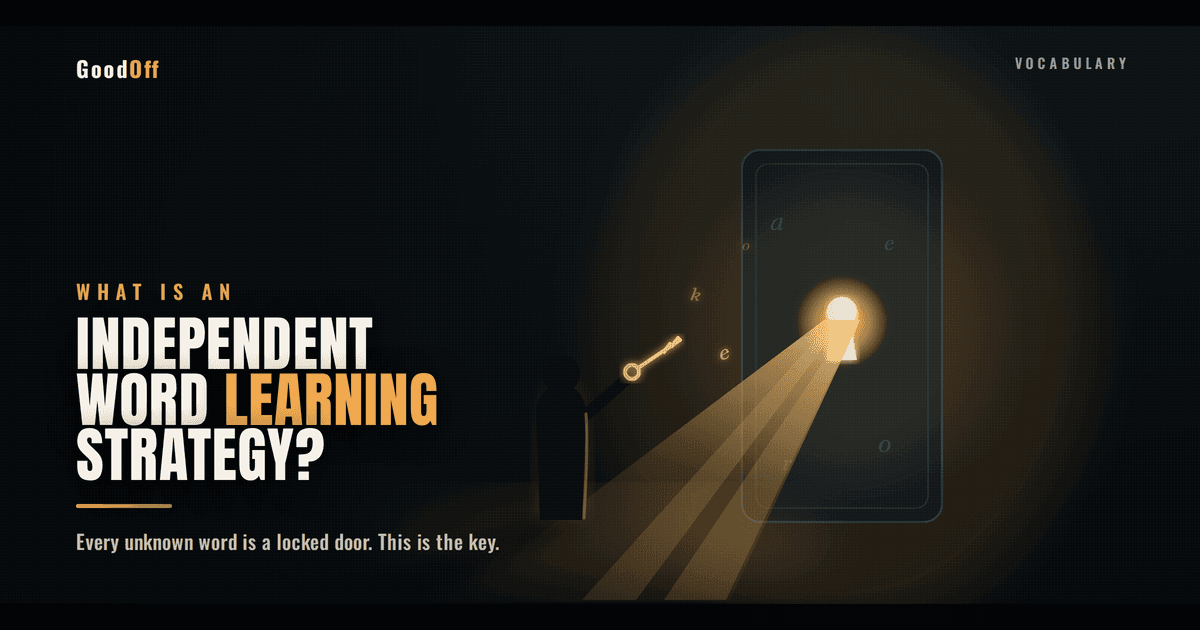
You're reading along, cruising through a chapter, and then you hit it. A word you've never seen before. It sits there, blocking the sentence like a locked door.
You have three options. Skip it and hope it doesn't matter. Stop everything and look it up. Or figure it out yourself using the clues already in front of you.
The learners who build huge vocabularies almost always reach for that third option. Not because they're smarter, but because they have a system for it. That system has a name, and it's what we're unpacking today.
What Is an Independent Word Learning Strategy?
Let's answer the question directly.
An independent word learning strategy is a method you use on your own to work out and learn the meaning of an unfamiliar word, without needing a teacher to explain it to you.
The key word is independent. Someone teaching you a list of vocabulary words is helpful, but it doesn't scale. There are far too many words in the world for anyone to hand you each one.
So the most powerful vocabulary skill isn't memorizing definitions someone gives you. It's being able to decode new words yourself, any time, in any book, for the rest of your life.
That's the difference between being given fish and learning to fish. An independent word learning strategy is you, learning to fish.
Why These Strategies Matter More Than Memorizing Words
Here's a number that reframes everything: most of the vocabulary you know was never formally taught to you. You picked it up through reading and listening, by inferring meanings from context over and over.
That means your vocabulary growth is capped by one thing: how good you are at learning words independently.
And it compounds. A bigger vocabulary makes reading easier, which lets you read more, which grows your vocabulary further. Strong word-learning strategies are the engine of that loop. They pay off in:
Reading comprehension. You stop losing the thread every time an unknown word appears.
Exams. Tests like the SAT, ACT, GRE, and TOEFL lean heavily on vocabulary and context.
Writing and speaking. You can only use words you actually own.
Now let's get to the strategies themselves.
The 4 Core Independent Word Learning Strategies
There isn't just one strategy. There are a few, and strong readers switch between them depending on the word.
1. Context clues (read around the word)
This is the first move, and often the fastest. Context clues are hints in the surrounding words and sentences that point to a word's meaning.
For example: "The professor's lecture was so soporific that half the class was asleep before the end." You may not know soporific, but "asleep" hands you the answer. It means sleep-inducing.
Clues come in a few flavors worth recognizing: a nearby definition or synonym, an antonym or contrast ("unlike her cheerful sister"), or an example that shows the word in action.
2. Word parts (break the word open)
When context isn't enough, look inside the word. This is called morphemic analysis, which just means using the meaningful parts of a word: prefixes, roots, and suffixes.
Prefix: "mal" means bad, so malevolent leans negative. "bene" means good, so benevolent leans positive.
Root: "dict" means say, which powers predict, dictate, and contradict.
Suffix: "able" means capable of, so unbreakable means not able to be broken.
Learn a few dozen common word parts and you gain a partial key to thousands of words.
3. Dictionary and reference skills (verify it)
Looking a word up sounds obvious, but doing it well is a skill. A good dictionary user does more than grab the first definition. They pick the meaning that fits the sentence, check the part of speech, and note the pronunciation so the word becomes usable, not just recognizable.
Used after context and word parts, the dictionary confirms your guess and locks it in.
4. Word consciousness (stay curious)
This one is a mindset more than a move. Word consciousness is simply paying attention to words: noticing new ones, wondering where they come from, and collecting the interesting ones.
Curiosity turns every page you read into a vocabulary lesson. Without it, unknown words slide past unnoticed. With it, they become yours.
How to Turn a Strategy Into a Habit
Knowing the strategies is not the same as using them. Here's a simple loop that makes them automatic. Think of it as Spot, Solve, Verify, Lock in.
Spot. Notice the unfamiliar word instead of skimming past it. This is word consciousness at work.
Solve. Try context clues first, then break the word into parts. Make a genuine guess before looking anything up. That effort is what builds the memory.
Verify. Check a dictionary to confirm or correct your guess, and note the part of speech.
Lock in. This is the step almost everyone skips, and it's the one that matters most. A word you decoded once will fade unless you actively revisit it.
That last step is where most vocabulary efforts quietly fail. You figure out a word, feel clever, and forget it a week later. Real retention takes deliberate review, and doing that by hand for every new word is a chore.
That's exactly where a tool can carry the load.
Making New Words Stick With GoodOff
An independent word learning strategy gets you to the meaning. The harder part is keeping it. GoodOff handles that "lock in" step so the words you work out actually stay with you.
Turn new words into a deck instantly. Add the words you're collecting, or drop in a reading, and GoodOff builds vocabulary flashcards and quizzes for you in seconds, no manual card-making required.
Practice active recall. Instead of rereading definitions, GoodOff quizzes you, so you retrieve each meaning from memory. That retrieval is what turns a word from "seen it" into "know it."
Review on a smart schedule. GoodOff uses spaced repetition to resurface each word right before you'd forget it, moving it into long-term memory with minimal effort.
Ask Sage for the nuance. When a word has shades of meaning or a tricky usage, Sage, GoodOff's AI tutor, explains it in plain language and gives you example sentences.
You keep the thinking part, decoding words on your own, and GoodOff makes sure that effort is not wasted.
The Bottom Line: Learn to Fish for Words
If you remember one thing, make it this:
The goal isn't to memorize every word. It's to get so good at learning words on your own that you never feel stuck by a new one again.
An independent word learning strategy is the skill that keeps paying you back for life. Read around the word, break it into parts, verify it, and then lock it in with real review. Do that consistently, and your vocabulary stops depending on anyone else.
Ready to make every new word stick? Try GoodOff free and turn the words you learn into flashcards that keep them for good.